Flights to Ljubljana: Routes, Airlines and Costs
Ljubljana's airport is small, the city is 26 km away, and the fare you pay depends more on which hub you connect through than on the airline's name. Here is how the routes, the costs and the transfer actually work.
Short answer
Ljubljana is served by Jože Pučnik Airport (LJU), about 26 km from the city, with a mix of network carriers and low-cost operators feeding a handful of European hubs. Fares swing with season and routing rather than with distance. An airport bus runs into the centre, and Slovenia is in the EU, the eurozone and Schengen, so there are no border formalities arriving from most of Europe.
Which Airport Do You Fly Into for Ljubljana?
Every scheduled flight labelled Ljubljana lands at Jože Pučnik Airport, known by its code LJU, which sits about 26 km north of the city near the village of Brnik. There is no second commercial airport serving the capital, and no city airport in the centre. The terminal is small by European standards, which is genuinely good news: walking from gate to arrivals hall to taxi rank takes minutes, not the half-hour treks of a major hub.
That smallness cuts both ways. A compact airport means fast arrivals and short walks, but it also means a short route list. LJU is not a hub; it is a spoke. Aircraft largely fly point-to-point to a set of major European airports, and the practical consequence for a traveller is that the connection, not the origin, decides the price and the convenience of the journey.
Slovenia's position shapes the whole flying experience. It is a member of the European Union, it adopted the euro on 1 January 2007, and it joined the Schengen area on 21 December 2007, with internal air border checks lifted on 30 March 2008. The Slovenian government's own EU-membership page states the two Schengen dates explicitly, and the two-date structure is the detail most often written wrong elsewhere. In plain terms: if you are connecting through Vienna, Frankfurt, Munich, Zurich, Paris or Amsterdam, you clear Schengen entry at that first airport, and the hop to Ljubljana is treated like a domestic flight. There is no passport check at Brnik, no currency to change, and no duty-free allowance arithmetic to do on the way in.
For British and Irish travellers the position is different: those routes arrive from outside Schengen, so passport control happens at LJU itself. The queue is rarely long at an airport this size, but it exists, and it is worth knowing which side of the line your journey falls on before you plan a tight connection in either direction.
The airport's own website is the authority on the current route map, but it blocks automated reading, so this guide deliberately publishes no per-airline timetable. Route lists at small airports change seasonally, and a month-old screenshot of destinations is worse than no screenshot at all. Check the live route list when you book, not when you read a guide.
How Much Do Flights to Ljubljana Cost?
There is no honest single number for a flight to Ljubljana, because the fare is set by routing, season and how far ahead you book rather than by distance. Direct low-cost hops from Western Europe are usually the cheapest way in, one-stop tickets through a big hub sit in the middle, and booking in the low season undercuts the summer peaks by a wide margin. Anyone quoting one flat fare is quoting a day, not a market.
The honest way to talk about cost is to talk about what moves the price. The first factor is the hub. Because LJU is a spoke airport, most journeys involve a connection, and the connecting airport's own pricing dominates the total. A ticket routed through a congested slot-controlled hub costs more than one through a secondary base, even when the flying time is identical.
The second factor is season, and this is where Ljubljana's own calendar matters more than most. The city's Christmas market draws a genuine December peak, and the lake season pushes July and August fares up across the whole country. The shoulder months, and especially late autumn, are where the bargains sit, with one weather caveat covered later in this guide.
The third factor is the day of the week you fly, and the fourth is how far ahead you commit. Neither is Ljubljana-specific: midweek departures and early booking beat weekend flights and last-minute leaps almost everywhere in Europe. The useful local nuance is that because the route list is thin, a sold-out date on one carrier cannot be rescued by a competitor on the same route. On busy weekend dates the market does not correct, it just sells out.
| Cost driver | What pushes the fare up | What pushes the fare down |
|---|---|---|
| Routing | Connections through slot-congested major hubs | Direct low-cost services, or one-stop via secondary bases |
| Season | July and August, and the December festive market | Late autumn and the November to March low season |
| Day of week | Friday and Sunday, the city-break peaks | Tuesday to Thursday departures |
| Booking window | Last-minute, or the first days of a new schedule release | Early booking, especially for summer dates |
| Local events | Christmas market weekends, large summer festivals | Ordinary weekends with nothing scheduled |
One cost that is easy to forget sits on the ground, not in the air. Ljubljana charges a tourist tax of 3.13 EUR per person per night, made up of a 2.50 EUR tax and a 0.63 EUR promotion surcharge, with a half rate of 1.57 EUR for ages 7 to 18 and children under 7 exempt. The official tourist board page publishes the breakdown. It is collected through your accommodation, so it does not change your flight search, but it belongs in an honest budget.
If you are weighing the flight against the whole cost of the trip, our broader Ljubljana prices guide breaks down what a day in the city actually costs once you have landed.
Is It Cheaper to Fly Into a Nearby Airport Instead?
Sometimes, yes, and it is worth checking Trieste, Venice, Zagreb and Klagenfurt before you commit, because fares at those airports can undercut Ljubljana's thin route list by a wide margin. But the arithmetic only works if you price the onward leg honestly: a cheaper ticket plus a transfer of several hours by bus or train can cost more in money, and certainly more in daylight, than the direct flight you avoided.
Trieste in Italy is the closest serious alternative, and our Ljubljana to Trieste route guide covers the onward journey in detail. Venice adds a longer transfer but a far denser flight network, and the Ljubljana to Venice guide walks the bus and train options. Zagreb works for travellers combining the two capitals, and Croatia's own accession to both Schengen and the euro on 1 January 2023 means that border crossing is now internal too: no passport checks, no money changing. The Ljubljana to Zagreb guide covers it.
The honest comparison is not airport against airport but door against door. A fare that looks like a bargain can stop being one the moment you price a cross-border coach, a rail connection or a second night's accommodation because the transfer ate a day. The table below is deliberately free of invented fares: prices on every one of these routes move weekly, and a guide that printed a number would be wrong before the season turned.
| Alternative airport | Country | Border position for Slovenia | Onward transfer reality |
|---|---|---|---|
| Trieste (TRS) | Italy | Internal Schengen, both in the euro | Cross-border coach, the shortest of the alternatives |
| Venice (VCE) | Italy | Internal Schengen, both in the euro | Longest transfer, densest and often cheapest flight network |
| Zagreb (ZAG) | Croatia | Internal Schengen since 2023, both in the euro | Direct coach between the capitals |
| Klagenfurt (KLU) | Austria | Internal Schengen, both in the euro | Short hop but a thin route list of its own |
There is a second, softer reason the alternative-airport play deserves caution: your first evening. Landing at LJU puts you in the centre of Ljubljana within the hour, with the whole evening ahead of you. Landing three countries of coach away puts you in a transfer seat, and the city's two-night average stay, which the national statistics office's arrival and overnight figures support, does not stretch well to a lost half-day at each end.
How Do You Get from Ljubljana Airport to the City Centre?
An airport bus links LJU with the city centre, and it is the standard budget transfer; times and frequency should be checked before you fly because the airport's own site does not publish a stable timetable that any guide can responsibly copy. Taxis and pre-booked transfers cover the same 26 km more quickly and at a much higher price, and there is no rail link from the airport itself.
The bus is the workhorse. It exists, it runs between the terminal and the city, and it is the option most visitors use. What this guide will not do is print a fare or a timetable for it, because the airport's website blocks automated access and no primary source publishes a stable figure that has been verified. Treat any number you read elsewhere, including in printed guidebooks, with suspicion and check the live information before you travel. The dedicated Ljubljana Airport to city centre guide covers the transfer options in full.
Taxis and pre-booked [private transfers](https://gettransfer.tpk.ro/Ab8maxge) are the counterweight. They cost more, sometimes a lot more, but they run on your clock rather than a schedule, which matters for the two flights this guide worries about most: the early departure and the late arrival. If your flight lands at 23:30, the question is not which transfer is cheapest in the abstract but which one is running at all. Other pages covering the same trip are gathered on Ljubljana Travel Guide.
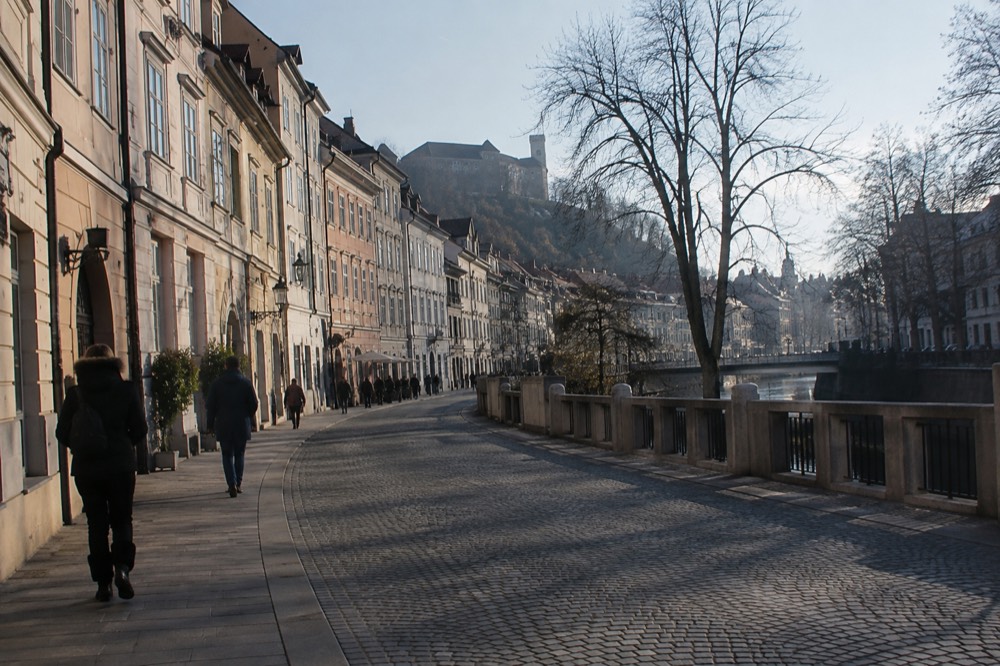
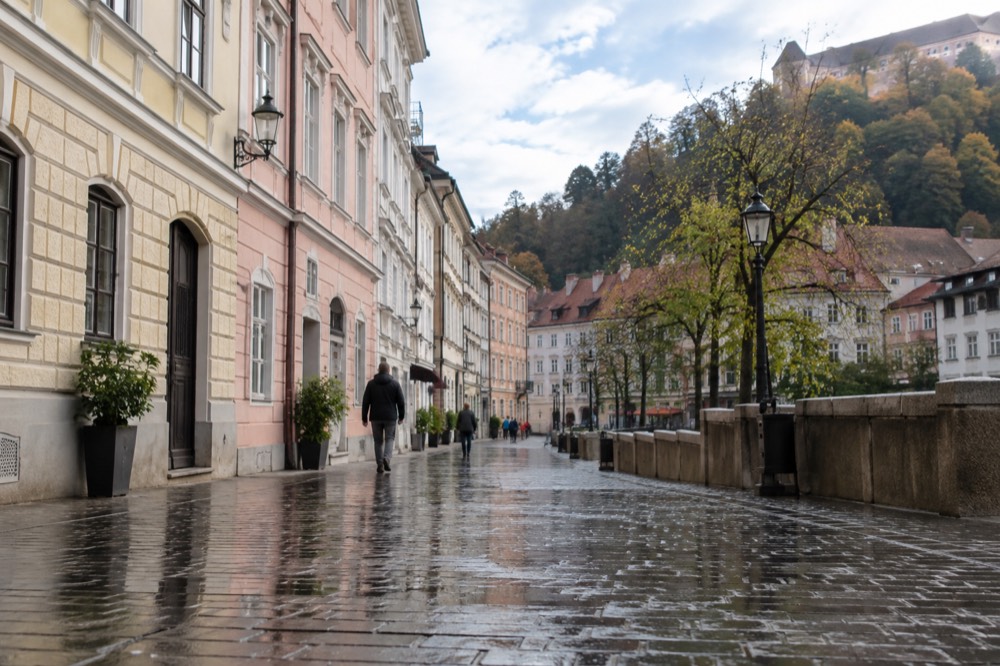
One planning note belongs here rather than anywhere else: the historic centre is pedestrianised, a car-free zone of roughly 20 hectares that the city has progressively expanded since 2007. Whatever brings you in, car, taxi or airport bus, it stops at the edge of that zone. The last stretch is on foot, which in a city this compact is a pleasure rather than a penalty, but it is worth knowing before you [book a hotel](https://booking.tpk.ro/siijcqre) and imagine a door-to-door drop.
| Transfer option | Best for | Watch out for |
|---|---|---|
| Airport bus | Budget travellers on a normal schedule | Times and frequency must be checked live; no verified fare is published |
| Taxi from the rank | Late arrivals and small groups | Highest price per kilometre of the options here |
| Pre-booked private transfer | Early departures, families, fixed-cost certainty | Book ahead; the 26 km does not shrink for anyone |
| Rental car | Day-trip plans beyond the rail network | The centre is pedestrianised; plan parking at the zone's edge |
If a rental car is in your plans, the car rental in Ljubljana guide covers where to collect and where to park, and no nightly hotel rate or hire rate appears anywhere on this site because those figures are date-specific and sit behind booking walls.
When Is the Cheapest and Best Time to Fly to Ljubljana?
The cheapest fares sit in the November to March low season outside the Christmas market weeks, and the best overall flying window for weather is late spring through September, with one local twist most guides miss: September and October are Ljubljana's joint wettest months at 147 mm each and among its foggiest at 12.4 fog days a month, so the cheap autumn shoulder comes with a genuine weather trade-off that is worth pricing in before you book.
That fog figure deserves its own sentence because it is the site's core information-gain axis and it is almost never written correctly. Ljubljana sits in a basin. In the colder half of the year cold air is trapped under warmer air above, and the city fogs in while the hills a few hundred metres up sit in sunshine. ARSO's climate normals put numbers on it: Ljubljana averages 37 clear days a year against 130 overcast, and in December the city records just 56 hours of sunshine against 120 hours at Kredarica, the station at 2514 m on Triglav. The mountain above the city is sunnier than the city all winter.
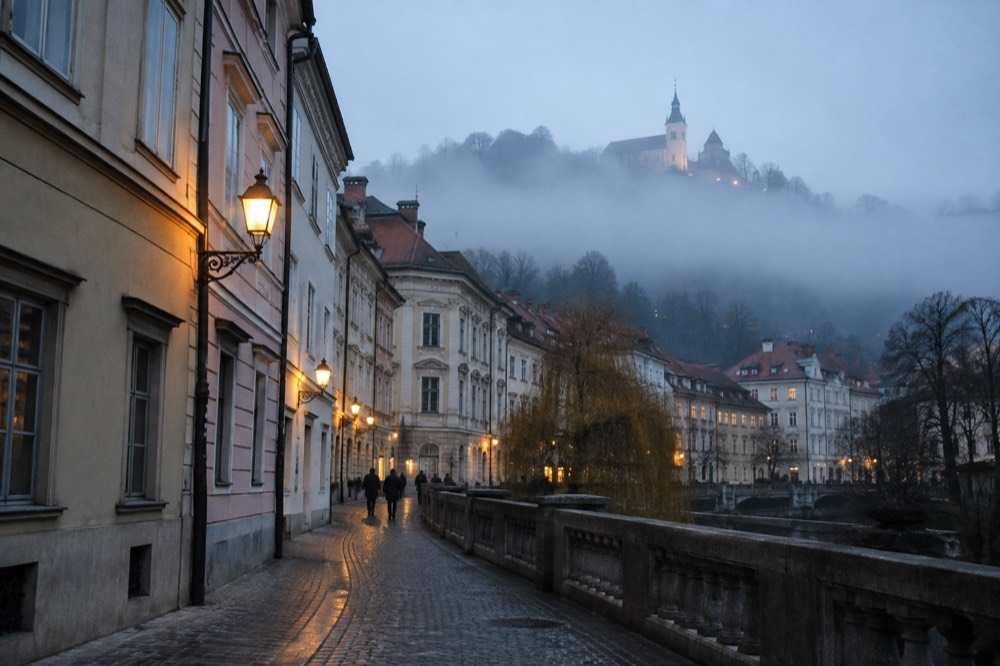
For flight planning the practical translation is simple. A cheap November fare buys you a city that records 66 hours of sunshine that month, and a cheap September fare buys you a real chance of morning fog and an afternoon downpour. Neither is a reason not to come; both are reasons to pack layers and to keep at least one indoor plan in your back pocket. The caves hold roughly the same temperature year round, around 10 C at Postojna, which is exactly why they are the reliable wet-weather answer, and the best time to visit Ljubljana guide works through the whole calendar month by month.
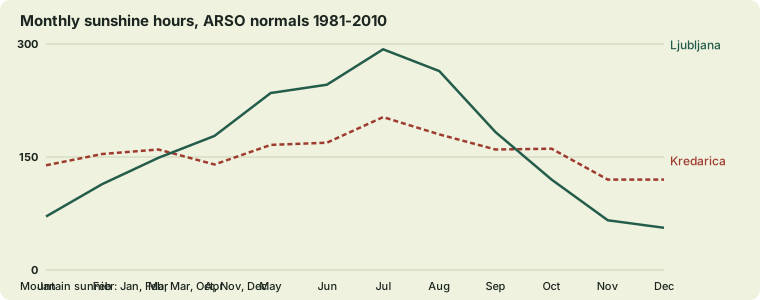
| Month group | Fare level | What the climate record says |
|---|---|---|
| Late June to August | Peak | Sunniest stretch in the city, 264 to 293 sunshine hours a month |
| September and October | Shoulder, often cheap | Joint wettest at 147 mm each, and 12.4 fog days a month |
| November | Low | 66 sunshine hours; short, grey days in the basin |
| December | High around the market, low after it | 56 sunshine hours and 2 clear days in the whole month |
| January to March | Low | Fog and low cloud in the basin, sun up on the hills |
| April to June | Mid, rising | The city's sunshine begins to beat the mountains |
What Can You Actually Do Once You Have Landed?
Ljubljana rewards a short flight with a walkable, pedestrianised centre and a day-trip hinterland that punches far above the city's size, with Lake Bled carrying more search demand than the capital itself and the karst caves running whatever the weather is doing above ground. The practical move is to book the flight for the city and the days for the country around it.
Start on foot, because the centre invites it. The free GuruWalk walks are the cheapest orientation there is: the Ljubljana Unveiled walk, Romans to Dragons, runs about two hours, is free with pay-what-you-think-it-was-worth tipping, and carries a 4.91 rating from 1496 reviews. GuruWalk must be named here because these are not this site's tours and the platform is the booking route, not a brand to hide. It is a strong first-day move after any flight, precisely because it costs nothing to move if your arrival is delayed.
Beyond the city, the day trips split into three families. Lake Bled is the headline, and the six-hour Lake Bled and Bled Castle trip, rated 4.7 from 1641 reviews and priced from $86, is the most direct way to see the lake, the island and the castle viewpoint in one organised day. The Julian Alps and the Soča Valley answer for anyone whose flight was booked for scenery rather than city-break culture, and the karst caves answer for every rainy or foggy day, because their temperature does not move with the weather.
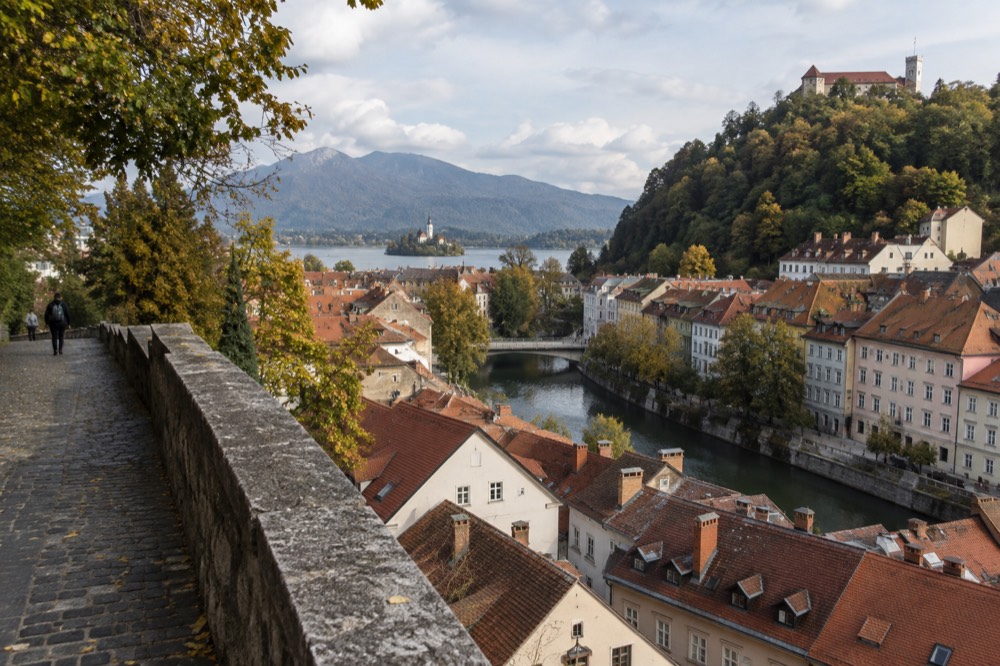
The cave-and-castle day trip is the one this guide keeps returning to, because it solves the two problems a Ljubljana flight most often creates: a short stay and an unreliable sky. The six-hour Postojna Cave and Predjama Castle tour, rated 4.8 from 2802 reviews and priced from $132, bundles the underground train ride and the cliff castle into a single door-to-door day, and the cave's constant 10 C means the weather above ground is irrelevant to the experience. Our day trips from Ljubljana guide maps the full menu, and the Postojna Cave guide covers the cave itself in depth.
Do You Need a Visa, Border Checks or Euros for Slovenia?
Slovenia is in the European Union, in the eurozone and in the Schengen area, so travellers arriving from within Schengen face no routine border checks and eurozone travellers change no money; the euro has been the currency since 1 January 2007, and land and sea Schengen checks were lifted on 21 December 2007 with air checks following on 30 March 2008. Visa requirements follow EU rules for your nationality, not anything Slovenian-specific.
The European Union's own country page for Slovenia confirms the 2004 accession, and the Slovenian government's membership page confirms the Schengen dates. What this means at the airport is simple. If your journey starts in or connects through another Schengen country, you enter the zone at that first airport and the flight to Ljubljana is border-free. If you start outside, from the United Kingdom or Ireland for instance, passport control happens at LJU, a small airport where the queue moves quickly.
Money is the other non-question. The euro is the only currency you need, and quoting anything else for a Slovenian price is simply wrong. Cards are widely accepted, including contactless on the city's buses, though cash does not work on board at all, a rule the getting around Ljubljana guide explains in full. The Urbana card costs 2.00 EUR and a 90-minute zone 1 ride with transfers is 1.50 EUR, which covers most of what a visitor needs.
| Question | Answer for Slovenia |
|---|---|
| Currency | The euro, since 1 January 2007 |
| EU membership | Since 1 May 2004 |
| Schengen, land and sea | Checks lifted 21 December 2007 |
| Schengen, air | Checks lifted 30 March 2008 |
| Border check from Italy, Austria or Hungary | None, routine internal travel |
| Border check from Croatia | None since Croatia joined Schengen on 1 January 2023 |
| Tourist tax | 3.13 EUR per person per night, collected via accommodation |
One last practical note that closes the loop with the flight search itself: because the city averages about two nights per visitor, the honest itinerary is a short one. Our one day in Ljubljana and weekend in Ljubljana planners exist for exactly that shape of trip, and a cheap midweek flight plus two nights is the pattern the arrival numbers say most people actually live.
Common Questions About Flights to Ljubljana
Which airport do you fly into for Ljubljana?
Jože Pučnik Airport (LJU), about 26 km north of the city near Brnik. It is the only commercial airport serving the capital, and it functions as a spoke airport feeding a set of European hubs rather than a hub in its own right.
Is there an airport bus into Ljubljana city centre?
Yes, an airport bus links the terminal with the centre and it is the standard budget transfer. Its times and frequency should be checked before you travel, because no verified stable timetable or fare has been published in a form a guide can responsibly copy.
Is it cheaper to fly to Trieste, Venice or Zagreb and travel on?
Sometimes, especially from markets with thin direct service to Ljubljana. But price the onward leg honestly: a cross-border transfer of several hours can erase the fare saving and will certainly cost you daylight in a city where the average stay is about two nights.
Do I need to change money or clear a border arriving in Slovenia?
No, if you are coming from the eurozone and Schengen. Slovenia has used the euro since 1 January 2007 and lifted internal land and sea border checks on 21 December 2007, with air checks following on 30 March 2008. Croatia joined both in 2023, so the Zagreb route is internal too.
When are flights to Ljubljana cheapest?
In the November to March low season, outside the Christmas market weeks, and on midweek departures booked well ahead. The cheap autumn shoulder comes with a trade-off: September and October are the joint wettest months at 147 mm each and among the foggiest, so pack for it.
Can you walk from the airport into Ljubljana?
No, the airport is about 26 km out and there is no rail link from the terminal. The transfer is by airport bus, taxi or pre-booked car, and every option stops at the edge of the pedestrianised centre, so the final stretch into the Old Town is always on foot.