Ljubljana Weather and the Best Time to Visit
Ljubljana sits in a basin, and that single geographic fact explains more about its weather than any other. The city fogs in while the hills above it stay in sun, the wettest months are September and October, not midsummer, and the best time to visit depends on which of those you would rather plan around.
Short answer
The best months to visit Ljubljana are May, June and September, when the city averages 21 to 24 degrees Celsius at midday and the fog season has not yet closed in. July and August are the warmest but busiest. October to February is grey and damp in the basin: ARSO records just 56 hours of December sunshine, while the mountains above the city get 120.
Ljubljana averages 37 clear days a year against 130 overcast ones, and the wettest months are not the ones most visitors expect. ARSO's 1981-2010 climate normals put September and October joint first for rainfall at 147 mm each, ahead of July's 115 mm. The same records show the city fogged in on 12.4 September mornings out of every month's worth, level with midwinter. Almost every general guide gets this wrong, which is a shame, because it changes when you should come and what you should book.
This page lays out the city's weather honestly, month by month, using the Slovenian environment agency's own published figures. It also explains the basin inversion, the single most useful piece of climate knowledge for anyone visiting between October and March: on many winter days the city sits under grey fog while the hills a few hundred metres up, and the mountains beyond them, are in bright sunshine. If you know that, you can plan around it.
What Is the Best Month to Visit Ljubljana?
May, June and September are the best months to visit Ljubljana for a balance of weather, prices and crowds. June averages 19.1 degrees Celsius overall with midday highs of 24.6, and September cools only to a mean of 16.0 with highs near 21.6. May is slightly fresher at 15.8 but drier than June at 109 mm of rain against 144.
All three sit outside the peak July-August arrival window, so hotel rates and attraction queues are lower, and the long daylight lets you fill evenings along the Ljubljanica.
The trade-offs are worth knowing before you commit. June is technically wetter than July on the 1981-2010 normals, 144 mm against 115, but its rain falls in heavier, shorter bursts rather than the grey drizzle of autumn. September looks like summer on paper until you remember the fog statistic: 12.4 fog days, the joint second-highest month of the year. That fog usually burns off by late morning in early autumn, but it means your first coffee of the day may be indoors.
If you want the absolute warmest, most reliable weather, it is July: 21.3 degrees mean, 27.3 average high, 293 hours of sunshine, the sunniest month the city records. You pay for it with the year's biggest crowds, and the old centre, being pedestrianised and stone-paved, holds heat in a way that makes midday touring harder work than the numbers suggest.
For a fuller month-by-month comparison, including the events that might pull you one way or another, see our best month to visit Ljubljana breakdown. The short version for this page is that the shoulder months win on value, and winter wins on atmosphere if you accept the grey.
What Is Ljubljana's Weather Like Month by Month?
Ljubljana has four genuine seasons: a cold, grey, foggy winter from November to February, a quick spring, a warm and fairly wet summer from June to August, and a long, damp, fog-prone autumn. January averages 0.3 degrees Celsius against July's 21.3, and the extremes run from a record low of -20.3 to a record August high of 37.3.
Rain falls somewhere in the city on 153 days a year totalling 1362 mm, and it peaks in September and October at 147 mm each, not in summer. December is the darkest month with 56 hours of sunshine across the whole month, under two hours a day.
Here are the full 1981-2010 normals from ARSO, the Slovenian Environment Agency, transcribed from its published table for the Ljubljana Bežigrad station at 299 m.
| Month | Mean temp (C) | Mean high (C) | Mean low (C) | Rain (mm) | Sunshine (h) | Clear days | Fog days* |
|---|---|---|---|---|---|---|---|
| January | 0.3 | 3.4 | -2.5 | 69 | 71 | 2 | 11.3 |
| February | 1.9 | 6.4 | -2.0 | 70 | 114 | 4 | 7.6 |
| March | 6.5 | 11.4 | 1.7 | 88 | 149 | 4 | 4.5 |
| April | 10.8 | 16.1 | 5.8 | 99 | 178 | 3 | 3.0 |
| May | 15.8 | 21.4 | 10.3 | 109 | 235 | 3 | 3.6 |
| June | 19.1 | 24.6 | 13.7 | 144 | 246 | 3 | 3.0 |
| July | 21.3 | 27.3 | 15.5 | 115 | 293 | 5 | 3.7 |
| August | 20.6 | 26.7 | 15.2 | 137 | 264 | 6 | 6.5 |
| September | 16.0 | 21.6 | 11.5 | 147 | 183 | 2 | 12.4 |
| October | 11.2 | 15.9 | 7.7 | 147 | 120 | 1 | 12.4 |
| November | 5.6 | 8.8 | 2.8 | 129 | 66 | 1 | 10.4 |
| December | 1.2 | 3.8 | -1.1 | 107 | 56 | 2 | 12.6 |
*The fog series is published by ARSO only for the 1971-2000 reference period, so those figures are from that table and cannot be mixed with the 1981-2010 columns in a single comparison. The temperature, rain, sunshine and cloud rows are all 1981-2010. The two periods genuinely disagree where they overlap, which is why the label matters.
Three things jump out of that table. First, October and November each average a single clear day: a month in Ljubljana's basin can pass with one properly blue afternoon. Second, the rain peak is an autumn peak, not a summer one. Third, the fog column rises sharply in September, which catches out visitors who book early autumn expecting the dry shoulder season the guidebooks promise.
Whatever month you pick, a guided introduction helps you read the city, and the weather decides the format. These three options cover the main styles:
Why Is Ljubljana Grey in Winter While the Hills Are Sunny?
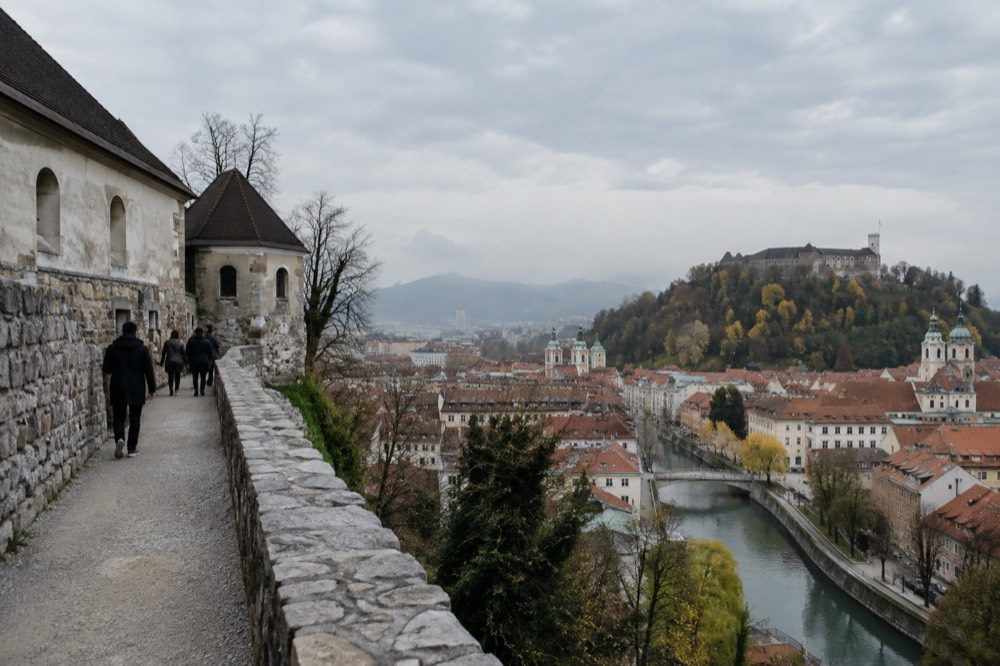
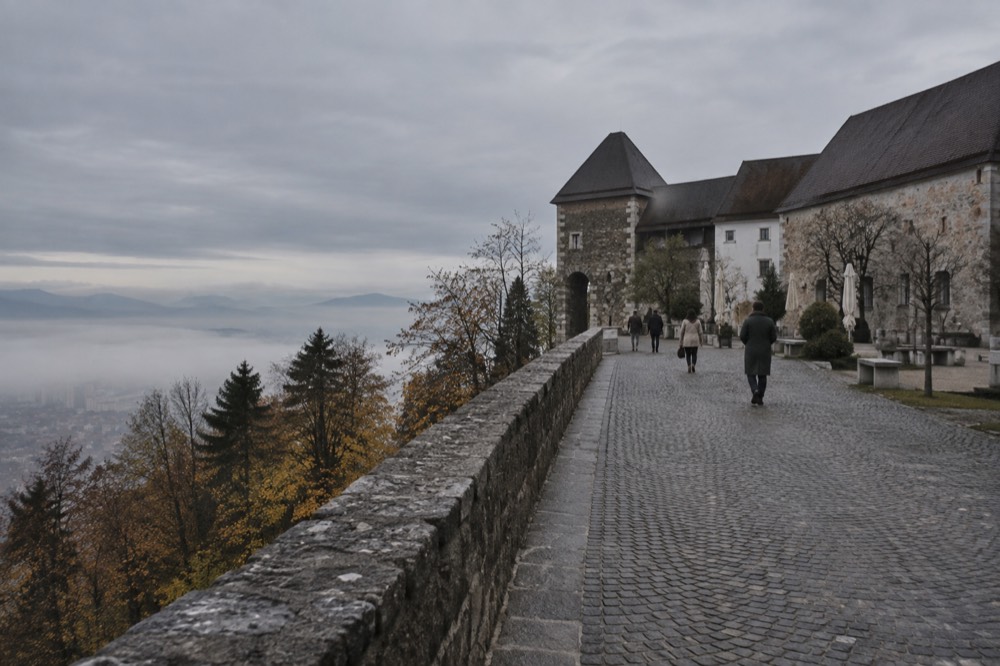
Ljubljana sits on the floor of a basin at 299 m, and in the colder half of the year cold air gets trapped under a lid of warmer air above it. Cloud and fog form in that trapped layer, so the city can sit under grey for days while Šmarna gora, Rožnik or the castle hill, only a few hundred metres higher, are in full sunshine.
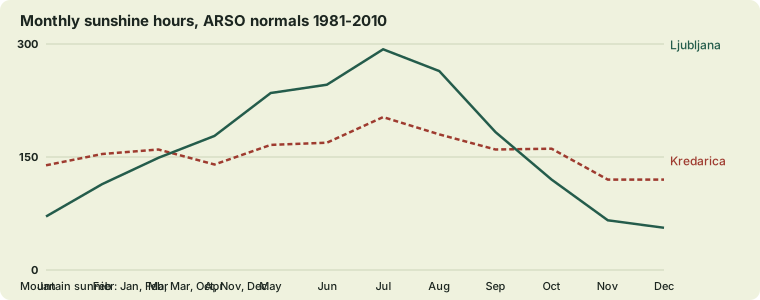
ARSO's own tables show Kredarica at 2514 m getting 120 hours of December sunshine against the city's 56, and 139 January hours against 71: the mountain is sunnier than the capital all winter, and the annual totals still finish within 102 hours of each other, 1872 against 1974.
This is the information most competing pages do not have. The inversion is not a curiosity, it is a planning tool. On a grey Ljubljana morning in January, the correct move is to go up: the funicular to Ljubljana Castle, a walk up Šmarna gora, or a day trip to the Julian Alps where the cloud deck ends. The live temperature readings back this up on the day scale: on inversion mornings a station at 660 m can read warmer than the city at 299 m, because the cold pool sits at the bottom.
The annual numbers make the pattern unmistakable. The city wins the sunshine contest from April to September and loses every month from October to March. The lines cross, and they cross exactly at the point when most visitors stop coming.
| Month | Ljubljana (299 m), sunshine h | Kredarica (2514 m), sunshine h |
|---|---|---|
| January | 71 | 139 |
| February | 114 | 154 |
| March | 149 | 160 |
| April | 178 | 140 |
| May | 235 | 166 |
| June | 246 | 169 |
| July | 293 | 203 |
| August | 264 | 180 |
| September | 183 | 160 |
| October | 120 | 161 |
| November | 66 | 120 |
| December | 56 | 120 |
| Year | 1974 | 1872 |
One honesty note that matters: the mountains are not warmer than the city on average. Kredarica's January mean is -7.1 degrees against Ljubljana's +0.3. The inversion reverses temperature on individual days, on the mornings when the cold pool is locked in, but the monthly means stay mountain-cold. What the mountains reliably offer in winter is sun, not warmth. Pack for both.
When Is Ljubljana Cheapest and Quietest?
November, early December before the Christmas market opens, and late January to February are the cheapest and quietest times in Ljubljana, and they are also the greyest. November averages one clear day and 66 hours of sunshine for the whole month, and February improves only to 114 hours. The trade is real: fewer visitors, lower accommodation rates across the centre, and museums you can walk into without booking, in exchange for fog, drizzle and short days.
March, averaging 149 sunshine hours and 6.5 degrees, is the better compromise for anyone who wants quiet without full winter gloom.
The quiet-season argument is stronger than it first sounds because so much of Ljubljana's appeal is indoor or covered. The National Gallery, the City Museum, the Ethnographic Museum and the Plečnik House are all a short walk apart, and the national institutions are free on the first Sunday of every month, which makes a grey first-Sunday weekend genuinely cheap. The Central Market's covered halls run Monday to Friday 07:00-16:00 and Saturday 07:00-14:00, so even a wet Saturday has a food-and-flower option under roof.
Admission to the national museums is free on the first Sunday of each month, confirmed on the National Gallery's own visiting page, and most state museums close on Mondays, so a quiet-season itinerary should be built Tuesday to Sunday. If you are here on a Friday between roughly March and November, Odprta Kuhna, the Open Kitchen street-food market, runs on Pogačarjev trg from 10:00 into the evening, but the tourist board's own listing says "every sunny Friday", which is literal: it is cancelled in bad weather. In November, do not build your day around it.
For a fuller rundown of free museums, free viewpoints and the free castle grounds, see our Ljubljana for free guide, and for the winter-specific picture, including the December market and the New Year closures, read Ljubljana in winter.
How Much Rain Should You Actually Expect?
Ljubljana records 1362 mm of rain across 153 days a year, and the wettest months are September and October at 147 mm each, above July's 115 mm. That is a lot of rain for an inland capital, and it means the dry September shoulder season that most travel content implies does not exist here.
Summer rain tends to come as heavy afternoon thunderstorms, while autumn rain settles in as long, grey, drizzly spells that can last two or three days, so the same millimetre total costs you far more of a day in October than in July.
The practical difference between summer and autumn rain matters more than the totals. A July downpour interrupts an afternoon; an October front can delete one. If you are visiting in September or October, build each day with one indoor fallback, and treat any forecast of a clearing front as your window for the big outdoor items, the Bled day trip, the gorge walk, the castle hill.
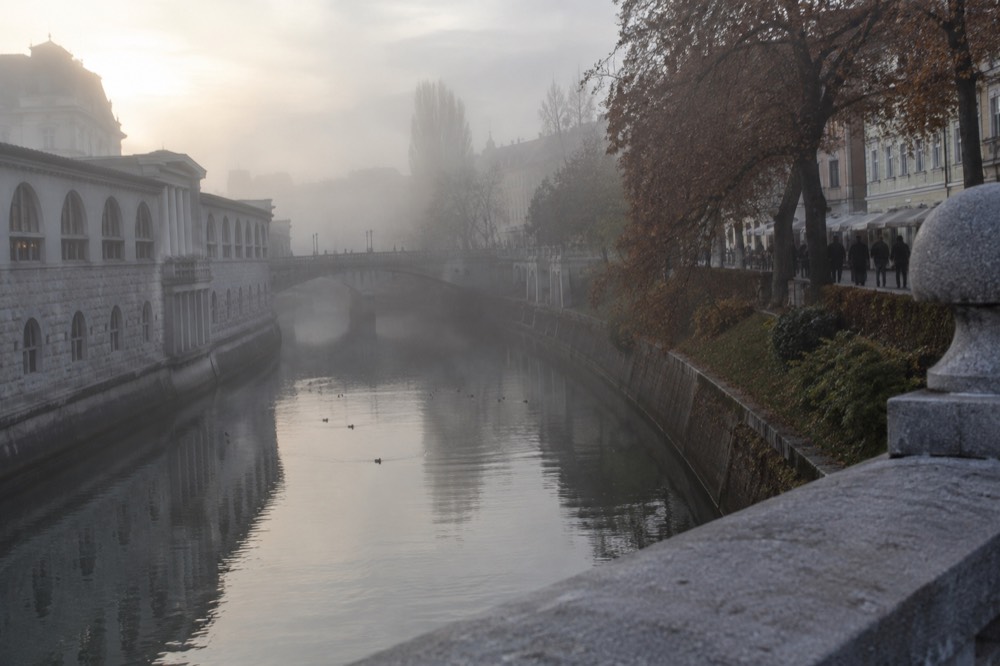
The fog numbers deserve their own sentence, because they are the site's most counterintuitive climate fact. ARSO's 1971-2000 series gives Ljubljana 91.2 fog days a year, and September and October tie at 12.4 each, level with December's 12.6 and above January's 11.3. September's 07:00 relative humidity averages 94 percent, the most humid mornings of the year. The foggiest season is early autumn, not deep winter, and the city's own weather service records it plainly in its published climate normals for Ljubljana.
| Season | Rain pattern | Fog risk | Best use of the day |
|---|---|---|---|
| December-February | Light, persistent, 107-69 mm per month | Very high, 11-13 days a month | Museums, caves, go above the inversion |
| March-May | Showers easing, 88-109 mm | Low from April | Full days outdoors, day trips |
| June-August | Heavy afternoon storms, 115-144 mm | Very low | Mornings outdoors, siesta at 15:00 |
| September-November | Long wet spells, 129-147 mm | High, 10-12 days a month | One outdoor plan plus one indoor fallback |
What Can You Do When the Weather Turns?
Caves are the reliable all-weather answer, because they hold roughly the same temperature year round: Postojna sits at about 10 degrees Celsius whatever the season, and Škocjan at 12. A grey, drizzling Ljubljana morning is therefore not a lost day, it is a cue to head underground. Postojna Cave runs every day including holidays and in bad weather, its 3.7 km route travelled partly by train, and the combined cave and Predjama Castle tour from Ljubljana covers both in six hours, rated 4.8 from 2802 reviews.
The same logic covers heatwaves. When the city hits its August warmth, with mean highs of 26.7 and a record of 37.3 degrees, a cave at 10 degrees is the coolest place within an hour of the capital. Bring a layer for it: visitors arrive in shorts and are cold within twenty minutes, and the cave's own guidance says the same.
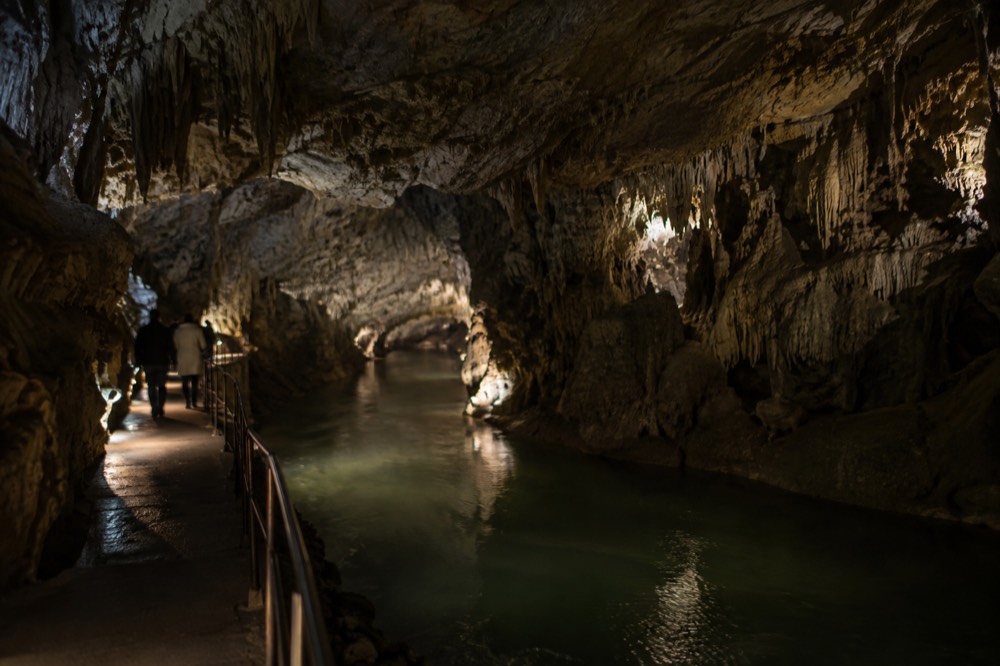
In the city itself, the wet-day menu is better than most capitals can offer. The covered Central Market halls, the Museum of Illusions open daily 09:00-21:00, the National Gallery's permanent collection at 10 EUR, and a 50-minute Ljubljanica river cruise, which runs in most conditions since the boats are flat and sheltered, all sit within a short walk of each other. Our rainy day in Ljubljana guide lists the full set, and the [Ljubljana Card](/guides/ljubljana-card/) covers the river cruise, the castle funicular, city buses and more than thirty museums on one pass, which is worth running the numbers on for any stay of two days or more.
Does the Weather Change What You Should Pack?
Yes: the basin climate means you should pack for two weather regimes at once from October to March, warm layers and rain protection for the city, and sunglasses and sun cream for the hills above the inversion. Summer needs only light clothes plus one warm layer for caves and air-conditioned museums, around 10 degrees underground even in August.
Winter visitors should assume damp cold rather than deep cold: January's average low is -2.5 and the record low is -20.3, but the damp basin air makes 2 degrees feel worse than the number suggests, and snow lies on the ground on about 50 mornings a year.
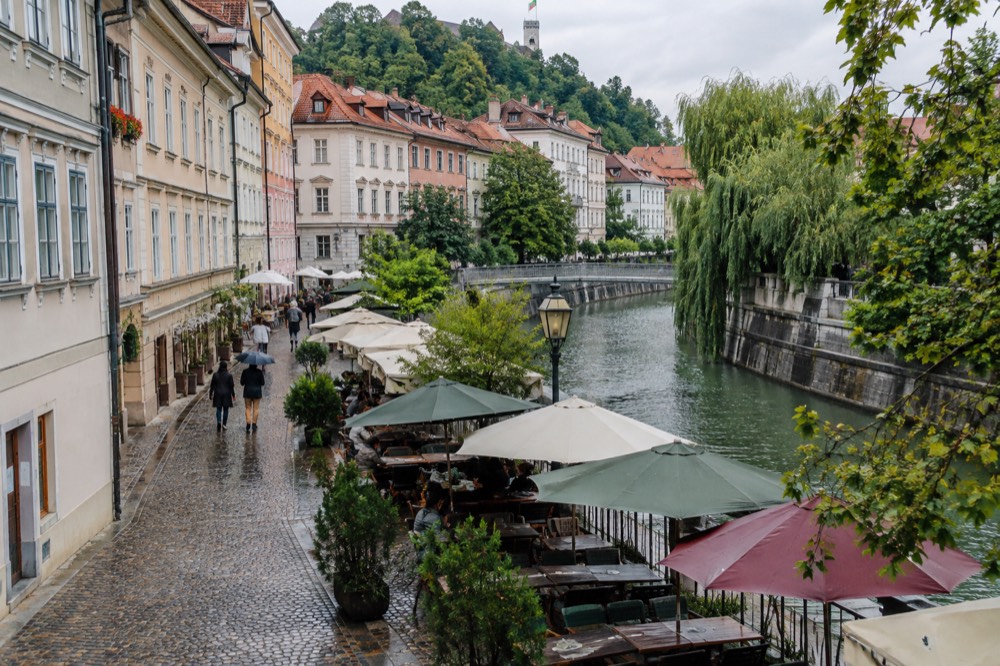
Footwear is the item people get wrong. The old centre is pedestrianised, roughly 20 hectares of it, and you will walk far more than you expect on stone surfaces that stay slick in the drizzle months. Waterproof shoes beat trainers from October to March. An umbrella is less useful than a hood, because the autumn wind along the river flips umbrellas reliably.
The sunshine chart below is the whole argument of this page in one image: the city's line and the mountain's line cross in autumn, and everything about winter planning in Ljubljana follows from that crossing.
Which Activities Suit Each Season?
Summer belongs to the river, the lake and the long evenings; winter belongs to museums, caves and the Christmas market; and the shoulder months suit everything that needs daylight without heat, such as cycling, hiking and full-day trips. The Ljubljanica cruise season runs hourly from May to September, Vintgar Gorge is open April to October only, and the stand-up paddle and bike tours concentrate on the warm half of the year.
Booking pressure is highest in July and August, when the day-trip coaches to Lake Bled fill first, so book those excursions ahead in peak weeks.
| Activity | Best season | Why |
|---|---|---|
| Ljubljanica river cruise | May-September | Hourly departures from the Breg; reduced hours after |
| Lake Bled day trip | Year round, best May-June | The lake works in any weather; summer crowds peak July-August |
| Vintgar Gorge | April-October | Closed for winter; the operator does not publish exact closing dates |
| Postojna Cave | Year round | 10 C inside every day of the year, runs in all weather |
| Open Kitchen food market | March-November, Fridays | Cancelled in bad weather, literally "every sunny Friday" |
| Christmas market | December | The one winter event that makes the grey worth it |
| Šmarna gora hike | Year round | Above the inversion on grey winter mornings |
| Triglav National Park tours | June-September | High routes need the snow-free window |
The Vintgar Gorge row carries a warning worth repeating: the gorge is open between April and October, and the official page deliberately does not publish exact closing dates because closure depends on conditions. An October visitor should check before planning the walk, and our Vintgar Gorge guide keeps the seasonal detail in one place. For the mountain side of the shoulder season, the Triglav National Park page covers the tours that only run in the warm window.
Common Questions About Ljubljana Weather and the Best Time to Visit
What is the best month to visit Ljubljana?
May, June and September offer the best balance of warmth, daylight and manageable crowds. June averages 19.1 degrees Celsius with midday highs of 24.6, and September stays near 16 with highs above 21. July is the warmest and sunniest at 293 sunshine hours, but it is also the busiest.
What is the rainiest month in Ljubljana?
September and October are the joint wettest months at 147 mm each on ARSO's 1981-2010 normals, ahead of July's 115 mm. Autumn rain also settles in as long grey spells rather than short summer storms, so plan indoor fallbacks for those months.
Is Ljubljana foggy in winter?
Yes, and not only in winter. ARSO's 1971-2000 series records 91.2 fog days a year, with September and October at 12.4 each, level with December at 12.6 and above January's 11.3. Early autumn is just as foggy as midwinter, which surprises most visitors.
Is Ljubljana sunny in winter?
Rarely. December averages 56 hours of sunshine across the whole month, under two hours a day, and just 2 clear days. The mountains above the city are a different story: Kredarica at 2514 m records 120 December sunshine hours, so going up is the standard move on a grey day.
How cold does Ljubljana get?
January averages 0.3 degrees Celsius with a mean low of -2.5, and the record low is -20.3. Snow lies on the ground on about 50 mornings a year, mostly January and February, with the deepest recorded cover at 89 cm. The damp basin air makes the cold feel sharper than the numbers.
Is summer a good time to visit Ljubljana?
Yes, if you accept the crowds. July and August bring mean highs of 27.3 and 26.7, 293 and 264 sunshine hours, the river cruise at full frequency and the Open Kitchen market on Fridays. Rain falls as short heavy storms, and caves and museums give you a cool midday break.
Whatever month you choose, the honest summary is this: come in the shoulder season for the best overall experience, come in summer for the river and the long evenings, and if you come between October and February, check the fog forecast, then go up. The team at Ljubljana Travel Guide keeps this page's figures pinned to ARSO's published normals, and the day you arrive, the hills will tell you whether the inversion is in.