What Is the Best Month to Visit Ljubljana?
June wins on sunshine and warmth, but the best month for Ljubljana depends on what you want: caves work year round, the coast needs summer, and winter fog changes the calculus. A month-by-month breakdown using ARSO climate data.
What Is the Best Month to Visit Ljubljana?
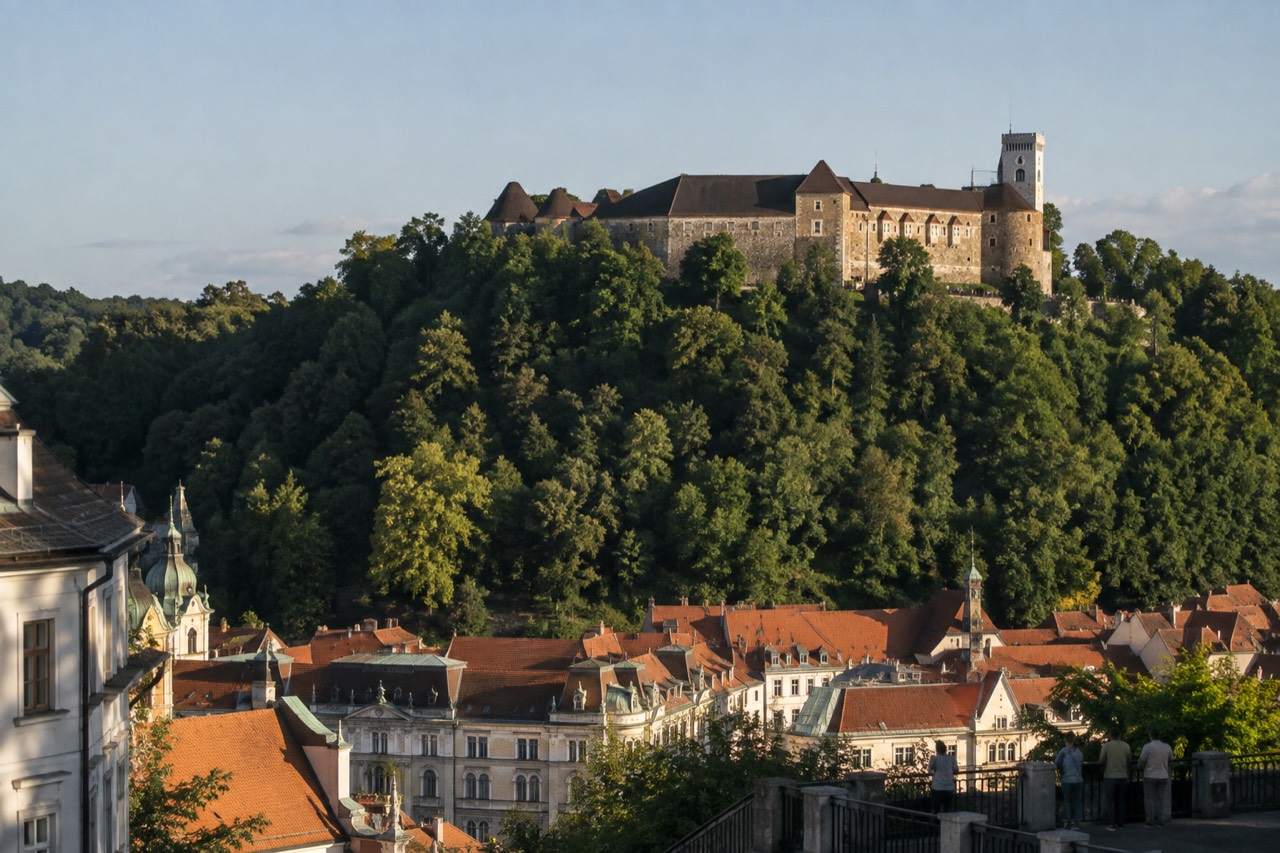
June is the best month to visit Ljubljana. ARSO's 1981-2010 normals give the city 246 hours of sunshine that month at a mean of 19.1 degrees Celsius, with rain falling on only 15 days. You get July's warmth without July's crowds, the river banks are full, and the daylight runs long enough for an evening walk after dinner. May and September are strong runners-up, each with a real trade-off worth knowing before you book.
The case for June is arithmetic before it is opinion. The city's own climate record, published by the national weather service, puts June's mean daily maximum at 24.6 degrees Celsius and its mean daily minimum at a mild 13.7. Rain does fall, 144 mm across the month, but it comes in short summer downpours rather than the long grey drizzle of November. Contrast that with December, which manages just 56 hours of sunshine across the entire month, under two hours a day, with 19 overcast days. The difference between the best and worst month here is not marginal. It is the difference between a city living outdoors and a city living under a lid.
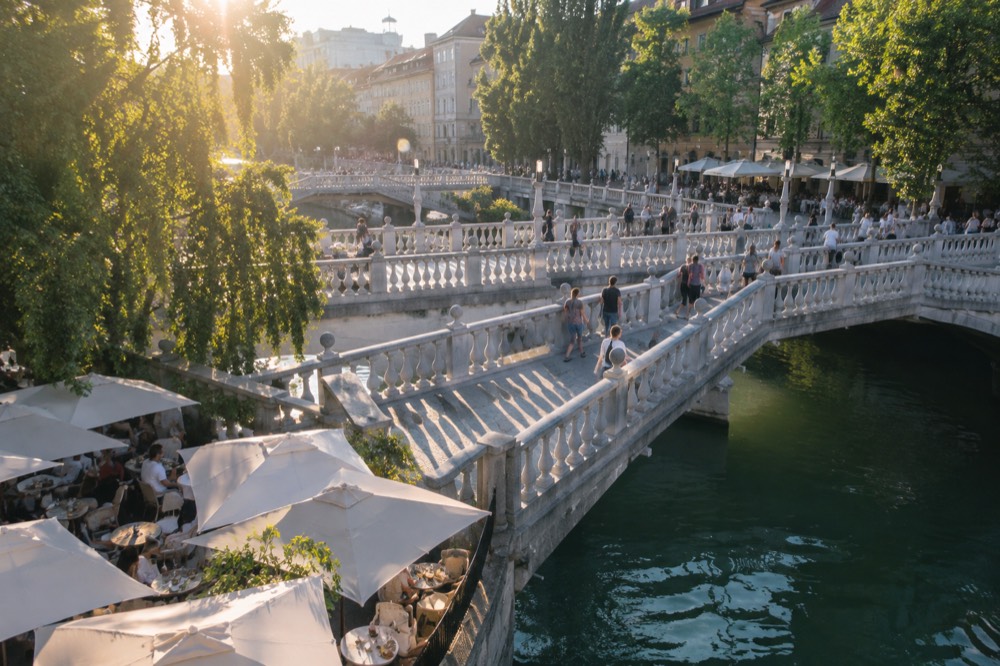
May is the quiet compromise. At 15.8 degrees Celsius mean and 235 hours of sunshine it is nearly as bright as June, the trees in Tivoli Park are at their best, and you are ahead of the school-holiday wave. The trade-off is a slightly higher chance of a wet afternoon, 109 mm across 14 days. September, at 16.0 degrees Celsius, is the other shoulder favourite, and it is the one many repeat visitors swear by, but it carries a hidden cost that most guides never mention, and it is big enough that we deal with it properly further down this page.
One more thing shapes the answer. Ljubljana is a two-night city: the national statistics office recorded 2,844,129 overnight stays across 1,392,728 arrivals in the municipality in 2025, an average stay of about 2.04 nights. People come briefly and day-trip out. So the best month for the city and the best month for the country are not always the same question, which is exactly what the next section untangles. For a fuller seasonal breakdown, the site's guide to the best time to visit Ljubljana goes month by month in more depth.
What Is the Best Month to Go to Slovenia?
For the country as a whole, June and September are the best months to go to Slovenia, with June the safer pick. The coast wants July or August, the Julian Alps want June to September, and the caves do not care at all: Postojna holds 10 degrees Celsius year round, which makes it the one headline attraction whose season never closes. What you plan to do outside Ljubljana should set the month, not the city's calendar.
Slovenia packs alpine, karst and Mediterranean worlds into a country you can cross in a few hours, and each of those worlds has its own best month. The Soca Valley and the peaks around Kranjska Gora are at their best from June into September, when the passes are open and the river is at its famous colour. The coast at Piran is a genuinely summer place, at its warmest and liveliest in July and August. The karst caves, Postojna and Skocjan, are the constant in the equation. Their temperature barely moves across the year, which is why this site keeps recommending them as the wet-weather and heatwave answer, and why a cave day trip is the one booking you can make in any month without checking the forecast.
That last point matters for planning. The most popular cave excursion from the capital, Postojna Cave and Predjama Castle, runs six hours, carries a 4.8 rating from 2,802 reviews and starts from $132, and it runs on the same schedule in February sunshine and February sleet. Pair it with a Bled day trip, from $86 for the six-hour castle version, and you have the two signature Slovenian sights locked in whatever the sky does. If your first day in the city needs an orientation instead, the free Ljubljana Unveiled walk on GuruWalk, tips-based, 4.91 from 1,496 reviews, runs in every season too.
The month-by-month logic for the rest of the country, then, is simple. June gives you open alpine passes, green valleys, and a coast that is warming up but not yet at peak prices. September gives you sea that has had all summer to warm and mountains still walkable, with a calmer feel everywhere. July and August are the full-summer months, best if swimming at Lake Bled or on the coast is the point of the trip. Winter belongs to the caves, the low-season city, and the ski hills, with the one big caveat about valley cloud we come to below.
Which Months Have the Best Weather in Ljubljana?
July is the sunniest and warmest month in Ljubljana, with 293 hours of sunshine and a mean of 21.3 degrees Celsius, but June and August are within a whisker of it and quieter. The worst weather sits from October to February, when sunshine collapses to between 56 and 120 hours a month. The numbers below come from ARSO's 1981-2010 climate normals for the city's Bežigrad station at 299 metres.
Here is the full monthly picture, transcribed from the official normals table. Read the sunshine row first, because it is the row that decides how a visit feels. A month with 293 hours of sunshine forgives almost anything; a month with 56 does not.
| Month | Mean temp (C) | Sunshine (h) | Rain (mm) | Clear days |
|---|---|---|---|---|
| Jan | 0.3 | 71 | 69 | 2 |
| Feb | 1.9 | 114 | 70 | 4 |
| Mar | 6.5 | 149 | 88 | 4 |
| Apr | 10.8 | 178 | 99 | 3 |
| May | 15.8 | 235 | 109 | 3 |
| Jun | 19.1 | 246 | 144 | 3 |
| Jul | 21.3 | 293 | 115 | 5 |
| Aug | 20.6 | 264 | 137 | 6 |
| Sep | 16.0 | 183 | 147 | 2 |
| Oct | 11.2 | 120 | 147 | 1 |
| Nov | 5.6 | 66 | 129 | 1 |
| Dec | 1.2 | 56 | 107 | 2 |
The source is ARSO's published 1981-2010 climate normals for Ljubljana, the national met service's own record for the city station. Two rows deserve a second look. August is the only month whose clear-day count reaches 6, which surprises people who assume July owns the summer. And the September row is where the popular shoulder-season story starts to wobble, because 147 mm of rain makes September the joint wettest month of the entire year, level with October and ahead of July's 115 mm.
That September fog and rain peak is the single most under-reported fact in Ljubljana travel writing. The month has a reputation as a golden, quiet shoulder, and the quiet part is true. But the city's own climate record says the early-autumn shoulder is as foggy as deep winter and wetter than high summer. None of this makes September a bad choice, the mean of 16.0 degrees Celsius is genuinely pleasant, but pack for it accordingly, and the site's packing advice for Ljubljana leans on exactly these numbers. If rain is your dealbreaker, the breakdown of the rainiest months in Slovenia covers the whole country.
When Is Ljubljana Cheapest and Quietest?
November to March is the cheapest and quietest period in Ljubljana, with the deepest calm in January and February, when sunshine bottoms out at 71 and 114 hours and the Christmas crowds have gone. Hotel rates, which this site does not quote because they move daily, are visibly lower then. The trade is honest: short days, fog, and a mean temperature between 0.3 and 6.5 degrees Celsius.
Low season here is not a marketing label, it is a real drop in bodies on the street. The Christmas market pulls a genuine crowd through December, and the Ljubljana Christmas market guide covers that window properly, but January and February belong to locals. Museums run their normal hours, restaurants take walk-ins, and the castle funicular runs its winter timetable, 09:00 to 19:00, without queues. The city's pedestrianised centre, the fact that matters most if you arrive by car, is at its most walkable when the day-trip coaches are elsewhere.
The smart low-season move is to spend the grey hours underground and the bright ones above ground. Postojna Cave holds its 10 degrees Celsius whatever the month, and the combined cave-and-castle excursion from Ljubljana, six hours, 4.8 from 2,802 reviews, from $132, is the standard way to do it without a hire car. Check availability alongside the full tour page if that fits your dates.
Budget travellers should also know what does not change with the season. The castle grounds are free, and it is the funicular and the tower that cost money, a distinction this site is careful about because the castle's own site does not spell it out. The Urbana card's 1.50 euro single fare in zone 1 is the same in January as in July. And the free GuruWalk walks, including the excellent Communist-era Ljubljana tour, run all year, which makes a winter city break unusually cheap to fill.
What Is Ljubljana Like in Winter?
Winter in Ljubljana is atmospheric but dim: December averages 56 hours of sunshine and 19 overcast days, with a mean of 1.2 degrees Celsius, and the city sits under a basin inversion that traps fog while the hills above it stay in sun. The Christmas market in December and the snow-dusted old streets are the payoff. If sunshine matters to you, plan to go up, not out.
The physics is worth sixty seconds because it changes how you use a winter day. Ljubljana sits on the floor of a basin at 299 metres. In the colder half of the year, cold air pools in the basin under warmer air above, a temperature inversion, and the city sits under fog and low cloud while the hills a few hundred metres up are in sunshine. ARSO's own normals show the result: Kredarica, at 2,514 metres on Triglav, records 120 hours of December sunshine against the city's 56, and 139 hours in January against the city's 71, per the official Kredarica normals table. The mountain is sunnier than the capital all winter.
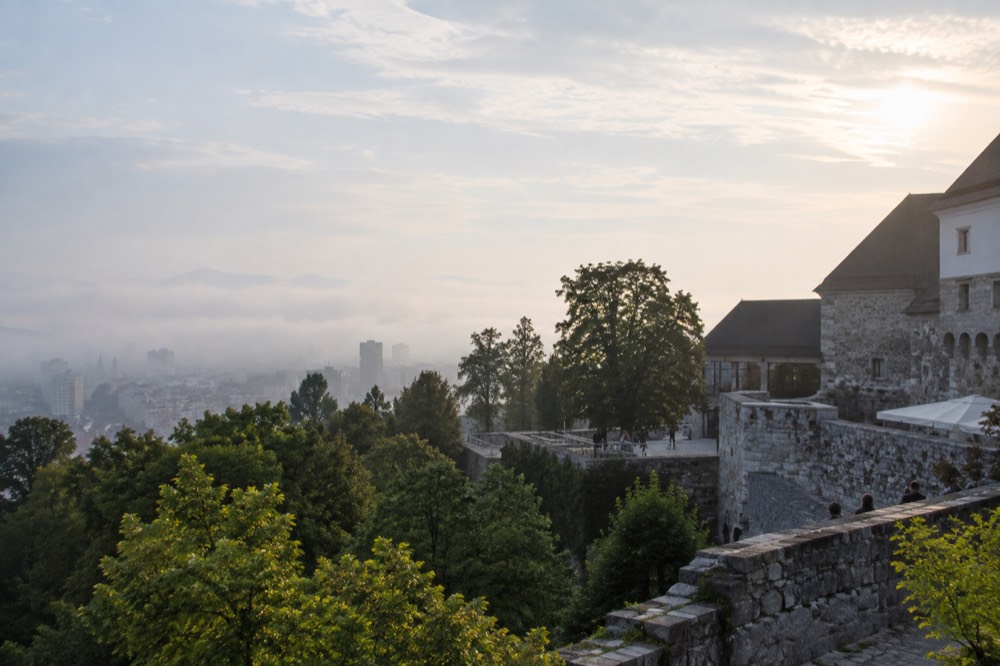
The practical translation: on a grey Ljubljana morning, the castle hill, Šmarna Gora, or a day trip up to Bled or Vogel can be in full sun while the streets below are grey. Winter visitors should check the December in Ljubljana guide for the market and daylight planning, and be honest with themselves about one thing: this is a city that averages just 37 clear days a year against 130 overcast, and winter is when that statistic is felt most. Snow helps. The city sees snow cover on roughly 50 mornings a year, deepest in January, and a snowfall transforms the old town in a way that makes the dim weeks suddenly worth it.
Are There Events That Make a Specific Month Worth It?
Yes: three calendar anchors genuinely shift the best-month answer. Open Kitchen runs on Fridays on Pogačarjev trg from roughly March to November, the Christmas market lights up December, and summer fills the river banks with festivals through June, July and August. If food is your reason to travel, aim for a warm Friday; if atmosphere is, aim for December.
Open Kitchen, Odprta Kuhna, is the one event that can dictate a travel date. Every Friday, roughly March to November, chefs set up on Pogačarjev trg next to the Central Market and the square turns into an open-air tasting hall from 10:00 into the evening. The official tourist-board wording is that it runs "every sunny Friday", and that is literal: the market cancels in bad weather, per the official event page. So a June or July Friday is the highest-probability Open Kitchen visit, and a late-October one is a coin toss. Pair it with a morning at the Central Market and you have the best single food day the city offers.
| Period | What is on | Why it matters |
|---|---|---|
| March to November, Fridays | Open Kitchen, Pogačarjev trg | Street food from dozens of kitchens, weather permitting |
| June to August | River-bank festival season, outdoor cinema | The Ljubljanica banks become the city's living room |
| Late November to early January | Christmas market and light displays | The old town's biggest single visitor draw |
| September | Autumn food and wine events | Shoulder-season prices with harvest menus |
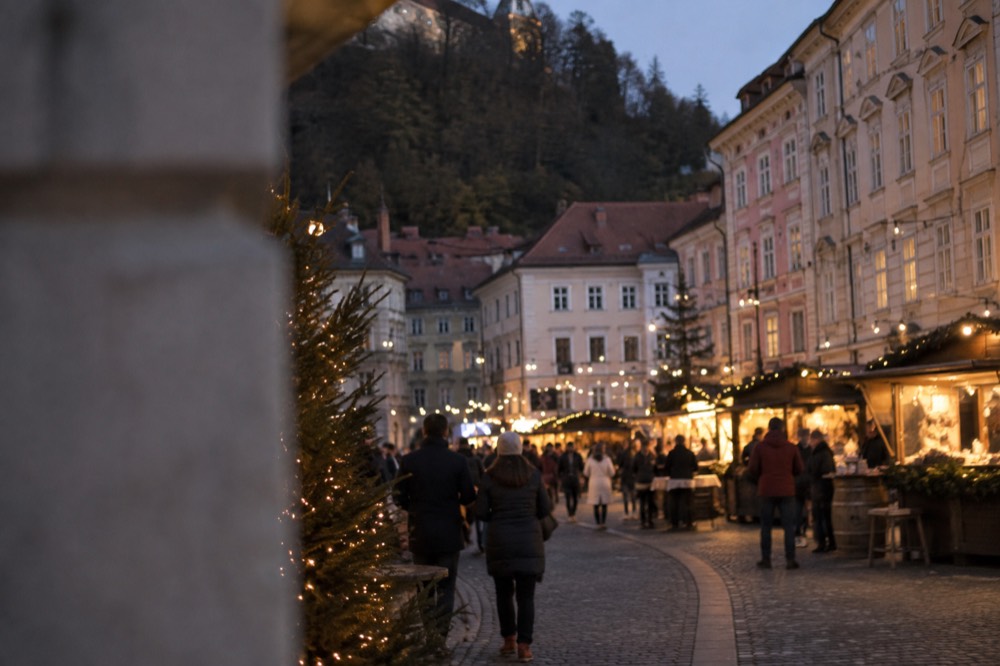
December deserves its own word even though its sunshine number is the worst on the page. The Christmas market wraps the old town in stalls and lights, mulled wine replaces the summer spritzers, and the atmosphere does what the weather cannot. Plenty of visitors who came in July for the sunshine end up returning in December for the market, which is the strongest argument that there is no single wrong month, only months that suit different trips.
So, to fold the whole answer into one sentence: pick June if you want the city at its best, September if you want quiet and can accept fog, December if the market is the point, and any month at all for the caves. This Ljubljana Travel Guide article's advice holds across all of them: the cave day trip, the Bled excursion and the free GuruWalk orientation walk are the three bookings that work in every month on the calendar, and they are the ones to lock in first.
Common Questions About the Best Month to Visit Ljubljana
What Is The Best Month To Visit Ljubljana?
June. ARSO's 1981-2010 normals give the city 246 hours of sunshine, a mean of 19.1 degrees Celsius and a 24.6 degree mean daily maximum, with the July crowds not yet arrived. May and September are the main alternatives, each cheaper and quieter with a weather trade-off.
What Is The Best Month To Go To Slovenia?
June for the country overall, with September close behind. The coast wants July or August, the Julian Alps want June to September, and the karst caves, at a near-constant 10 to 12 degrees Celsius, are the one headline attraction whose best month is every month.
What is the rainiest month in Ljubljana?
September and October are the joint wettest months at 147 mm each, ahead of July's 115 mm, in ARSO's 1981-2010 normals. The popular idea of a dry golden autumn shoulder is not supported by the city's own climate record, which also shows 12.4 fog days in each of those months.
Is December a good time to visit Ljubljana?
For atmosphere, yes: the Christmas market is the city's biggest seasonal draw and the old town looks its most storybook under lights. For weather, no: December averages 56 hours of sunshine and 19 overcast days, with a mean of 1.2 degrees Celsius. Go for the market, not the forecast.
When is Ljubljana least crowded?
January and February, after the Christmas market closes and before spring arrives. Museums keep normal hours and the free walking tours still run, so the low season is cheap to fill. The trade is short, grey days, with 71 and 114 hours of sunshine respectively.
Is Ljubljana sunny in winter?
Not in the valley, but often in the hills. The winter inversion traps fog and low cloud in the basin while the high ground above sits in sun: Kredarica at 2,514 metres records 120 hours of December sunshine against the city's 56. On a grey morning, going up is the reliable move.