Dragon Bridge (Zmajski Most): Ljubljana's Dragon Landmark Explained
Four copper dragons guard the corners of the Dragon Bridge, and they have become the symbol Ljubljana prints on everything from postcards to the city's own coat of arms lore. This guide covers what the bridge is, how to reach it on foot through the pedestrianised centre, when the light and the fog behave, and what to pair it with on the same afternoon.
Short answer
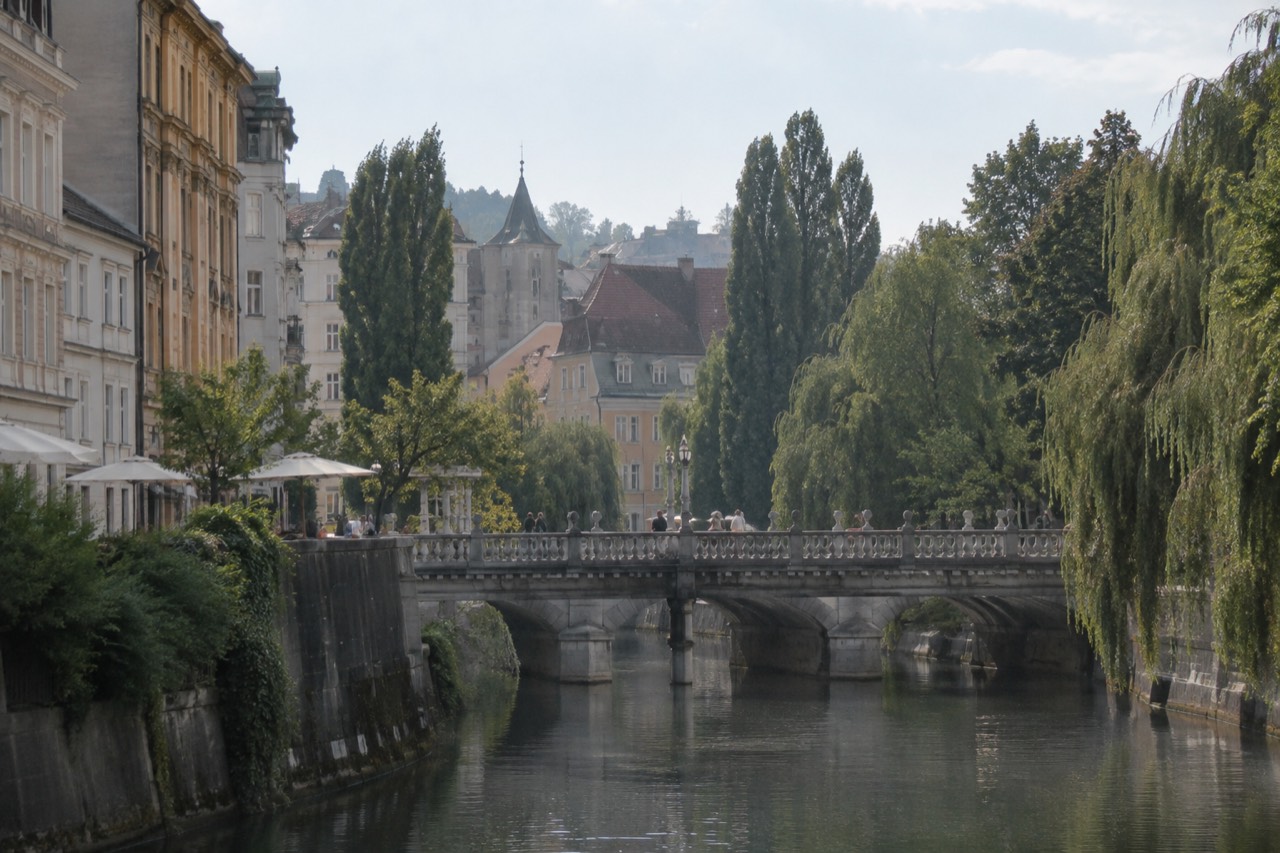
The Dragon Bridge (Zmajski Most) is a short walk from Prešeren Square across the Ljubljanica, marked by four dragon statues at its corners. It is free to visit at any hour, sits inside the car-free historic centre, and pairs naturally with the Central Market, the Triple Bridge and a Ljubljanica river cruise. Allow ten to fifteen minutes for the bridge itself, longer for photographs.
The Dragon Bridge, Zmajski Most in Slovene, is the single most photographed crossing on the Ljubljanica and the reason a dragon appears on so much of this city's souvenirs. Four cast dragons sit at its corners, wings spread, staring down at anyone crossing between the old centre and the market quarter. Visitors reach it on foot in a few minutes from Prešeren Square, pay nothing to stand on it, and usually leave with a camera roll full of dragon portraits. This page from Ljubljana Travel Guide covers the landmark from every practical angle: what it is, why the dragons are there, how to reach it, when the light is best, and what to see in the streets around it.
What Is the Dragon Bridge (Zmajski Most)?
The Dragon Bridge is a road and footbridge across the Ljubljanica in central Ljubljana, named for the four dragon statues mounted on its corner pedestals. It is one of the city's defining landmarks, sits within the pedestrianised historic centre, and costs nothing to visit, day or night. Most visitors spend ten to fifteen minutes here, photographing the dragons and the river views, before walking on toward the Central Market or the Triple Bridge.
The bridge carries traffic between the streets on either bank, but the experience of it is entirely pedestrian. You walk on past the dragon pedestals, look up at the scaled wings and open jaws, and look down the Ljubljanica in both directions. The dragons are the draw, and they earn it: each sits on an octagonal pedestal at a corner of the parapet, so a visitor standing at the centre of the bridge sees two ahead and two behind, framing the crossing like heraldic gatekeepers.
The bridge's position matters as much as its decoration. It stands at the north-western edge of the old core, close to the Central Market's covered halls and the open-air stalls of Vodnikov trg, and a short stroll from the Triple Bridge and Prešeren Square. That makes it a natural waypoint on almost any walk through the centre rather than a destination requiring a detour. The Old Town walking guide routes it between the river and the market, which is the order most visitors naturally follow.
What surprises many first-time visitors is the scale. Photographs make the dragons look enormous; in person they are statue-sized, close enough to study the detailing of scales and claws from the pavement. The bridge is short, and the pleasure of it comes from detail rather than grandeur. Go expecting a five-minute marvel and it over-delivers; go expecting a monument to spend an hour at and you will be finished early.
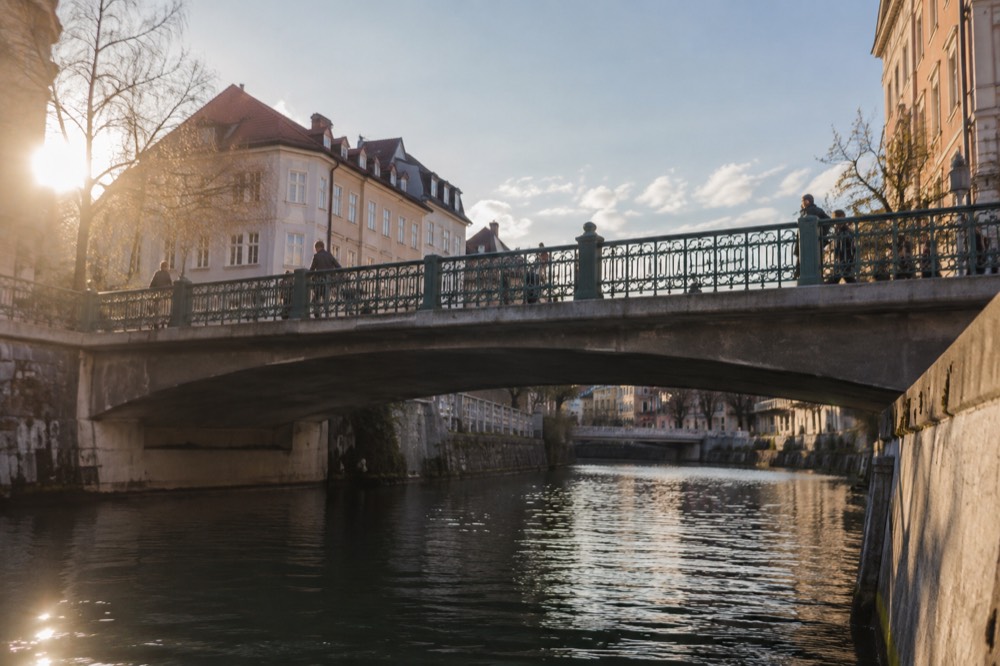
| Quick fact | Detail |
|---|---|
| Slovene name | Zmajski most |
| What it crosses | The Ljubljanica river |
| Its signature | Four dragon statues on corner pedestals |
| Cost to visit | Free, no ticket, no gate |
| Access | On foot, inside the pedestrianised centre |
| Nearest landmarks | Central Market, Triple Bridge, Prešeren Square |
| Time needed | 10-15 minutes, longer for photographs |
Why Does Ljubljana Have a Dragon Bridge?
Ljubljana's dragon legend ties the city to Jason and the Argonauts, the Greek myth in which Jason steals the golden fleece and flees home through unknown lands. The story goes that the Argonauts sailed up rivers to the Ljubljanica basin and encountered, and killed, a dragon in the marshes where Ljubljana now stands. The dragon became the city's symbol, and the bridge gave it its most visible permanent home.
The Jason connection is the version guides tell on the bridge itself, and it is retold on walks across the city. Whether the myth predates the statue or was attached afterwards is the kind of question that keeps local historians arguing, and the honest answer for a visitor is that the dragon and the city are now inseparable either way. The dragon appears on the city coat of arms, above castle gateways, on manhole covers, and on the souvenirs that fill shop windows along Čevljarski most and Mestni trg. The four bridge dragons are simply the largest and most photographed of the lot.
A second, quieter layer of meaning sits in the bridge itself. Its dragons face outward as guardians of the crossing, and the balustrade decoration carries the flowing, organic lines of the art-nouveau taste that was fashionable in central Europe when the bridge was built. Visitors who know Vienna or Budapest will recognise the mood immediately. Look along the parapet and at the lamp brackets, not just at the beasts: the whole bridge is a piece of design, and the dragons are its punctuation.
The best way to hear the legend told properly is with a guide who does it every day. The free Old Town Walk, Romans to Dragons on GuruWalk runs about two hours from the city's Roman roots to the Dragon Bridge, rated 4.91 across 1,496 reviews, and it is pay-what-you-think-it-was-worth rather than a fixed fee. A tips-based walk suits this kind of storytelling particularly well, because the dragon legend is the guide's home turf.
For visitors who prefer a fixed-price structure, the paid alternatives cover the same ground with different emphasis. The Classic Ljubljana group walking tour sweeps the Old Town's main sights in one walk, and the food-focused options weave the dragon quarter into a tasting route instead.
How Do You Get to the Dragon Bridge?
The Dragon Bridge is reached on foot from anywhere in the pedestrianised historic centre, roughly a few minutes' walk from Prešeren Square and the Triple Bridge. There is no ticket, no gate and no closing time. Drivers should park on the edge of the car-free zone and walk in, because the historic centre is closed to general traffic, a pedestrian area of roughly 20 hectares that has been progressively expanded since 2007.
Arriving from the main square, the route is simple: cross the Triple Bridge, bear right along the river, and the dragons appear ahead. Arriving from the opposite direction, from the Ljubljana bus station or the train station side, you walk down through the streets north of the centre and meet the bridge at the market end. Both approaches are flat and paved, and both deliver you into the car-free zone where walking is the only sensible way to move. The city's own mobility pages describe the pedestrian scheme at ljubljana.si.
Public transport drops you at the edge of the zone rather than at the bridge. City buses run on the Urbana system: a single zone 1 ride costs 1.50 EUR and covers 90 minutes including transfers, the card itself costs 2.00 EUR, and cash is not accepted on board, though contactless bank cards and phone wallets now are. LPP publishes the payment rules at lpp.si. Buy or top up at the LPP Passenger Centre on Slovenska, at Urbanomat machines, kiosks or tourist information centres.
| Way in | What to know |
|---|---|
| On foot from Prešeren Square | Flat walk via the Triple Bridge, a few minutes |
| On foot from the bus or train station | Walk down through the streets north of the centre |
| City bus | Zone 1 single 1.50 EUR, 90 minutes with transfers; no cash on board |
| Urbana card | 2.00 EUR to buy, top-ups at kiosks, Urbanomats, the Passenger Centre |
| By car | Park at the edge of the pedestrian zone and walk in; the centre is car-free |
| Taxi or transfer | Set down outside the zone; see the taxi and transfers guide |
Cyclists have an easy time of it too. The car-free centre is one of the most bike-friendly urban cores in this part of Europe, and the bridge sits directly on the river-side cycling line. The BicikeLJ share system is included with the Ljubljana Card for four hours at a time, which is worth knowing if you are pairing the bridge with a longer loop of the Tivoli Park and the embankments.
If you are planning your first day in the city and want the bridge placed in a sensible order with everything else, the one day in Ljubljana itinerary slots it between the market and the riverside, which is exactly where it belongs.
What Can You See from the Dragon Bridge?
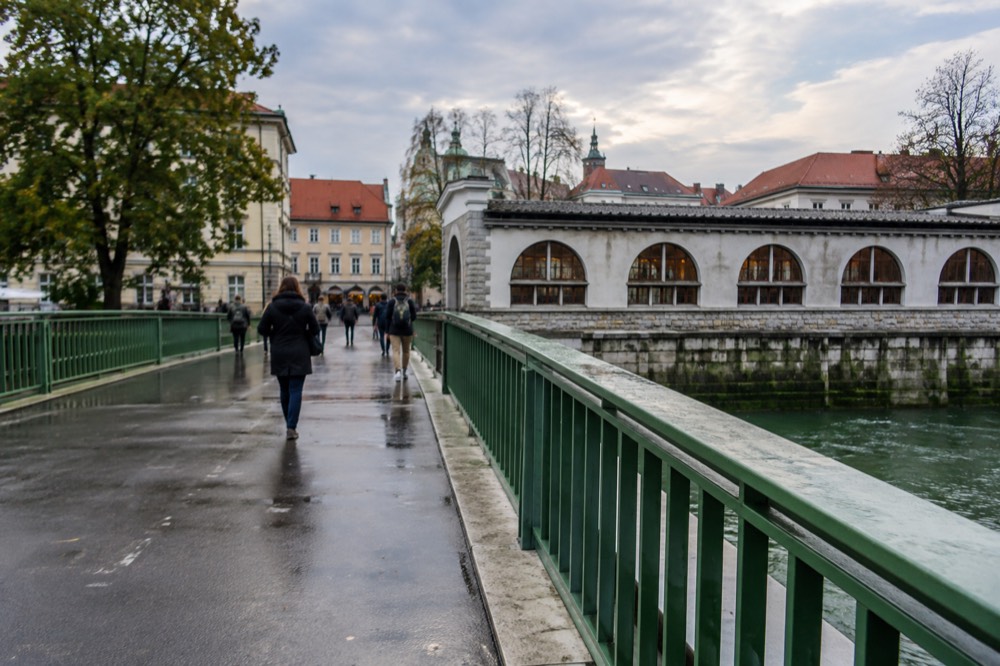
From the bridge you look straight down the Ljubljanica in both directions: upstream toward the Triple Bridge and the Franciscan church beyond it, downstream toward the quieter embankments and the reed-lined banks near the market. The river views, the dragon statues themselves and the market quarter at the north end make this one of the best free viewpoints in the centre, even though the bridge stands only a few metres above the water.
Upstream is the postcard direction. The Ljubljanica curves away toward Tromostovje, the Triple Bridge, and the pink front of the Franciscan Church of the Annunciation closes the vista above Prešeren Square. Early morning light comes from that side, which is why photographers cluster at the south-west corner of the bridge before the market crowds arrive. Downstream, the view is calmer: willows and reeds along the banks, pleasure boats at their moorings, and the green slopes that rise behind the city on clear days.
The river itself deserves a moment of attention. The Ljubljanica is a karst river that spends much of its course underground before surfacing near Vrhnika, and it runs about 41 km in its final visible form. Standing on the Dragon Bridge you are looking at the last stretch of a river that has already vanished and re-emerged several times upstream. The Ljubljanica river cruise guide covers the boat trips that put the same view at water level.
And water level is genuinely the better angle for the dragons. The 50-minute electric boat tour on the Ljubljanica, rated 4.6 across 149 reviews and from $17, glides under the bridge and gives you a dragon silhouette against the sky, a shot you cannot get from the pavement. It is the cheapest way to turn a five-minute bridge visit into a half-hour of the city's best scenery.
For visitors building a fuller day out of the river and the ridge above it, the guided walk with funicular to Ljubljana Castle, rated 4.6 across 650 reviews and from $24, starts in the Old Town and ends with the view down over the whole river bend, the Dragon Bridge a small detail in the mosaic below.
When Is the Best Time to Visit the Dragon Bridge?
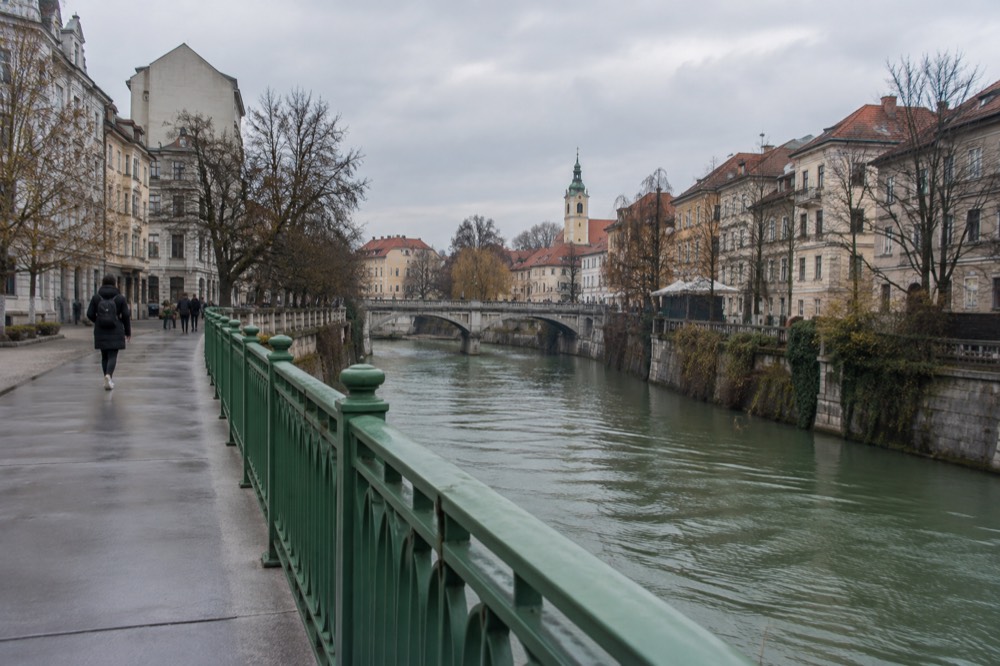
Early morning is the best time to photograph the Dragon Bridge, before the market crowds arrive and while the light comes from the east along the river. The bridge itself is worth visiting at any hour, but Ljubljana sits in a basin that fogs in from autumn to spring, with 91.2 fog days a year on the 1971-2000 ARSO normals, so a clear morning is a resource worth using rather than assuming.
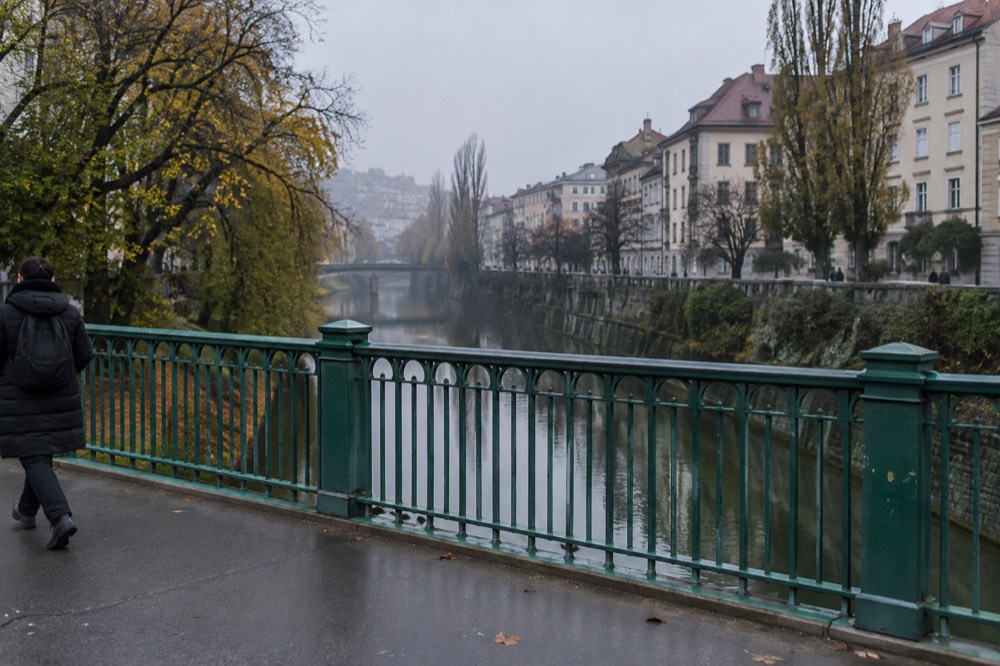
The fog statistic is the detail most guides miss. ARSO, the Slovenian environment agency, publishes fog figures only for the 1971-2000 reference period, and they show September and October averaging 12.4 fog days each, level with December's 12.6 and above January's 11.3. The same city that looks reliably sunny in July can spend half of September mornings under a grey lid, with the dragons emerging from the mist only after the sun burns through. Fog photography has its own appeal, and a dragon half-dissolved in river mist is a genuinely striking image, but visitors who want the postcard shot should plan around the numbers rather than hope.
The sunshine data tells the same story from the other side. On the 1981-2010 normals, Ljubljana receives 56 hours of sunshine in the whole of December and 71 in January, against 293 hours in July. The city averages just 37 clear days a year against 130 overcast, and October and November each average a single clear day. Winter visitors should expect to work for their light, and should check the morning forecast before setting out.
Practically, this means the bridge rewards two kinds of visitor at two different times. The early riser gets clean light, empty parapets and reflections on a calm river. The evening visitor gets the dragons lit against the sky and the riverside bars coming alive, which suits anyone continuing into the Ljubljana nightlife afterwards. Midday is the least flattering: the light is flat, the market traffic is at its peak, and every photograph includes strangers.
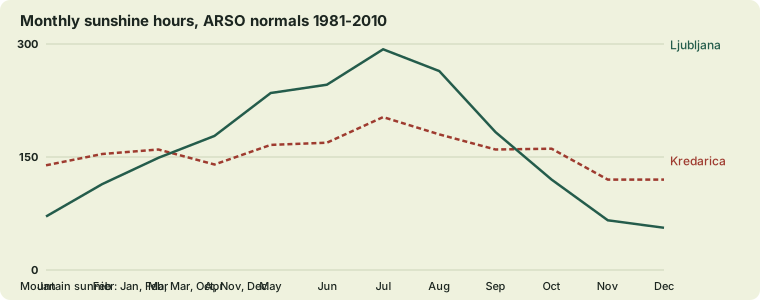
| Month | Sunshine hours | Clear days | Overcast days |
|---|---|---|---|
| January | 71 | 2 | 16 |
| April | 178 | 3 | 11 |
| July | 293 | 5 | 4 |
| September | 183 | 2 | 8 |
| October | 120 | 1 | 13 |
| December | 56 | 2 | 19 |
Is the Dragon Bridge Free to Visit?
Yes, the Dragon Bridge is completely free. It is a public street crossing with no ticket, no gate and no opening hours, so you can walk it at midnight or at dawn. That makes it one of the best free experiences in a city that is already generous with free sights, and it pairs naturally with the other free river crossings, the pedestrian streets and the castle grounds, which are also free to enter even though the funicular and the tower are not.
The distinction about the castle matters because visitors routinely confuse it. Ljubljana Castle's grounds are free to wander; the funicular ride and the castle attractions carry tickets, with a combined castle ticket including the funicular at 19.00 EUR for an adult on the castle's own price list. The Dragon Bridge, by contrast, has no paid component at all. Nothing about it can be charged for, which is worth saying plainly because a surprising number of visitors arrive expecting a ticket booth.
The free layer of the city runs deeper than one bridge. The free things to do in Ljubljana guide collects the rest: the riverside walks, the Metelkova autonomous cultural centre, where entry to the area is free and individual clubs set their own covers, and the first Sunday of the month, when the national museums and galleries open their doors without charge. A visitor can spend a full weekend in this city spending almost nothing beyond food, and the bridge is the natural anchor of that weekend.
Budget travellers should also know that the free GuruWalk walks, including the dragon-focused Old Town walk, operate on the same principle as the bridge itself: turn up, take the tour, pay what you think it was worth. The Ljubljana on a budget guide lays out how the tips-based walks and the free sights combine into a genuinely cheap city break.
Dragon Bridge Photography Tips
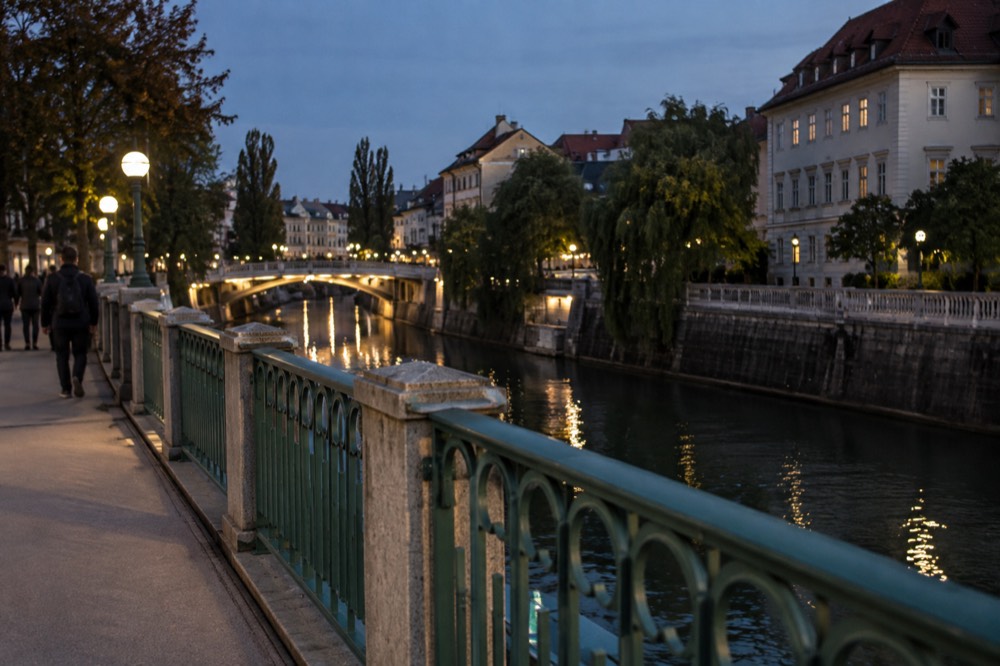
Photograph the dragons from the south-west corner in early morning light, from water level on a river cruise for silhouettes, and from downstream in the evening when the bridge lights come on. The statues read best with side light, so avoid flat midday sun, and if fog rolls in, work with it: a dragon dissolving into river mist is a stronger image than a postcard.
The four dragons each have a slightly different character, and it pays to walk the full circuit before lifting the camera. The corner pedestals mean you can shoot each beast against a different background: river, market, embankment, church tower. A short walk down either bank puts the whole bridge in frame, and the downstream side is usually quieter, so you can wait for a clean shot without foot traffic crossing the parapet.
Lens choice matters less than position. A phone camera handles the statues fine from the bridge itself; the compositions that need planning are the ones from the banks and the water. From a boat, the dragons stand against the sky, and the 50-minute electric boat tour passes directly beneath, which is why so many of the best images of the bridge come from the river rather than the road. On land, the steps down to the water near the market give a low angle that most visitors never find.
Timing your wider Ljubljana photography around the same morning is efficient. The Ljubljana photography spots guide ranks the river crossings and viewpoints, and the dragon quarter sits early on that list because it delivers three compositions in one stop: statue close-up, bridge panorama and river vista. Fog mornings, which ARSO's data shows are common from September onward, transform all three.
What Is Near the Dragon Bridge?
Within a few minutes' walk of the Dragon Bridge you have the Central Market's covered halls and open-air stalls, the Triple Bridge, Prešeren Square and the start of the Old Town's shopping streets. The bridge sits at the hinge between the market quarter and the riverside, so almost every central walk passes it, and the Ljubljana Castle funicular base is a short stroll further on beyond the main square.
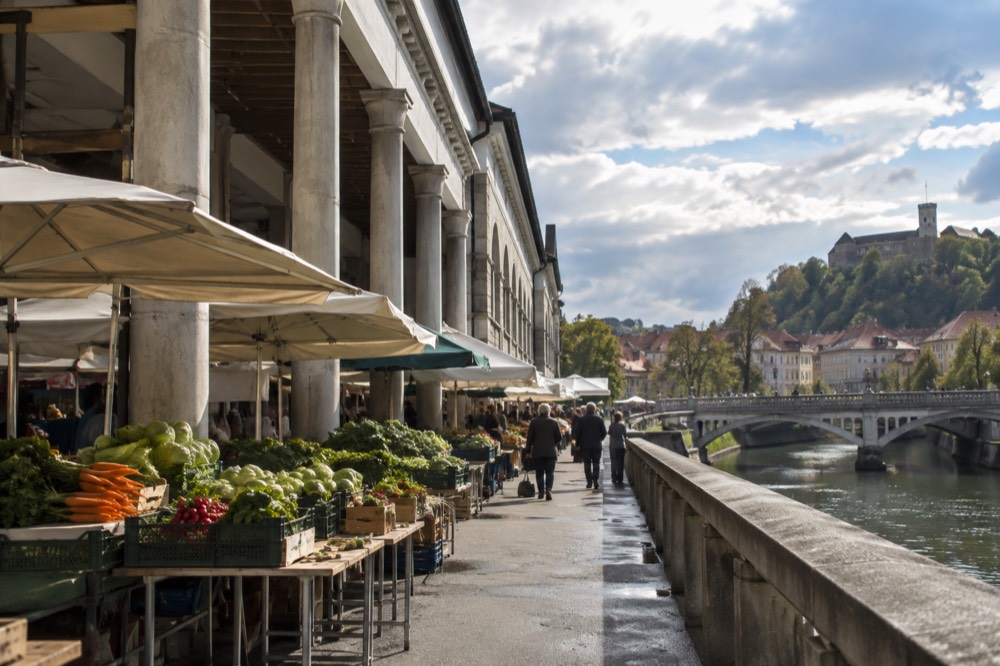
The Central Market is the immediate neighbour. Jože Plečnik's market halls run along the river bank beside the bridge, with outdoor stalls on Vodnikov trg and Pogačarjev trg roughly Monday to Saturday, 06:00 to 18:00 in summer and 06:00 to 16:00 in winter, and covered halls open Monday to Friday 07:00 to 16:00 and Saturday 07:00 to 14:00. On Fridays from roughly March to November, Pogačarjev trg hosts Odprta Kuhna, the Open Kitchen food market, from 10:00 into the evening, though the official wording is "every sunny Friday", and it is cancelled in bad weather. The Odprta Kuhna guide covers it in full, and the bridge is the natural place to eat your purchases with a view.
South-east along the river, the Triple Bridge leads to Prešeren Square and the start of the Old Town. North-west, the streets climb toward Tivoli Park and the museum quarter. The Central Market guide maps the stalls, and the Plečnik House is worth the tram ride for anyone interested in the architect whose embankments and market halls frame the river the dragons watch over. Note that Plečnik House is guided-entry only, with tours on the hour, at 12 EUR including the guide.
| Nearby sight | What it is | Why combine it |
|---|---|---|
| Central Market | Plečnik's riverside market halls and stalls | Beside the bridge; buy lunch, eat it on the embankment |
| Triple Bridge | Plečnik's three-parallel-bridge crossing | A few minutes south-east, on the way to the square |
| Prešeren Square | The city's main square and meeting point | Continue past the Triple Bridge |
| Ljubljana Castle | Hilltop fortress above the centre | Funicular base beyond the square; grounds free, attractions ticketed |
| Ljubljanica boat trips | River cruises from the central piers | See the dragons from the water |
The most efficient way to cover the whole cluster is with a guide. The guided walk with funicular ride to Ljubljana Castle, from $24 and rated 4.6 across 650 reviews, takes the Old Town, the river crossings and the castle in two hours, which suits visitors with one full day in the city. The 2 days in Ljubljana itinerary spreads the same ground more comfortably for anyone staying longer.
Where Else Can You Find Dragons in Ljubljana?
Beyond the bridge, dragons guard Ljubljana Castle's gateway, sit on the city coat of arms, hide on manhole covers across the centre, and fill the souvenir shops of the Old Town. The Dragon Bridge is the biggest and best-known of the city's dragon sites, but a dragon-spotting walk through the centre turns up a dozen more, and it makes a surprisingly good game for children.
Start at the castle. The gateway above the funicular's upper station carries the dragon in stone, and the view from the ramparts looks down over the river bend the bridge crosses. From there, descend into the Old Town and hunt the smaller dragons: the coat of arms on institutional buildings, the cast-iron covers underfoot, the shopfronts along Mestni trg and Čevljarski most. The Ljubljana with kids guide suggests the dragon hunt as a ready-made family activity, and it costs nothing.
The dragon also marks the city's self-image in quieter ways. The local basketball club and the city's promotional branding both lean on it, and every Christmas market stall along the river sells some new variation on the theme. Visitors who want the full symbolic story, from Jason's Argonauts to the modern logo, get it told best on the free GuruWalk walks, where the dragon legend is the standard closing act.
For visitors using the city as a base for day trips, the dragon works as a landmark in a different sense: it marks the edge of the compact centre, beyond which the bus hub and the routes out to Postojna Cave and Lake Bled begin. The cave and castle day trip from Ljubljana, six hours, rated 4.8 across 2,802 reviews and from $132, is the most popular of those routes, and the Lake Bled and Bled Castle trip, also six hours, rated 4.7 across 1,641 reviews and from $86, is the classic first excursion for anyone whose first morning in the city ends at the dragons.
Common Questions About the Dragon Bridge
Is the Dragon Bridge free to visit?
Yes. It is a public street crossing with no ticket, no gate and no opening hours. You can walk across it at any time of day or night, and the four dragon statues can be photographed freely from the bridge or the riverbanks.
How far is the Dragon Bridge from Prešeren Square?
A few minutes on foot. Cross the Triple Bridge from the square, bear right along the river bank, and the dragons come into view. The whole route is flat, paved and inside the pedestrianised centre.
Why does Ljubljana have dragon statues?
The dragon is the city's symbol, tied to the legend of Jason and the Argonauts, who are said to have encountered a dragon in the Ljubljanica marshes. The four bridge dragons are the largest and most photographed of the city's many dragon images, which also appear on the coat of arms and manhole covers.
When is the best time to photograph the Dragon Bridge?
Early morning, when the light comes from the east along the river and the market crowds have not yet arrived. Evening works well for the lit dragons and riverside atmosphere. Be aware that Ljubljana fogs in often from September onward, with 91.2 fog days a year on the ARSO 1971-2000 normals, so check the morning forecast.
Can you see the Dragon Bridge from a river cruise?
Yes. The Ljubljanica boat trips from the central piers pass directly beneath it, giving a low, sky-silhouetted view of the dragons that cannot be had from the pavement. The 50-minute electric boat tour is the shortest option that includes the crossing.
What is close to the Dragon Bridge?
The Central Market's halls and stalls, the Triple Bridge, Prešeren Square and the start of the Old Town, all within a few minutes' walk. The bridge sits at the hinge between the market quarter and the riverside, so nearly every central walk passes it.