Ljubljana Old Town: A Practical Walking Guide to the Historic Centre
Ljubljana's Old Town is small, car-free and stacked along a river bend, which makes it one of the few historic centres in Europe you can walk end to end in under an hour. This guide covers the sights, the real costs, the eating streets and the timing mistakes to avoid.
Short answer
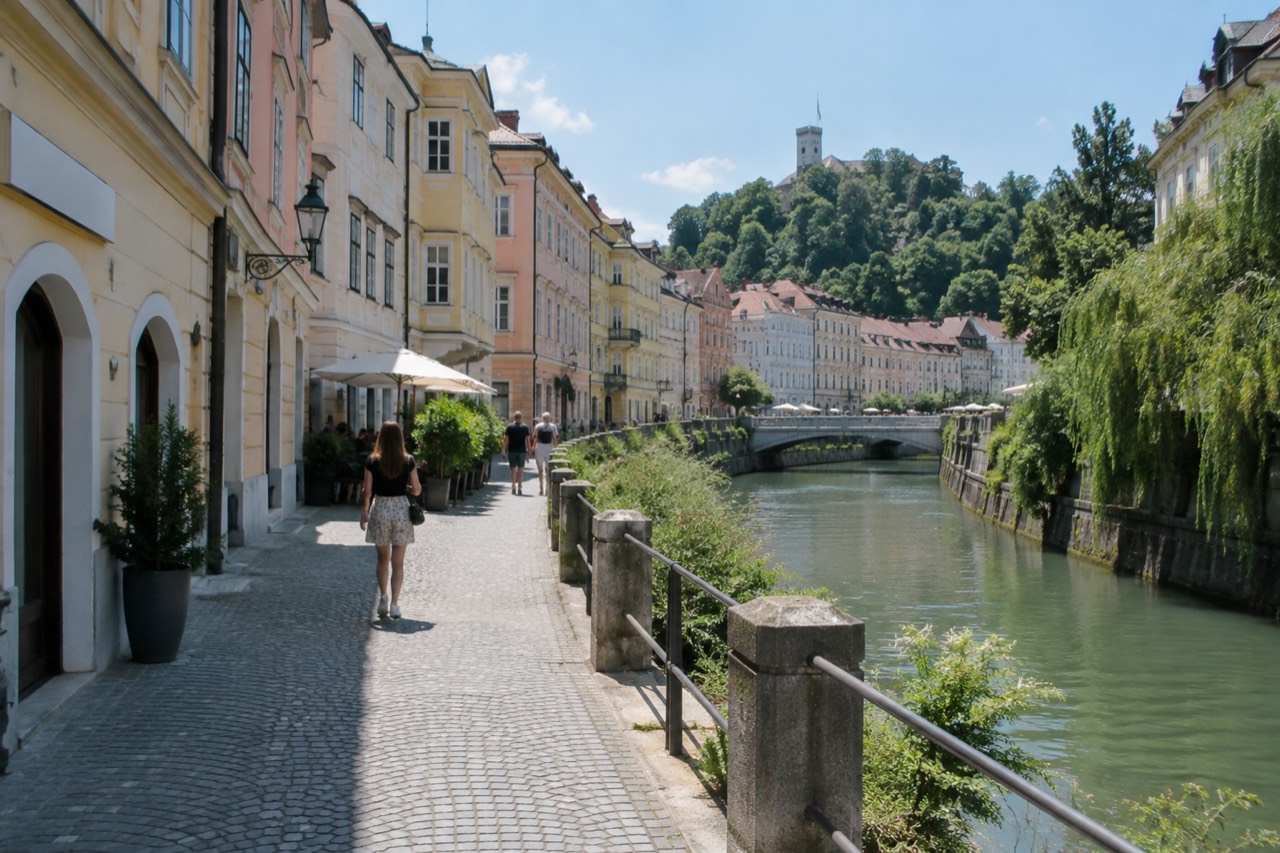
Ljubljana's Old Town is a pedestrianised district of roughly 20 hectares on the right bank of the Ljubljanica, centred on Mestni trg, Gornji trg and the castle hill above. Entry is free, the castle grounds are free, and a castle ticket with the funicular is 19.00 EUR. Allow half a day on foot, more if you climb to the castle.
Ljubljana Old Town: A Practical Walking Guide to the Historic Centre
Ljubljana's Old Town occupies the stretch of land inside the river's bend, below the castle hill, and the whole of it is closed to general motor traffic. The city has progressively pedestrianised the centre since 2007, and the zone now covers roughly 20 hectares, which the city's own mobility pages document. That single fact shapes everything about a visit: no traffic noise, no kerbside parking stress, and a historic centre you can cross on foot in about twenty minutes at a stroll.
The district is not large, but it is dense. Three squares, two bridges that every visitor photographs, a funicular, a market, a cathedral and a hill. This guide walks through what is actually there, what genuinely costs money, where to eat, and when to go, with the climate facts most guides skip. The Ljubljana Travel Guide covers each of the individual sights in more depth; this page is the orientation layer.
What Is the Ljubljana Old Town, and Where Does It Begin?
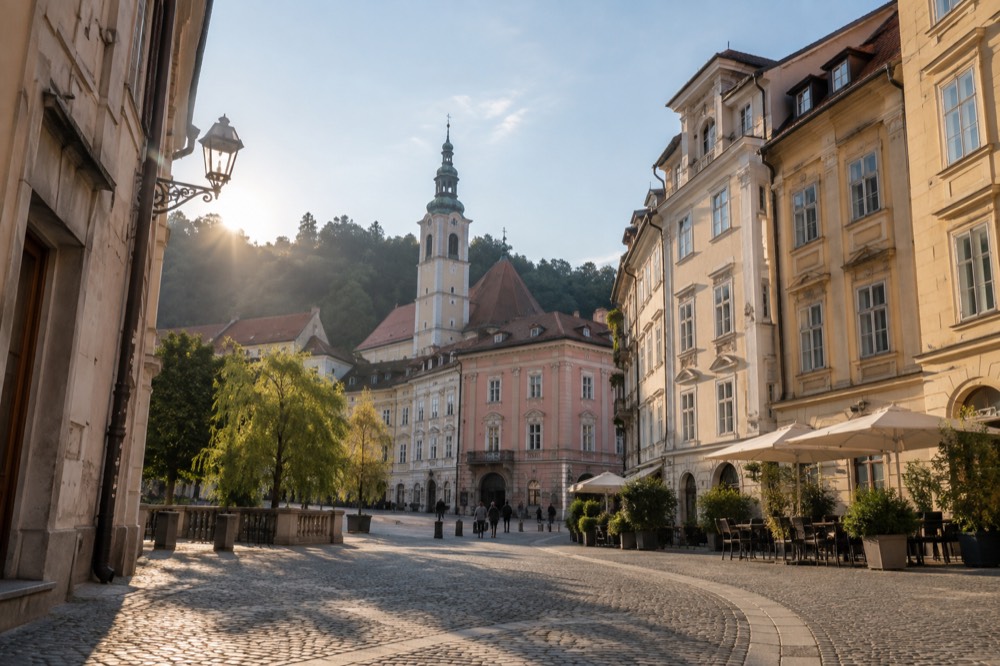
The Old Town is the historic core on the right bank of the Ljubljanica, running from Tromostovje and the Triple Bridge at its northern edge, through Mestni trg and Gornji trg, up to the foot of castle hill, with the river wrapping three sides of it. Most people enter across the Triple Bridge from Prešeren Square, which is technically on the other bank, and immediately find themselves on Mestni trg, the wide cobbled street that climbs gently toward the castle. The whole walkable district is under a kilometre from end to end.
Boundaries matter less than structure. The Old Town is essentially one main spine, Mestni trg continuing into Gornji trg, with narrow lanes dropping off it toward the river on one side and toward the hill on the other. Prešeren Square sits just across the water and functions as the de facto front door, and the Triple Bridge is the threshold crossing. Once you are over it, you are in it.
The architecture is a mix that rewards looking up. Baroque facades in ochre and dusty pink, a handful of medieval footprints, and the hand of Jože Plečnik everywhere in the river embankments and bridges. The Plečnik House is a short walk outside the district itself, and it is guided-entry only, tours on the hour, which is worth knowing before you set off.
A note on scale, because expectations cause most of the disappointment here. This is not Prague or Dubrovnik. It is a compact quarter of a modest capital city, and its charm is exactly that: you see it, you eat in it, you climb the hill, and you are done by mid-afternoon. The visitor figures back this up: 2,844,129 overnight stays across 1,392,728 arrivals in the municipality in 2025 works out to an average stay of about two nights, so most people are doing exactly what you are doing, a day and a bit in the centre.
What Should You See First in the Old Town?
Walk the spine first: enter over the Triple Bridge, up Mestni trg to the Town Hall and the Robba Fountain, continue to Gornji trg at the foot of the hill, then loop back along the river embankment to the Dragon Bridge. That single loop takes under an hour at walking pace and passes every headline sight. Only then decide what deserves a longer stop, because the loop tells you what you actually want to look at.
The order matters less than the pieces. Here is what the loop contains and what each piece is:
| Sight | What it is | Time needed |
|---|---|---|
| Triple Bridge | Plečnik's three-parallel-bridge crossing at the top of Mestni trg | 5 minutes, longer at sunset |
| Town Hall (Magistrat) | Baroque building on Mestni trg, courtyard open to walk through | 10 minutes |
| Robba Fountain | Triple-figure baroque fountain outside the Town Hall | A look |
| Ljubljana Cathedral | Baroque cathedral with green dome, off Mestni trg | 15 minutes |
| Gornji trg | Quiet upper square at the foot of castle hill | A pause |
| Ljubljana Castle | Hilltop fortress above the whole district | Half a day if you go in |
| Dragon Bridge | Four dragon statues, east end of the district | 5 minutes |
| Central Market | Plečnik's colonnade and open-air stalls along Vodnikov trg | 30 to 45 minutes |
Two of these deserve a flag. The cathedral is easy to miss because its entrance is tucked off the main square, and the green dome you see from the castle ramparts is the thing you were standing under an hour earlier. And the market is not a five-minute photo stop: the covered halls run Monday to Friday 07:00–16:00 and Saturday 07:00–14:00, with the outdoor stalls roughly 06:00–18:00 in summer, so morning is the only time you get the full version.
If you would rather have the loop narrated, the free GuruWalk walks are the cheapest way in, and Ljubljana Unveiled, rated 4.91 from 1,496 reviews, runs the Roman-to-dragons route in two hours. The paid options are stronger on the castle end: the guided walk with the funicular ride up to Ljubljana Castle, 4.6 from 650 reviews, from $24, pairs the Old Town loop with the hill climb in one ticket.
How Much Time Do You Need, and What Does It Cost?
Walking the Old Town itself is free, and so are the castle grounds; the paid items are the castle attractions and funicular at 19.00 EUR combined, a river cruise at about 15 EUR, and any guided tour you add. A half day covers the ground loop plus the castle hill. A full day lets you add the market, a boat trip and a long lunch, and that is the version most visitors end up wishing they had planned for.
The cost picture in one table, using the operators' own published prices:
| Item | Cost | Notes |
|---|---|---|
| Walking the Old Town | Free | The whole district is a pedestrian zone |
| Castle grounds | Free | The hill, courtyard and ramparts views cost nothing |
| Castle attractions ticket, adult | 19.00 EUR | Includes Viewing Tower, exhibitions and the funicular both ways |
| Funicular return, adult, on its own | 6.00 EUR | Single is 3.30 EUR |
| River cruise, 50 minutes | 15 EUR | Barka Ljubljanica, hourly May to September from 11:00 |
| Single city bus ride | 1.50 EUR | 90 minutes including transfers; no cash accepted on board |
| Tourist tax | 3.13 EUR per night | Added to accommodation, under-7s exempt |
The castle split is the fact people get wrong most often. The castle grounds are free to wander; the funicular and the tower are not. The castle's own price list publishes the 19.00 EUR combined ticket covering the Viewing Tower, the exhibitions and the funicular both ways, and the official price page carries the full breakdown. Decide before you climb whether you want the tower view, because the free ramparts view is already good.
Timing the castle matters too. The funicular runs 09:00–19:00 from January to April and October to December, and 09:00–22:00 from May to September. Last tickets go on sale up to an hour before closing. On 31 December everything shuts at 17:00, and on 1 January it opens from 10:00, which is worth knowing if you are here for the season.
The [Ljubljana Card](/guides/ljubljana-card/) changes the arithmetic if you are doing several of these. At 41.00 EUR for 24 hours it covers the funicular, the river cruise, city buses and more than 30 museums, one entry each, and the castle ticket with funicular plus a cruise is already about 34 EUR bought separately. The card only pays if you will genuinely use the museum entries.
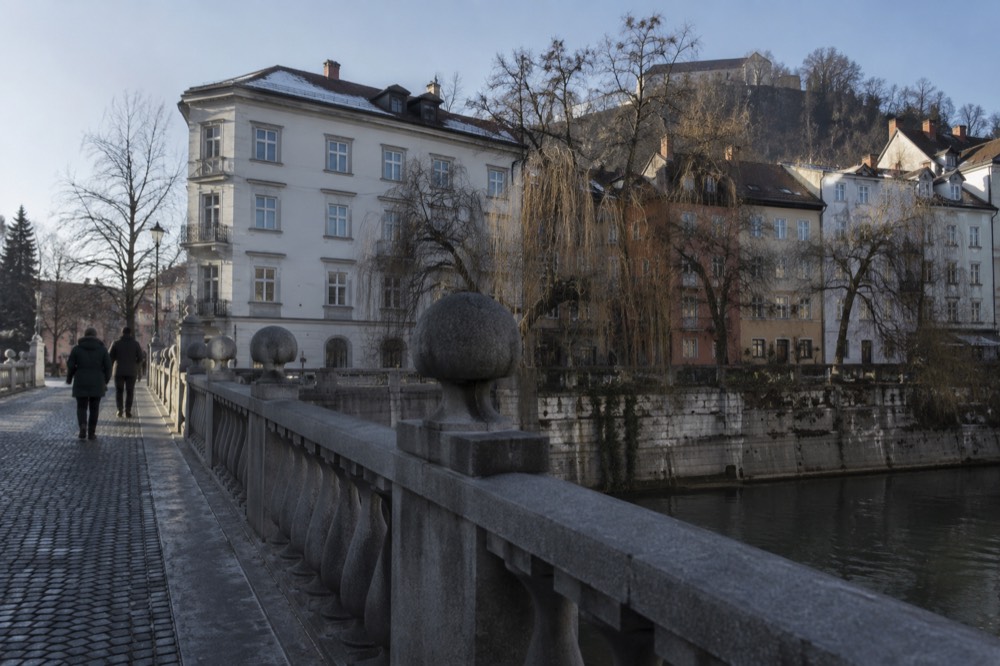
If you are splitting the day, the clean structure is this: market and coffee in the morning, the walking loop late morning, the funicular up and castle after lunch, then the river embankment in the late afternoon when the light comes across the water. The guided walk and funicular tour does the loop-and-castle combination in two hours for visitors who would rather not self-navigate, and it is the one paid tour that maps exactly onto this itinerary.
Where Do Locals Eat and Drink in the Old Town?
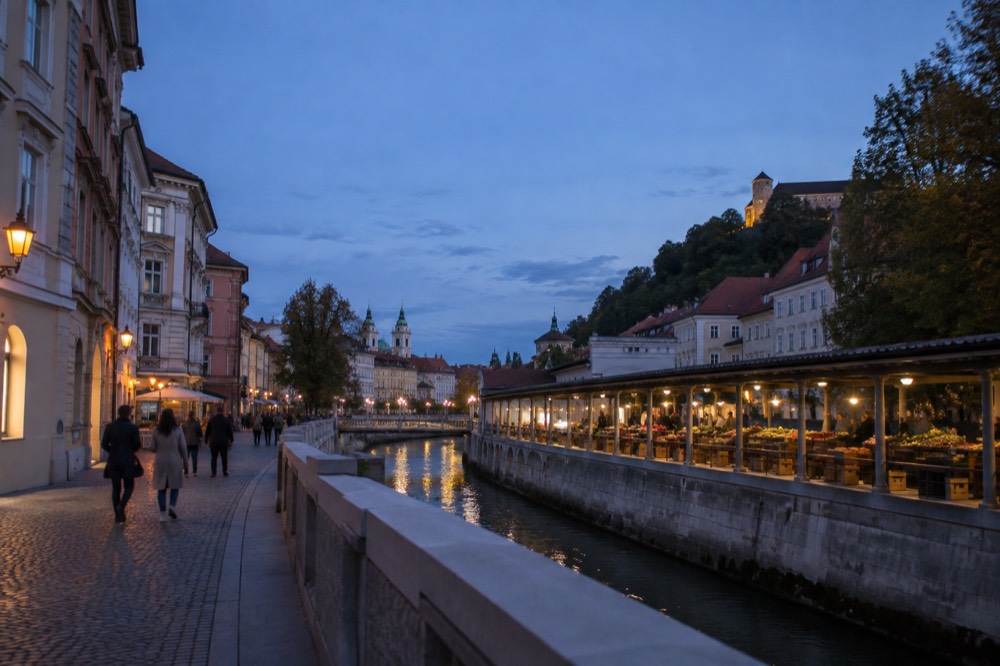
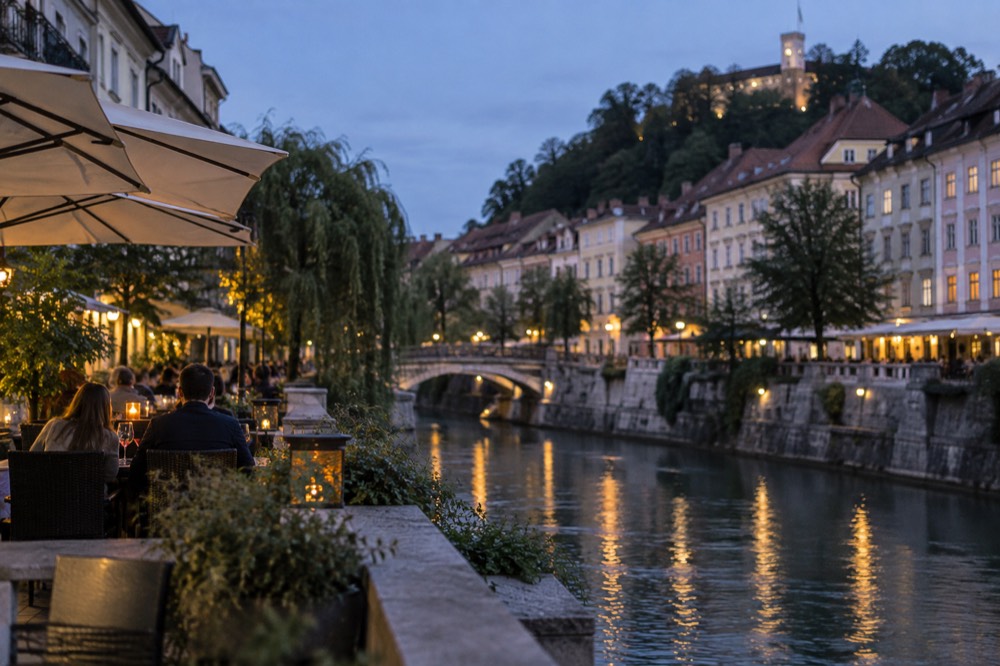
The eating weight of the Old Town sits along the river on Petkovškovo nabrežje and on the lanes off Mestni trg, with the Central Market the best morning stop and Odprta Kuhna the Friday event; the tourist-strip restaurants directly on the main squares are the ones to walk past. The rule of thumb is simple: one street back from the river is where the kitchens locals actually use sit.
The market deserves the morning slot. The Central Market runs its outdoor stalls roughly 06:00–18:00 Monday to Saturday in summer, with the covered halls on shorter hours, and the produce is from the surrounding market gardens as much as from further out. Buy fruit, buy a burek, eat standing. On Fridays from roughly March to November, Pogačarjev trg hosts Odprta Kuhna, the Open Kitchen street-food event, 10:00 to 21:00 and later on warm days. One honest warning: the official wording is "every sunny Friday", and the event is cancelled in bad weather, so a grey Friday means no stalls.
| Eating stop | What it is | When to go |
|---|---|---|
| Central Market halls | Produce, cheese, bread, cured meats | Morning, Mon to Sat |
| Odprta Kuhna | Friday street-food market, dozens of kitchens | Fridays, March to November, weather permitting |
| Petkovškovo nabrežje | Riverside restaurant and bar terraces | Evening |
| Gornji trg lanes | Small cafés and wine bars, quieter than the river | Afternoon |
| Craft beer bars | Slovenian microbreweries, several within walking distance | Evening |
For the deeper version of eating your way through the district, the Ljubljana food tour page maps the tasting walks, and the where locals eat in Ljubljana guide goes beyond the centre. If you want a guided version inside the Old Town itself, the Slovenian cuisine walking tour with tastings, 4.8 from 552 reviews, runs four hours from around $104, and the smaller three-hour traditional flavours walk holds a 5.0 from 54 reviews.
Drinking is the Old Town's evening strength. The riverside terraces fill from late afternoon, and the price step between the river row and the lanes one street in is real. A useful anchor from the national figures: a beer in Slovenia has a known price range, and the river terraces sit at the top of it. For going out properly, Metelkova is a fifteen-minute walk northeast, an autonomous cultural centre in former army barracks where the clubs set their own covers and the evenings run late, busiest Friday and Saturday.
What Is the Best Way to See the Old Town: On Foot, by Bike or from the Water?
On foot is the only way to see the Old Town's interior, because the lanes are pedestrian and nothing with wheels gets through them; the water and the hill are the two worthwhile additions, a 50-minute river cruise and the funicular, and a bike only earns its keep for the districts beyond. The centre is car-free by design, so the choice is not car versus foot, it is foot plus what else.
The comparisons that actually matter:
| Way to see it | Best for | Cost | Time |
|---|---|---|---|
| Self-guided walk | Everything inside the district | Free | 1 to 3 hours |
| Free GuruWalk tour | Stories, history, orientation | Pay what you think it was worth | 2 hours |
| Guided walk plus funicular | The loop and the castle in one go | From $24 | 2 hours |
| Classic group walking tour | The main sights with a group | Price is on the live listing | Around 2 hours |
| River cruise | The district from the water | 15 EUR, 50 minutes | Under an hour |
| Bike tour | Tivoli, Metelkova, Trnovo, the bits beyond | From $39 | 3 hours |
The free walks deserve their own paragraph, because they are the genuine budget option here and they are not a scam of any kind. GuruWalk runs eight free, tips-based walks in Ljubljana, and the model is simple: the walk is free, you pay what you think it was worth at the end. Ljubljana Unveiled, 4.91 from 1,496 reviews, is the flagship, two hours from Roman roots to the Dragon Bridge. The Snacking Love Walk pairs sights with snack stops in one hour forty-five, 4.93 from 1,324 reviews, and its listing states the tastings carry a fixed extra cost, so budget a few euros for those. Ljubljana by Night, 4.91 from 470 reviews, takes the after-dark corners. See this free tour on GuruWalk to check the meeting point before you go.
The paid group alternative is the classic Ljubljana group walking tour, 4.8 from 406 reviews, which covers the Old Town's main sights on the same footprint. It suits visitors who want a fixed start time and a conventional group structure rather than a tips-based walk. Check availability on the operator's live listing if the free walks are fully booked, which happens in July and August.
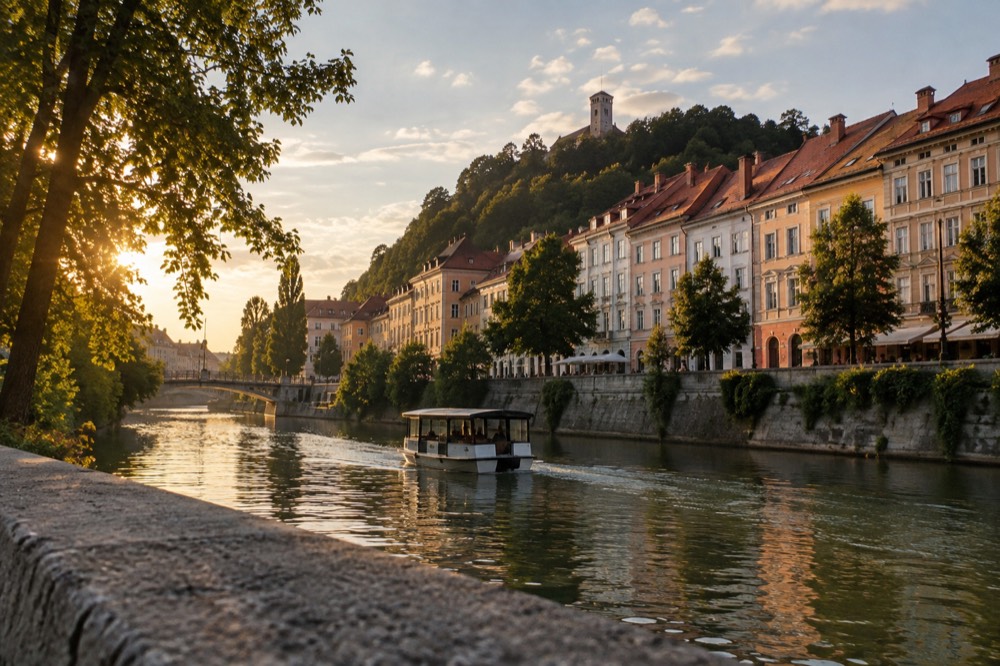
From the water, the Ljubljanica river cruise is the underrated half hour. The 50-minute electric boat trip, 4.6 from 149 reviews, from $17, runs the same river you have been walking beside, and the embankment architecture reads differently from water level. The river cruise guide has the departure points and seasonal hours. Bikes come into their own only outside the district: the street art and culture bike tour, 4.5 from 85 reviews, from $39, uses the centre as a starting point and spends its three hours in the neighbourhoods around it, which is the right use of two wheels in a pedestrian zone.
When Is the Best Time of Day, and the Best Month, to Visit?
Mornings and early evenings are the best hours: the market is at full stretch before 10:00, the tour groups peak midday, and the riverside is at its best from late afternoon; for months, late spring and summer beat the autumn, because Ljubljana's foggiest and wettest period is September and October, not midwinter. That last part surprises people, and the numbers are worth knowing before you book.
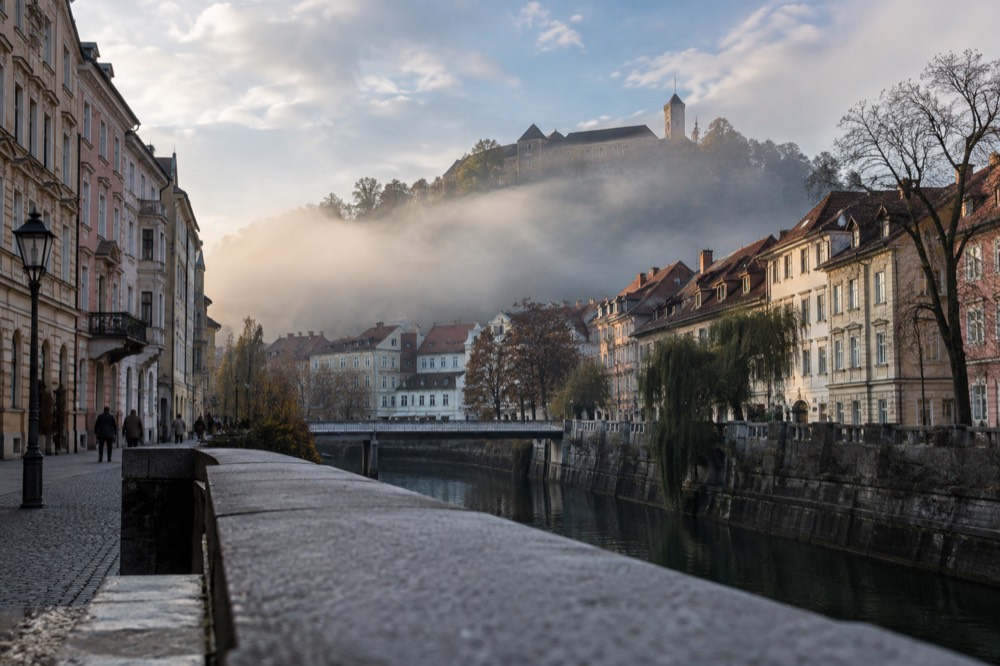
Ljubljana sits in a basin, and in the colder half of the year cold air is trapped under warmer air above, so the city fogs in while the hills a few hundred metres up sit in sunshine. The national weather service, ARSO, publishes fog figures only for its 1971–2000 reference period, and those give Ljubljana 12.4 fog days in September and 12.4 again in October, level with December's 12.6 and above January's 11.3, out of 91.2 fog days a year. The same shoulder months are the joint wettest of the year in the 1981–2010 normals, at 147 mm of rain each, above July's 115 mm. The ARSO normals table carries the fog series.
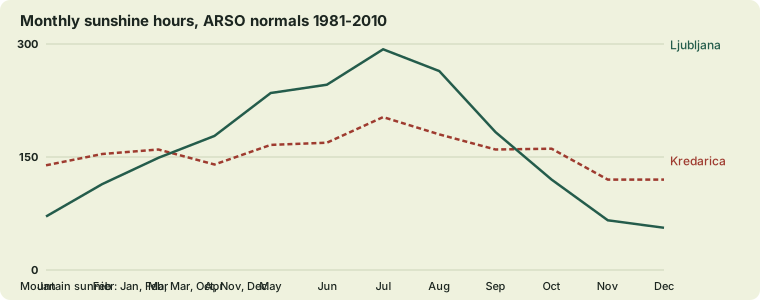
The inversion cuts the other way in deep winter, and this is the single most useful climate fact for an Old Town visit. ARSO's 1981–2010 normals put Ljubljana at 56 hours of sunshine in the whole of December and 71 in January, against 120 and 139 at Kredarica, at 2,514 m up on Triglav. The city averages just 37 clear days a year against 130 overcast. In practical terms: a December or January morning can be grey at river level while the castle hill is in sun, and the funicular ride up is also a ride out of the fog.
| Month group | What to expect in the Old Town |
|---|---|
| May to August | Longest days, riverside terraces at full hours, most crowds |
| September and October | Wettest months at 147 mm each, 12.4 fog days, thinner crowds |
| November to February | Basin fog at river level, sun on the hill, Christmas market from late November |
| March and April | Quietest, changeable, market back to summer hours from April |
For the full month-by-month picture including the Christmas market period, the best time to visit Ljubljana guide breaks it down, and the Ljubljana in December page covers the fog season specifically. If you do get a wet day, the district has an answer: the museums mostly cluster within a short walk, and the rainy day in Ljubljana guide maps them. The national institutions open free on the first Sunday of every month, and almost all of them close on Monday, which is the planning fact that catches people out.
What Practical Facts Should You Know Before You Go?
The Old Town is fully pedestrianised, city buses take no cash on board, the euro is the currency, and there are no border formalities arriving from Italy, Austria, Hungary or Croatia, because Slovenia is in the EU, the eurozone and the Schengen area. Each of those changes how you plan the day, and each is the thing visitors most often get wrong.
Transport first. The centre being car-free means you park at the edge or arrive [by bus](https://busbud.tpk.ro/4kLAIElq) or train. If you are driving in for the day, the park-and-ride lots on the ring are the standard move, and the car rental guide covers the edge-of-centre problem in detail. On the buses themselves, a single zone 1 ride is 1.50 EUR and valid 90 minutes including transfers, an Urbana card costs 2.00 EUR, and the rule that catches people is that cash is not accepted on board, though contactless bank cards and phones now are. The paying for public transport post covers the mechanics.
Money and borders. Slovenia adopted the euro on 1 January 2007 and joined Schengen on 21 December 2007, with air checks lifted 30 March 2008, so there is no currency to change coming from the eurozone and no routine border check coming from any neighbouring Schengen country. Croatia joined Schengen and the euro on 1 January 2023, so even the Zagreb and Istria runs are internal. The tourist tax is 3.13 EUR per person per night, added to your accommodation bill, with under-7s exempt.
| Practical item | The fact |
|---|---|
| Currency | Euro, since 1 January 2007 |
| Schengen status | In, since 21 December 2007 |
| Centre access | Pedestrian zone, roughly 20 hectares |
| Bus fare, zone 1 | 1.50 EUR, 90 minutes, no cash on board |
| Tourist tax | 3.13 EUR per person per night |
| Museums | Mostly closed Monday; national institutions free first Sunday of the month |
| Airport distance | Ljubljana Airport is about 26 km from the city |
Accessibility and luggage are covered on their own pages, including accessible Ljubljana and [luggage storage](https://radicalstorage.tpk.ro/3nyf4NSa) if you are day-tripping in. The short version: the district's cobbles are the main obstacle for wheel users, and the funicular is the easiest route up the hill for anyone who would struggle with the footpaths.
What Is Worth Seeing Just Beyond the Old Town?
Everything that matters beyond the district is within a 15-minute walk: Tivoli Park to the west, Metelkova and the museum quarter to the northeast, and Trnovo across the river to the south, with the castle hill itself the only thing that counts as inside-and-above. The Old Town is the centre of gravity, but a two-night stay, which is what the average visitor has, leaves time for at least one of these.
The near misses, ranked by how often visitors regret skipping them:
| Beyond the Old Town | What it is | Walk from the Triple Bridge |
|---|---|---|
| Tivoli Park | The city's main park, straight down the pedestrian axis | 15 minutes |
| Museum quarter, Metelkova area | MSUM, Moderna galerija, the Ethnographic Museum, plus Metelkova itself | 15 minutes |
| Trnovo | Quiet riverside quarter, Plečnik's church, student life | 15 minutes |
| Franciscan Church | The pink church on Prešeren Square, technically outside the district | 2 minutes |
| National Gallery | The national collection, in Tivoli's corner | 15 minutes |
The pattern in that table is deliberate: the museum quarter and the park are the same direction, so one afternoon covers both, and Trnovo is the opposite direction for a river-evening. If your stay is short and you want the biggest single add-on, the day trips are the other half of the Ljubljana experience, and Lake Bled alone carries more visitor demand than the entire city. The day trips from Ljubljana guide ranks them, from Postojna Cave to the Soča Valley to Piran.
For a first visit structured around all of this, the one day in Ljubljana and 2 days in Ljubljana itineraries build the Old Town into a full plan, and the Ljubljana city break page frames the whole stay. The Old Town is the anchor; the rest is radius.
Common Questions About the Ljubljana Old Town
Can you visit the Ljubljana Old Town for free?
Yes, entirely. The district is a public pedestrian zone, walking it costs nothing, and the castle grounds on the hill above it are free to enter. Only the castle attractions, the funicular, the river cruise and any guided tour cost money.
How long does it take to walk the Ljubljana Old Town?
The core loop, Triple Bridge up Mestni trg to Gornji trg and back along the river to the Dragon Bridge, takes under an hour at a stroll. Allow half a day with the castle hill, and a full day if you add the market, a boat trip and a long lunch.
Is the Ljubljana Old Town car-free?
Yes. The historic centre has been progressively closed to general motor traffic since 2007 and is now a pedestrian zone of roughly 20 hectares. Nothing with an engine gets through the lanes, which is why every visit is on foot.
What is the best free walking tour of the Old Town?
Ljubljana Unveiled, the tips-based GuruWalk, is the most-reviewed free walk at 4.91 from 1,496 reviews, covering the district from its Roman roots to the Dragon Bridge in two hours. You pay what you think the walk was worth at the end.
When should I avoid visiting the Old Town?
September and October are the joint wettest months at 147 mm of rain each and average 12.4 fog days apiece, which surprises visitors expecting a dry autumn shoulder. Monday is the day the museums close, and midday in July and August is when the tour groups peak.
Do I need to book anything in the Old Town in advance?
The free walks fill up in July and August, so reserve a spot ahead in summer. The castle ticket can be bought on the day, but the Plečnik House outside the district is guided-entry only with tours on the hour, and that one genuinely needs planning.