Prešeren Square: What to See at Ljubljana's Central Square
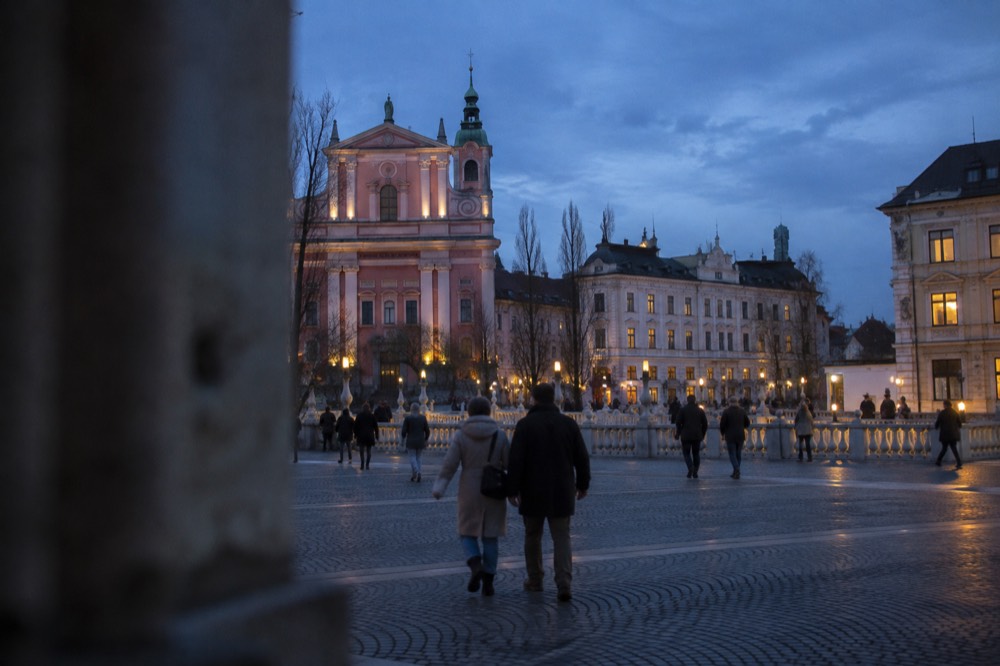
Prešeren Square is the crossroads of Ljubljana: the point where the Old Town, the river and the modern centre meet, and the place almost every visit begins.
Short answer
Prešeren Square is Ljubljana's central square, where the Franciscan Church, the Triple Bridge and the Prešeren monument stand within a hundred metres of each other. Most visitors spend 20 to 45 minutes here on a first walk, longer if the Open Kitchen market is running. It is free to visit at any hour, and every major walking tour in the city passes through it.
What Is Prešeren Square?
Prešeren Square is the central square of Ljubljana, the open pedestrian space where the historic Old Town, the Ljubljanica river and the modern city centre all meet. It takes its name from France Prešeren, the poet whose writing stands at the centre of Slovenian literary identity, and his monument marks the middle of the space. Almost every first walk through Ljubljana starts or passes here, and the square functions as the city's default meeting point. It costs nothing to stand in it, photograph it or cross it, and it is open at every hour of the day.
The square sits at the point where the Ljubljanica bends and the Triple Bridge carries foot traffic across to the medieval streets on the other bank. On one side rises the pink facade of the Franciscan Church of the Annunciation, the building that gives the square its most photographed backdrop. On another, the department store and café terraces of the modern centre look back at it. It is a small square by European standards, but it is dense: nearly everything a visitor has come to Ljubljana to see stands within a few minutes' walk.
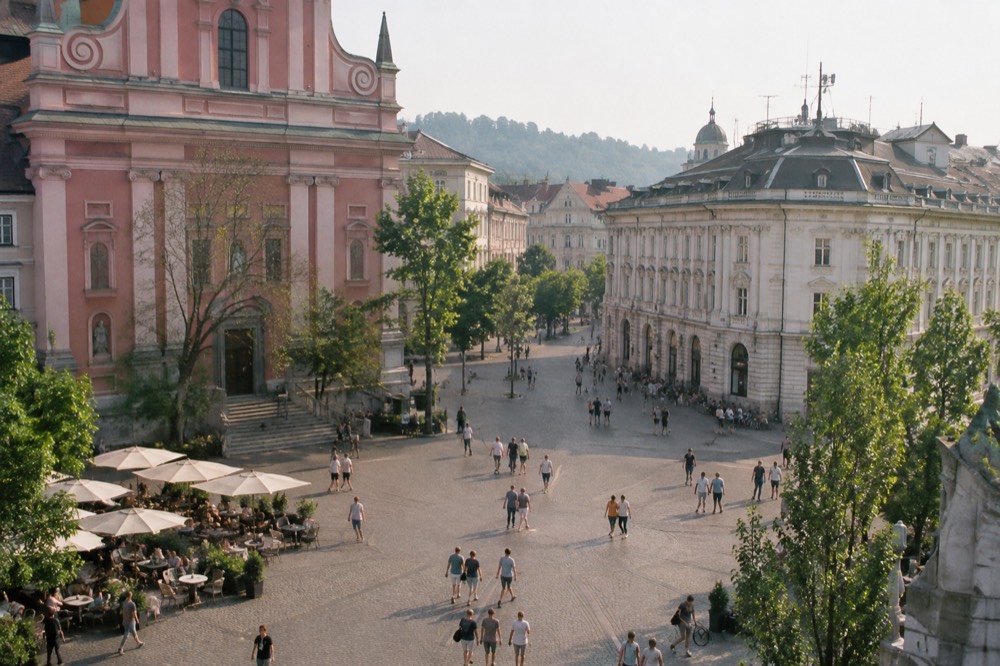
The layout rewards a slow loop rather than a quick snapshot. The Prešeren monument faces the church, so the classic postcard view puts the poet's statue in the foreground and the facade behind it. Walk twenty metres and the same square reframes itself around the Triple Bridge, then around the river, then around the rows of tables that spill out from the corner cafés in warm weather. The whole circuit takes ten minutes at a stroll, and it is the single best orientation exercise in the city.
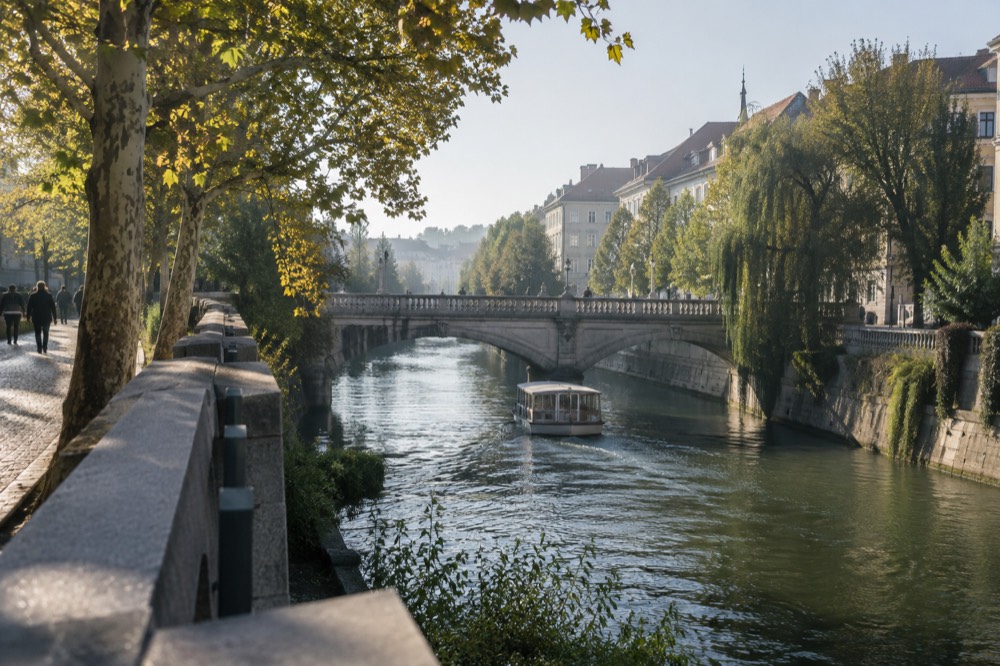
For a first visit, the honest advice is simple: do not treat the square as a destination you arrive at, tick off and leave. Treat it as your base. It is the point from which the Old Town, the river cruise piers, the central market and the funicular up to the castle are all within a short walk, and it is the natural place to return to between them.
What Can You See from Prešeren Square?
From the centre of Prešeren Square you can see the Franciscan Church facade, the Prešeren monument, the Triple Bridge, the Ljubljanica river and the hilltop outline of Ljubljana Castle, all without moving your feet. Each of these is a sight in its own right, and four of them have their own dedicated pages on this site. The square is effectively a viewing platform for the city's most recognisable set of landmarks. That density is why tour groups gather here rather than anywhere else.
The table below lists what stands in and around the square, and what each one is, so you can decide what deserves a closer look on your own route.
| Sight | What it is | Where it sits |
|---|---|---|
| Prešeren monument | Statue of the poet France Prešeren, the square's namesake | Centre of the square |
| Franciscan Church of the Annunciation | Pink-and-white baroque church, the square's facade | North-east side |
| Triple Bridge | Jože Plečnik's three-part footbridge crossing the Ljubljanica | South-west edge |
| Ljubljanica river | The river the city is built around, with cruise piers nearby | Just beyond the bridge |
| Ljubljana Castle silhouette | Hilltop fortress visible above the rooftops | Uphill, south-east |
| Central Market colonnade | Plečnik's riverside market complex | Two minutes' walk north |
The castle view deserves a specific note. From the square, Ljubljana Castle reads as a silhouette on the wooded hill rather than a building, and that is exactly the shot most visitors want: terracotta roofs in the foreground, the tower above. The castle grounds are free to enter, while the funicular and the tower are paid, so the silhouette you photograph from here and the interior you visit later are two different experiences of the same place. The full breakdown of tickets, funicular prices and hours is on our Ljubljana Castle page.
The church interior is the other sight people underestimate from outside. The facade photographs beautifully, but the church is a working building with a richly decorated interior, and entry is free during opening hours. Between the church, the bridge and the monument, a visitor who lingers can easily spend an hour inside a square that most people cross in five minutes.
If you would rather have someone walk you through all of this than piece it together yourself, the classic group walking tour is built for exactly that: a licensed guide covering the square, the bridges and the Old Town's main sights in a single outing. The pub crawl covers the same geography after dark, from a very different angle, and the Ljubljana City Card bundles the walking tour with the castle funicular, the river cruise and more than thirty museums, which is worth comparing if you plan to do several of those anyway.
How Much Time Do You Need at Prešeren Square?
Most visitors spend between 20 and 45 minutes at Prešeren Square on a first pass: long enough to photograph the monument and the church, cross the Triple Bridge and take in the river view. Give it an hour if you want to sit at a café terrace, and two hours or more on a Friday between March and November, when the Open Kitchen food market fills the neighbouring square with stalls. The square itself is crossed in under five minutes at walking pace.
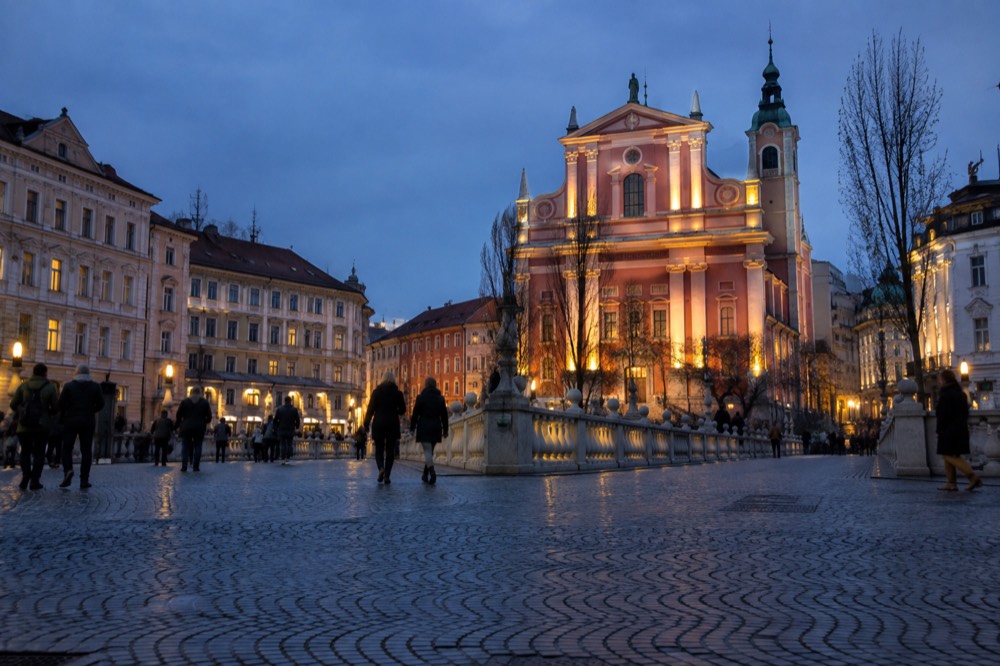
The time question is really a scheduling question, and it depends on what the square is doing when you arrive. On an ordinary weekday morning it is quiet by nine, busy by eleven, and at its most crowded between midday and late afternoon, when the tour groups cycle through. Early evening is softer, and after dark the church facade and the bridge are lit, which changes the photography entirely.
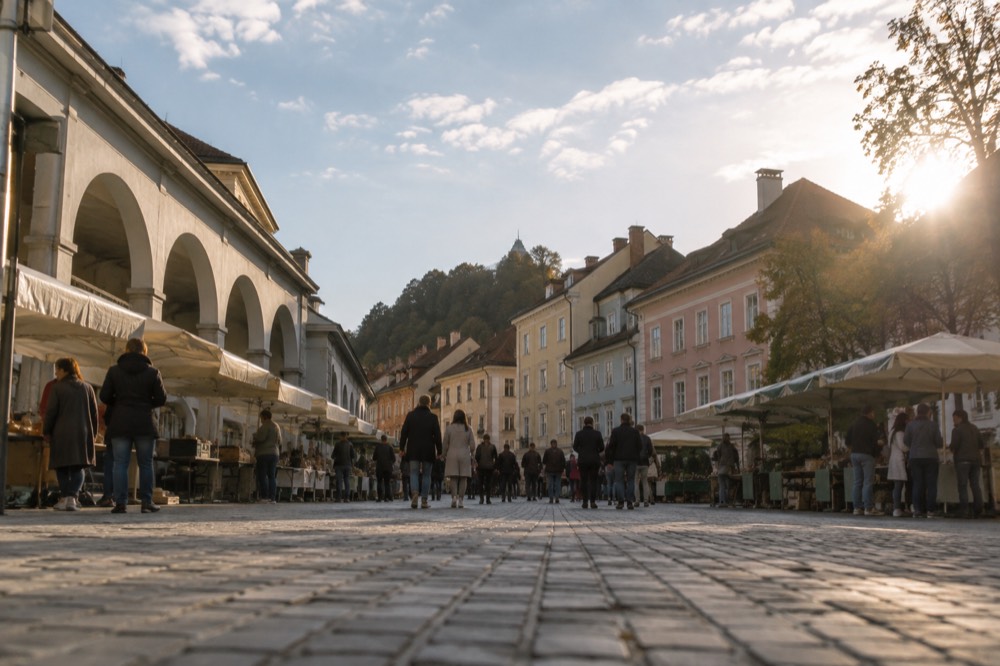
Fridays are the exception worth planning around. The Open Kitchen market, Odprta Kuhna, runs on Pogačarjev trg next to the central market, a few minutes' walk north, roughly from March to November, from 10:00 into the evening. The official wording is that it runs "every sunny Friday", which is literal: the market is cancelled in bad weather, so check before you build a Friday around it. When it runs, the whole riverbank area between the market and the square turns into the liveliest food scene in the city, and the square becomes the natural place to sit with whatever you have bought. The details, including the weather caveat, are on the Open Kitchen and Central Market pages.
A guided walk is the efficient answer if your time is short. The Classic Ljubljana Group Tour covers the square and the Old Town's headline sights with a guide, which compresses a morning of self-guided wandering into a single structured outing, and it pairs naturally with an afternoon at the castle or on the river.
When Is the Best Time of Day to Visit Prešeren Square?
Early morning, between 07:00 and 09:00, is the quietest time at Prešeren Square, with empty terraces and clean light on the church facade. Late afternoon and after dark are the most atmospheric, when the bridge and facade are lit and the café life picks up. Midday is the busiest window, when tour groups cluster around the monument and photography means waiting your turn. There is no bad hour, only different squares.
Morning has a practical advantage beyond the light. The square is the anchor of the pedestrianised centre, and the whole zone is closed to general motor traffic, so the calm of the early hours is real calm, not just thinning crowds. Anyone photographing the church facade or the Triple Bridge without strangers in the frame should be in position in the first hour after sunrise, especially at the weekend. The full index of guides sits on Ljubljana Travel Guide.
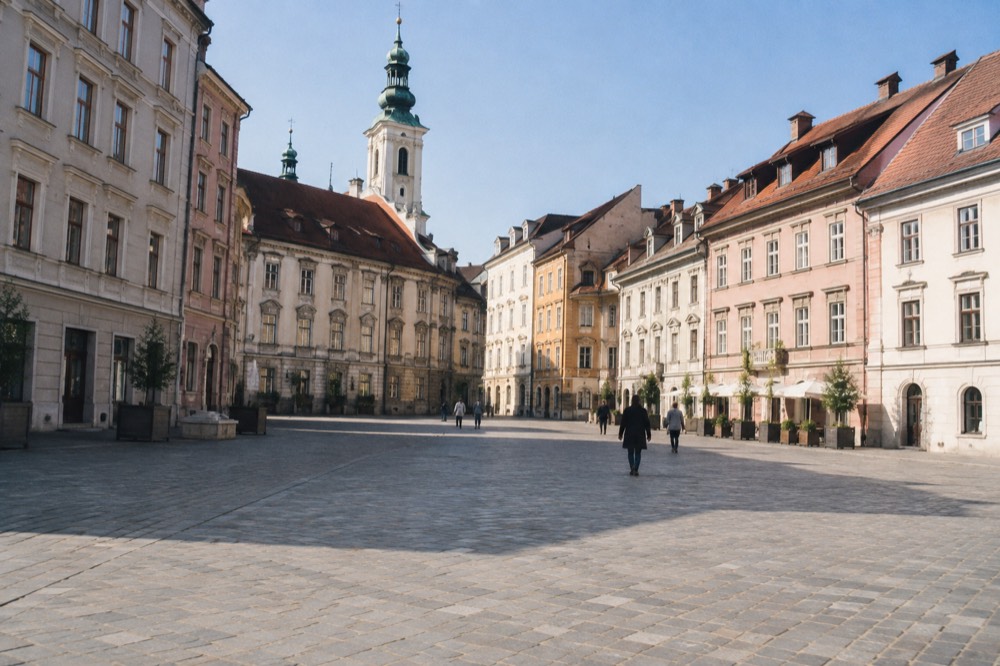
Evening changes the square's function more than its population. The cafés on the corners fill, the street musicians who work the pedestrian zone set up near the bridge, and the square shifts from a sight you look at to a place you sit in. This is also when the pub crawl route comes through, and the nightlife strip of the Old Town is a two-minute walk across the bridge. Our Ljubljana Nightlife page maps the rest of that evening.
The one time to be philosophical about is midday in high summer, when the square has almost no shade on its open centre and the crowds are at their thickest. The shade line along the church side and the riverbank moves through the afternoon, so if you are waiting out the heat, the shaded terrace rows are the place to do it.
| Time of day | Crowds | Light and atmosphere | Best for |
|---|---|---|---|
| 07:00-09:00 | Quietest of the day | Soft morning light on the church facade | Photography without strangers in frame |
| 09:00-12:00 | Building steadily | Bright, full sun on the square | A relaxed café stop before sightseeing |
| 12:00-17:00 | Busiest window | Harsh midday light, little shade in summer | Passing through, not lingering |
| 17:00-21:00 | Thinning, terraces filling | Warm evening light, then lit facade and bridge | Sitting, people-watching, evening walks |
| After 21:00 | Quiet again | Fully lit bridge and church, street musicians | Night photography, a calm loop of the centre |
Why Prešeren Square Can Be Grey: The Basin Fog Explained
Ljubljana sits in a basin, and in the colder half of the year cold air is trapped under warmer air above, so the city fogs in while the hills a few hundred metres up sit in sunshine. ARSO's climate normals record just 56 hours of sunshine in Ljubljana across the whole of December, against 120 hours at Kredarica at 2514 m on Triglav over the same month. A winter visit can find the square under low grey cloud while the castle hill above it is in the sun. The practical answer is to go up.
This is the single most useful piece of climate knowledge for anyone photographing the square, and almost no general guide mentions it. The inversion is real and measurable: the city's clear-day count across a whole year is 37, against 130 overcast days, and October and November each average a single clear day. The foggiest months are not midwinter, either. ARSO's 1971-2000 normals put September and October at 12.4 fog days each, level with December and above January's 11.3, so the early-autumn shoulder season is just as grey as deep winter, a fact most seasonal advice gets wrong.
What this means for the square specifically is that a flat, low, open space shows the weather at its most honest. When the basin is capped, the church facade disappears into grey from a hundred metres away, and the castle silhouette vanishes entirely. The fix is altitude: the funicular ride up to the castle, the walk up Šmarna gora, or a day trip to Lake Bled all put you above the inversion layer. The funicular and the castle tower are paid, the grounds are free, and the view from the ramparts on a foggy morning is often the only clear view in the city.
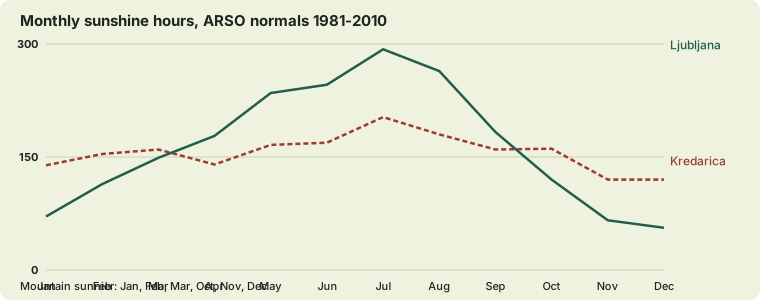
The chart above is the whole story in one image: the city wins the summer by a distance, and loses every winter month. If your visit falls between October and March, plan the square for the afternoon, when the fog has often thinned, and put the morning somewhere above the basin.
Eating and Drinking Around Prešeren Square
The streets within five minutes of Prešeren Square hold the densest concentration of cafés, restaurants and bars in Ljubljana, from the corner terraces on the square itself to the riverside rows across the Triple Bridge. Expect to pay city-centre prices for the privilege of the location: the square's terraces are where you pay for the view as much as the coffee. Two streets back, the same meal costs noticeably less.
The square's own corners are the classic move: order a coffee at a terrace table, sit for an hour and watch the whole city walk past. This is genuinely one of the best people-watching seats in Slovenia, because the square is the hinge between the pedestrianised centre and the Old Town, and nearly everyone passes through it. The trade-off is price, and it is a fair one if you treat the table as a seat for the show.
| Option | Where | Best for |
|---|---|---|
| Square terraces | On the square itself | Coffee, cake, people-watching at the crossroads |
| Riverside rows | Across the Triple Bridge | Lunch and dinner with a river view |
| Central Market | A few minutes north | Daytime produce, bakery stalls, Friday street food |
| Open Kitchen | Pogačarjev trg, Fridays | Street food from Slovenian kitchens, March to November |
| Old Town side streets | Beyond the bridge | Cheaper meals away from the front-row prices |
For a deeper food experience, the guided options all pass within a street of the square. The Slovenian Cuisine Walking Tour with Tastings runs four hours of tastings through the centre, and the free GuruWalk walks, including the tips-based Old Town walk from Roman roots to the Dragon Bridge, use the square as a natural waypoint. The full food picture, from štrukelj to the craft beer scene, is on our Where to Eat in Ljubljana and Slovenian Food in Ljubljana pages.
One food-and-drink experience starts close enough to the square to mention here: the wine tasting with appetizers runs as a silent electric boat ride along the Ljubljanica, boarding within a short walk of the bridges. Two hours, Slovenian wines, and a perspective on the square from the water rather than the pavement.
How Prešeren Square Fits Into a First Day in Ljubljana
Prešeren Square works best as the anchor of a first day: start here in the morning, cross the Triple Bridge into the Old Town, loop back through the Central Market, then take the funicular or the footpath up to Ljubljana Castle for the afternoon view. That circuit covers the square, the river, the market and the castle in a single walkable loop of a few kilometres, with the square as the natural place to pause between each leg. Nothing on it requires a vehicle.
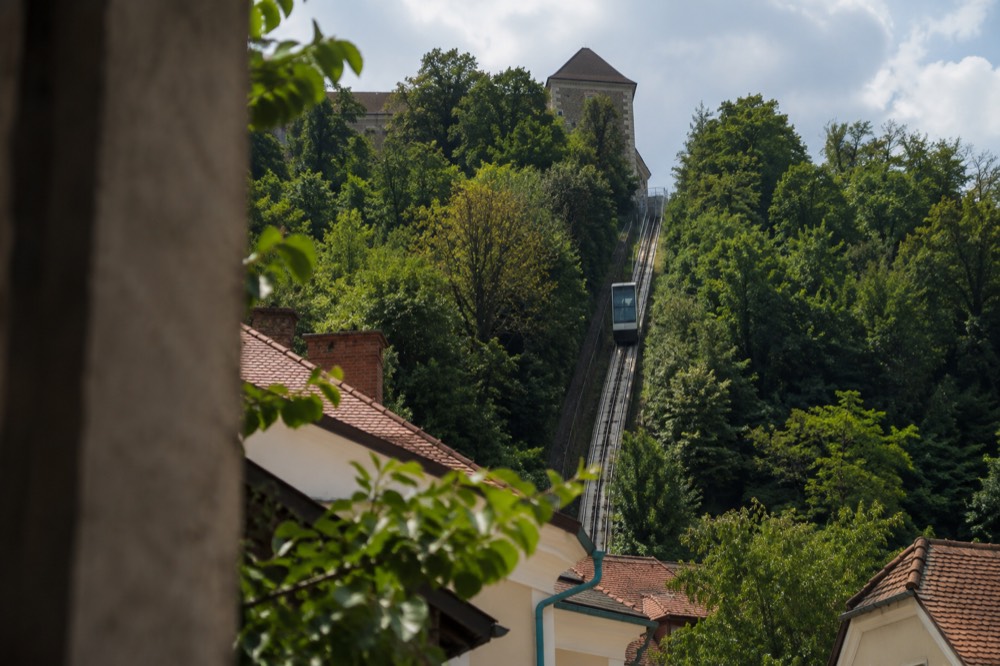
The square-to-castle leg is the one with a real choice in it. The funicular from near the river base costs 3.30 EUR for a single adult ride or 6.00 EUR return, and a castle ticket including the funicular is 19.00 EUR. The alternative is the footpath up through the woods, which is free and takes a steady fifteen to twenty minutes uphill. The full price breakdown, including the child rates and the seasonal hours, is on our Castle Funicular page.
Getting to the square in the first place is straightforward because the centre is pedestrianised. City buses stop on the ring around the old core, a single zone 1 ride costs 1.50 EUR and covers 90 minutes including transfers, and, the detail most guidebooks have out of date, cash is not accepted on board: you need an Urbana card, a contactless bank card or a mobile wallet. The Ljubljana Card folds unlimited bus travel in with the funicular, the river cruise and museum entries, which is worth doing the arithmetic on before you buy anything separately. The comparison is on our Ljubljana Card page.
The boat cruise and walking tour combination is the other natural pairing with the square: a walking leg through the centre followed by a river leg past it, two and a half hours in total, with the square visible from the water on the bend. It suits visitors who want the guided commentary but would rather not commit a full day.
For a longer stay, the square is also the departure logic for day trips: the coach and rail connections to Lake Bled, Postojna Cave and the coast all leave from stations within a twenty-minute walk, and the Day Trips page maps which ones are worth the journey. Most visitors average about two nights in Ljubljana, which is enough for the square-and-castle day plus one day trip, and the itineraries on our One Day in Ljubljana page build exactly that.
If you would rather hand the first day to a guide, the Classic Ljubljana Group Tour starts from the city's core and covers the square, the bridges and the Old Town's main sights in one structured walk. It is the tour we point first-time visitors at, and it leaves the afternoon free for the castle or the river.
Common Questions About Prešeren Square
Is Prešeren Square free to visit?
Yes. The square is an open public space in the pedestrianised centre, and it costs nothing to walk through, photograph or sit in at any hour. The paid sights are the ones around it: the castle funicular and tower, and any guided tour you choose to join.
How much time do you need at Prešeren Square?
Between 20 and 45 minutes for a first pass with photos, an hour if you sit at a café terrace, and longer on a Friday when the Open Kitchen food market is running a few minutes' walk north. The square itself is crossed in under five minutes.
What is the best time of day to photograph Prešeren Square?
Early morning, between 07:00 and 09:00, for empty paving and soft light on the church facade, or after dark for the lit bridge and facade. Midday brings the thickest crowds around the monument, and in winter the basin fog can hide the church facade entirely.
How far is Prešeren Square from Ljubljana Castle?
The castle sits on the hill directly above the square. The funicular base is a few minutes' walk away, the ride up is under a minute, and the free footpath alternative takes about fifteen to twenty minutes uphill. The castle silhouette is visible from the square itself.
Can you see the Triple Bridge from Prešeren Square?
Yes, the Triple Bridge forms the south-west edge of the square, carrying pedestrians across the Ljubljanica to the Old Town. It is one of the five major landmarks visible from the square's centre without moving.
Is Prešeren Square crowded?
It is busiest between midday and late afternoon, when tour groups cycle through, and quietest in the first two hours of the morning. Fridays from March to November add the Open Kitchen market crowds to the neighbouring square in the afternoon and evening.