Franciscan Church of the Annunciation: What to See at Prešeren Square's Pink Landmark
The Franciscan Church of the Annunciation is the pink-fronted church that anchors Prešeren Square, the busiest open space in Ljubljana. This guide covers what it is, how to see it, and how it fits into a day in the city.
Short answer
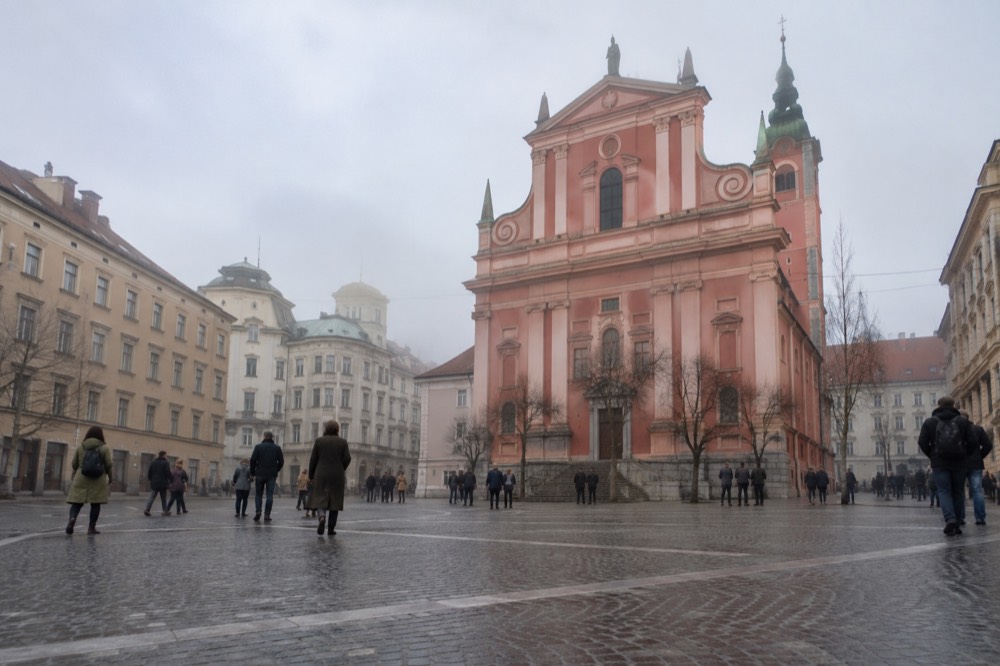
The Franciscan Church of the Annunciation is the pink-and-cream Baroque church at the head of Prešeren Square, Ljubljana's central pedestrianised hub. It faces the Triple Bridge over the Ljubljanica and sits at the junction of the old town and Čopova ulica. Entry to the church is free, it is open daily, and most visitors spend between ten and thirty minutes inside.
What Is the Franciscan Church of the Annunciation?
The Franciscan Church of the Annunciation is a Roman Catholic church run by the Franciscan order, and it is the single most photographed building on Prešeren Square, the main square of Ljubljana. Its pink-red facade, twin spires and rooftop dome define the skyline view that most visitors capture from the Triple Bridge, and its steps are where the city's street life gathers day and night. It is a working church rather than a museum, so visiting costs nothing and takes as little as ten minutes.
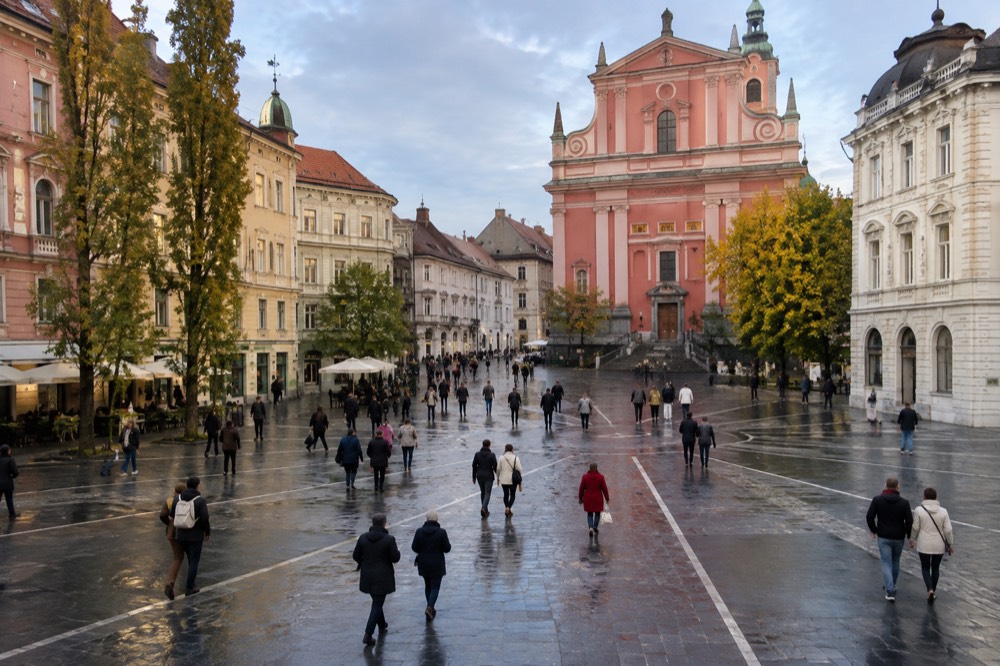
The church is the square's visual anchor. Stand anywhere on Prešernov trg and the pink frontage fills the frame; stand on the steps looking the other way and you look down the square towards the monument to France Prešeren, Slovenia's national poet, and across the Ljubljanica to the old town. The building's colour is the thing people remember. It is a warm reddish pink that shifts with the light, flat and chalky at midday, deep and almost terracotta at sunset.
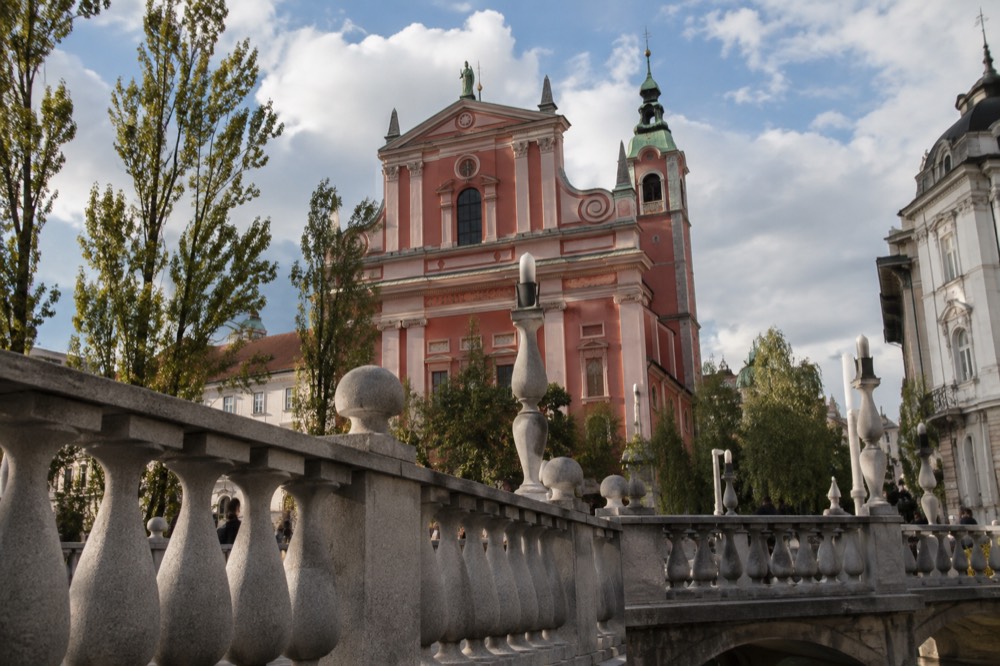
Because the church sits at the point where Prešeren Square meets the river, it appears in almost every walk through the centre. The pedestrianised old town, the Triple Bridge, and Čevljarski most, the shoemakers' bridge, all sit within a couple of minutes on foot. Most first-time visitors pass it several times a day without planning to.
The church is also a genuine place of worship. Mass is held here for the local Catholic community, and the interior is quieter and darker than the bright exterior suggests. If a service is running when you arrive, the respectful move is to wait outside; the steps themselves are a destination in their own right, and the square never runs out of things to watch.
Where Is It, and How Do You Get There?
The church stands on the western edge of Prešeren Square, at the point where the square meets the Ljubljanica and the Triple Bridge. The entire historic centre of Ljubljana is pedestrianised, so almost everyone arrives on foot. From anywhere within the old town ring you are at most ten minutes' walk away, and the square is the reference point taxi drivers, hotel staff and bus routes all use when giving directions.
Ljubljana's centre is closed to general motor traffic, a pedestrian zone of roughly 20 hectares that has been progressively expanded since 2007, as the city's own mobility pages set out. That single fact shapes every visit. You do not drive to the church, you park at the edge of the zone or arrive [by bus](https://busbud.tpk.ro/4kLAIElq) and walk in, and the walk is flat, short and along the river for most of the way.
If you are staying further out, city buses drop you within a few minutes' walk. The useful transport facts are few and firm. A single ride on an LPP city bus costs 1.50 EUR with a 2.00 EUR Urbana card, covers 90 minutes including transfers, and cash is not accepted on board, though contactless bank cards and phones now are. The [Ljubljana Card](/guides/ljubljana-card/) covers city buses along with the river cruise and the castle funicular, which matters if you plan to use the bus more than twice.
| Way of arriving | What to know | Cost |
|---|---|---|
| On foot from the old town | The centre is pedestrianised; the walk is flat and under ten minutes from anywhere in the ring | Free |
| City bus (LPP) | 1.50 EUR a ride, 90 minutes including transfers; no cash on board, contactless cards accepted | 1.50 EUR plus 2.00 EUR card if you want one |
| Taxi or transfer | Cars stop at the edge of the pedestrian zone; the square is the standard drop-off reference | Fare by meter |
| Bike share | The Ljubljana Card includes bike share; stands sit around the centre's edge | Included with the card |
For a first orientation, the free walks are hard to beat. The Old Town walk from Romans to Dragons on GuruWalk is a tips-based, two-hour route that starts in this exact part of the city and covers the square, the bridges and the dragon landmarks in one loop. It costs nothing up front, you pay what you think it was worth, and it is a sensible thing to do on day one before you explore on your own.
The square also works as a meeting point. Locals arrange to meet "at Prešeren", by the poet's statue, and the church steps serve as the overflow bench whenever the statue itself is crowded. If you are joining any walking tour in the centre, this is the most likely starting point you will be given.
Can You Go Inside, and What Will You See?
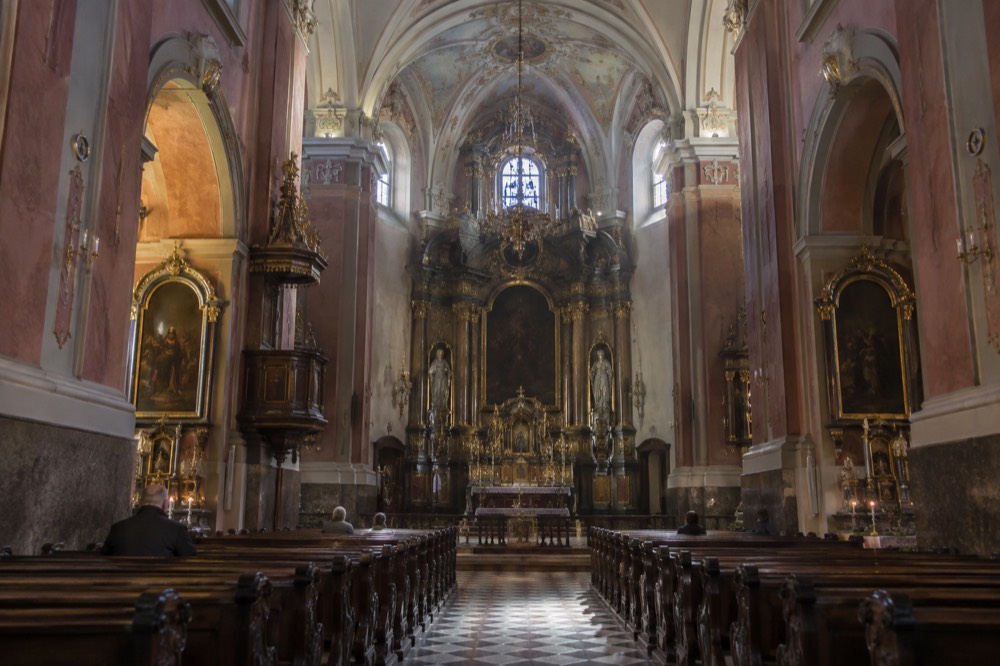
Yes, the church is open to visitors and entry is free, subject to services. Inside you will find a single nave considerably darker and cooler than the bright pink exterior suggests, an ornate high altar, and a quiet that contrasts sharply with the square outside. Most visitors spend ten to thirty minutes. Photography is tolerated when no service is running, but the space is small and fills quickly, so early morning is the comfortable hour.
The interior is the surprise for most people. The outside is all colour and theatricality; the inside is dim, vaulted and close, with the altar as the focal point. The contrast is deliberate and typical of the period, pulling the visitor from a bright civic square into a darker devotional space in a few steps.
Practical etiquette is simple. Dress as you would in any working church, keep your voice down, and if a Mass is in progress, wait. The church's congregation uses this building continuously, and the tourist flow through the doors is heavy in summer, so the quieter you are the longer you will be welcome. There is no ticket desk and no queue in the usual sense; the only waiting is for the space itself to clear.
The steps outside are arguably the bigger attraction. They face down the square, catch afternoon sun, and function as Ljubljana's front row. Street musicians set up below them, tour groups assemble around them, and in December the Christmas market stalls close in around them. If you want one photograph that says Ljubljana, the classic composition is taken from the Triple Bridge, looking back at the pink facade with the square's life in the foreground.
| Practical point | Detail |
|---|---|
| Entry | Free; it is a working parish church |
| Typical visit | 10 to 30 minutes |
| Best hour | Early morning, before the square fills |
| During services | Wait outside; the steps are worth the pause |
| Classic photo spot | From the Triple Bridge, facade framed over the Ljubljanica |
How Does the Church Fit Into Prešeren Square?
The church and the square function as one space: the facade closes the western side of Prešernov trg, the Prešeren monument stands opposite it, and the Triple Bridge carries the eye from the square across the Ljubljanica into the old town. This is the busiest pedestrian junction in the city, and everything in the centre, the bridges, Čopova ulica, the market and the castle, radiates out from here.
Prešeren Square is less a square in the formal sense than a widening of the city's walking routes, and the church is the wall that stops the space from bleeding into the streets behind it. The poet's statue anchors the middle. The Triple Bridge, Jože Plečnik's triple-set of crossings, anchors the river side, and you can read more about that crossing in our Triple Bridge guide.
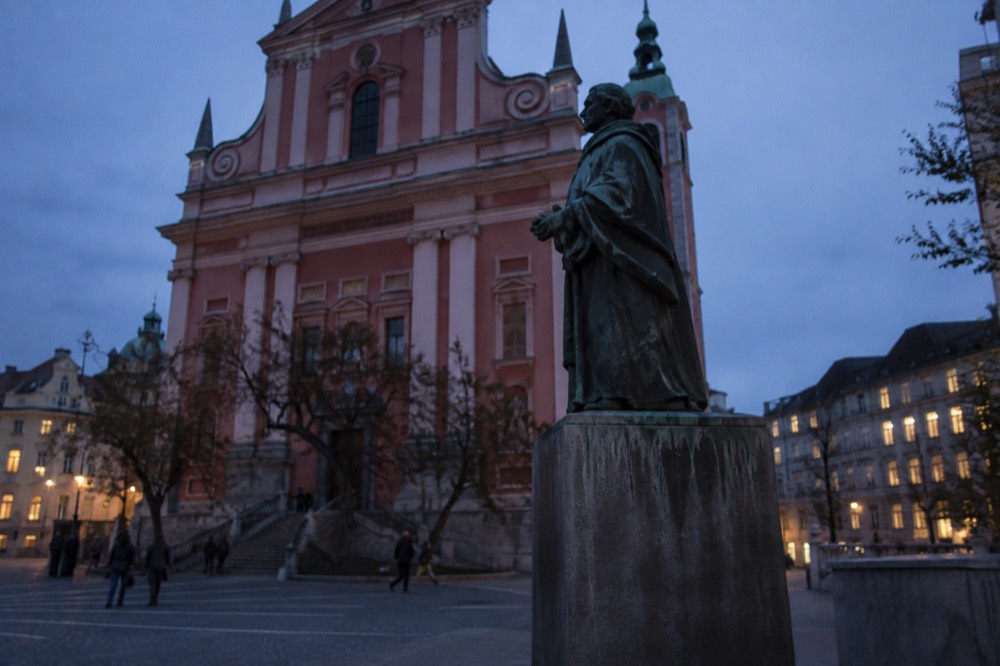
From the square, the walking options open in every direction. Čopova ulica runs straight back from the church towards the park at Tivoli, a long, café-lined pedestrian street. Downstream, the riverside leads past Čevljarski most to the Central Market colonnade and the funicular base for Ljubljana Castle. Upstream, Trnovo and the quieter stretches of the Ljubljanica wait for anyone with an hour to spare.
The square is also where the city's calendar happens. In December the Christmas market radiates from here. On Fridays from roughly March to November, the Open Kitchen food market runs on nearby Pogačarjev trg, and the official wording is "every sunny Friday", which is literal: bad weather cancels it. If your visit lands on a clear Friday, the square, the church steps and the food stalls together make the single best evening the centre offers.
If the square fills your morning, the afternoon opens up the country. The karst region begins barely half an hour south of the city, and the most-booked way into it from Ljubljana is the combined cave and castle day trip.
When Is the Best Time to Visit and Photograph It?
Early morning and the hour before sunset are the two windows that matter. In the morning you get the square nearly empty and the facade in flat, clean light; in the late afternoon the pink frontage deepens and the Triple Bridge view becomes the postcard shot. Midday works but delivers harsh light and the day's biggest crowds, and in winter the basin fog can swallow the facade entirely, which is its own kind of photograph.
The light on this building changes its character completely, so it is worth timing a visit around it rather than passing at random. Morning light comes from the east over the old town, softening the facade. Late afternoon and evening sun strikes it directly and pushes the pink towards terracotta, and the steps fill with people watching the square. The rest of the planning pages sit on Ljubljana Travel Guide.
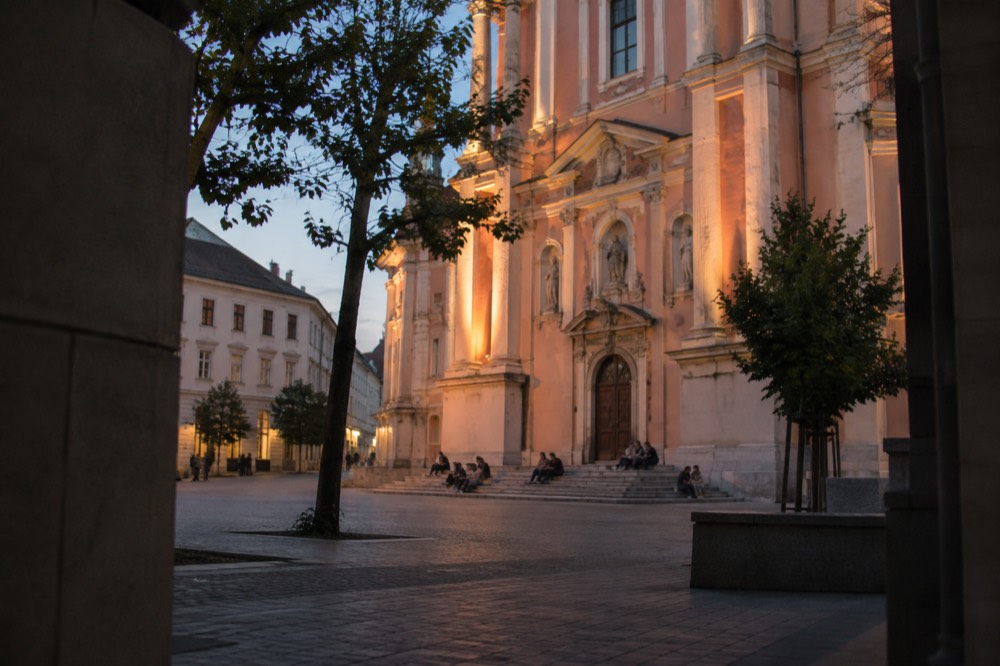
Crowd patterns are predictable. The square is busiest from late morning through the afternoon, exactly the window when most walking tours pass through. If an empty frame matters to you, arrive before nine. If a lively frame matters, come after five in the warmer months, when the terrace chairs spill out and the street musicians start.
Winter deserves a special word. Ljubljana sits in a basin, and in the colder half of the year the city fog sits under a temperature inversion while the hills above it stay in sunshine. The facade emerging from fog, half visible above the square, is a genuinely local image, and one that most visitors never plan for because most guides never mention it.
| Time of day | Light on the facade | Crowds |
|---|---|---|
| Before 09:00 | Soft, flat, clean | Square nearly empty |
| Late morning | Bright, high contrast | Peak walking-tour traffic |
| Mid-afternoon | Warm, direct | Busy but thinning |
| Golden hour | Deep pink to terracotta | Steps full, lively |
| Foggy winter morning | Diffused, atmospheric | Very quiet |
Why Does Ljubljana's Fog Matter to Your Visit?
Ljubljana averages 91.2 days with fog a year, and the foggiest months are September and October at 12.4 fog days each, level with December and above January, according to ARSO's 1971-2000 climate normals. That surprises visitors who assume midwinter is the grey season. For the church and the square it means the shoulder season can hide the facade, while the hills a few hundred metres up sit in sunshine.
This is the detail most guides miss. The city records 12.4 fog days in September and 12.4 in October, against 11.3 in January, and September is also the most humid morning of the year at 94 percent relative humidity at 07:00. The same 1981-2010 table makes September and October the joint wettest months at 147 mm each, above July's 115 mm. Autumn in Ljubljana is not the dry shoulder season people assume.
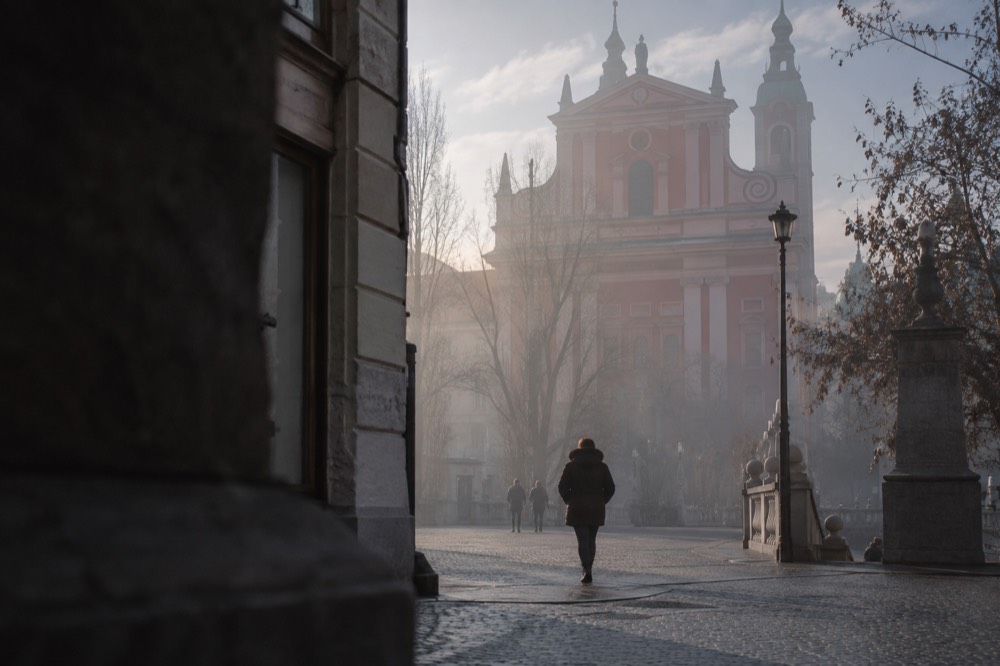
The reason is the basin. Cold air is trapped under warmer air above, so the city sits under fog and low cloud while the high ground above it is in sun. ARSO's own numbers make the point starkly: Ljubljana gets 56 hours of sunshine in the whole of December, under two hours a day, while Kredarica at 2514 m on Triglav gets 120 hours over the same month. Annually the city manages 37 clear days against 130 overcast.
For a photographer, this cuts both ways. A foggy morning costs you the postcard shot and hands you something rarer: the pink facade dissolving into grey above an almost empty square. For a planner, it means a September visit should carry a fog contingency, and the best fog-day answer is to go up, to the castle viewing tower, to Šmarna gora, or up the valley to the Julian Alps where the inversion ends.
What Is Near the Church, Within a Short Walk?
Almost everything in central Ljubljana is within ten minutes of the church steps. The Triple Bridge is directly in front of it, the Central Market colonnade and the funicular base are under five minutes away, and the old town's lanes, the cathedral, and the riverside cafés all sit inside the same small pedestrianised pocket. The church is the natural anchor for a walking loop of the entire centre.
The centre rewards walking above all other transport, and the church is the most convenient anchor point for it. A loop that covers the essentials takes under two hours at a stroll: out over the Triple Bridge, right along the river to the market, up to the castle by funicular or on foot, and back down through the old town lanes to the square.
| Nearby sight | Walking time from the church | What it offers |
|---|---|---|
| Triple Bridge and the Ljubljanica | Directly in front | Plečnik's crossings, river views, boat departures |
| Central Market colonnade | Under 5 minutes | Plečnik's riverside market halls, produce stalls |
| Ljubljana Castle funicular base | About 5 minutes | The ride up to the castle hill and viewing tower |
| Ljubljana Cathedral | About 7 minutes | Baroque cathedral in the old town lanes |
| Čopova ulica | Starts beside the church | Café-lined pedestrian street towards Tivoli park |
The river itself is the other half of the visit. The Ljubljanica boat trips depart from piers minutes from the square, and the 50-minute electric boat tour runs past the church's river frontage, the bridges and the old town banks. The two-and-a-half-hour boat cruise and walking tour pairs the river with the lanes behind the square, which is the most efficient way to cover both halves of the centre in one booking.
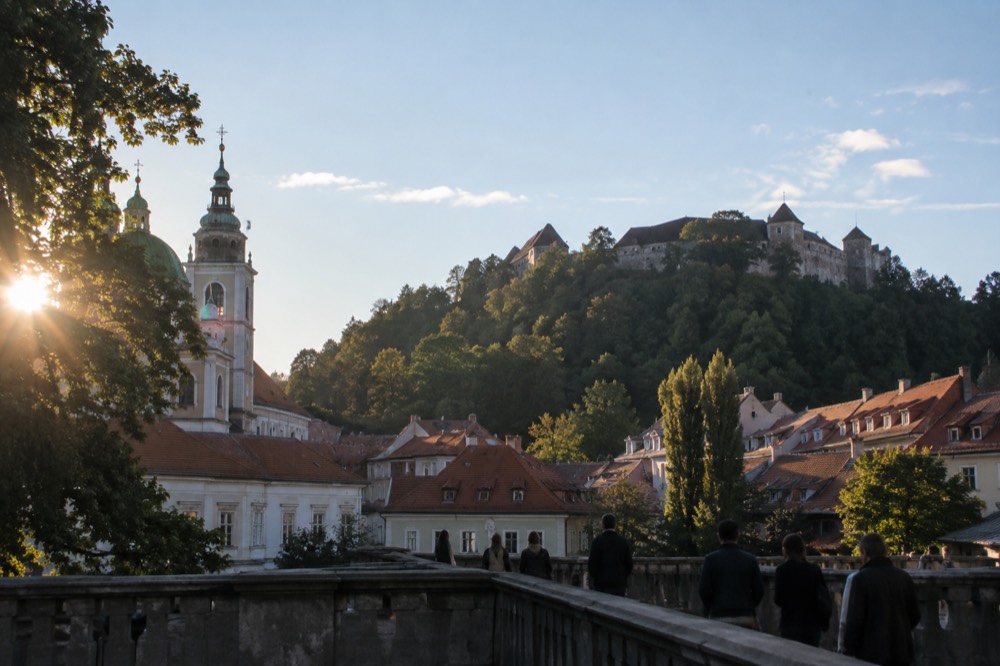
The castle completes the triangle. The hill is visible from the square, and the funicular base sits just along the river. The castle grounds are free to enter; the funicular, the viewing tower and the exhibitions are not, so know which part of the castle you are paying for before you queue. The skip-the-line castle entry ticket with optional funicular ride is the straightforward way to handle it.
Which Tours Pair Well with a Visit?
The church needs no ticket and no booking, so tours pair with it as add-ons rather than as access. The strongest pairings are a free GuruWalk tips-based walk for the city's stories, a river cruise or boat-and-walk combination for the water-level view, and a half- or full-day trip to Lake Bled or Postojna Cave once the centre is done. Most visitors spend one or two days in the city, so the pairing question is really a scheduling question.
Ljubljana is a two-night city: 2,844,129 overnight stays across 1,392,728 arrivals in 2025 works out to an average stay of about 2.04 nights. That is enough for a full day in the centre, including this church and everything around it, plus one big day trip. The trio below covers the three most-booked ways to spend that out-of-town day, and the free walk covers the in-town half.
| Option | Duration | Rating | From | Best for |
|---|---|---|---|---|
| Postojna Cave and Predjama Castle, tickets and tour | 6 hours | 4.8 from 2802 reviews | $132 | The karst in one easy day |
| Lake Bled and Bled Castle trip | 6 hours | 4.7 from 1641 reviews | $86 | Slovenia's most famous lake |
| Old Town walk on GuruWalk, Romans to Dragons | 2 hours | 4.91 from 1496 reviews | Free, pay what it was worth | Day-one orientation from the square |
The cave day trip deserves its top spot. Postojna Cave holds about 10 C year round, which makes it the reliable answer in any weather, and the six-hour combined tickets-and-tour option handles transport, the cave and the cliff castle at Predjama in one booking. Caves hold roughly the same temperature in every season, so the trip works in a foggy October exactly as well as in July.
If the lake calls instead, the Bled trip is the same six-hour shape, and the Lake Bled guide covers what to do when you get there. Whichever you choose, book the morning slot: both trips return in time for an evening on the church steps, which is where the day in Ljubljana tends to end anyway.
Common Questions About the Franciscan Church of the Annunciation
Is the Franciscan Church of the Annunciation free to enter?
Yes. It is a working Catholic church with no ticket desk, and entry is free. The only reason to wait is an ongoing service, and the steps outside are worth the pause in any case.
Can you photograph inside the Franciscan Church?
Generally yes when no service is running, but the interior is small and fills quickly, so be quick and quiet about it. The classic exterior shot is taken from the Triple Bridge, not inside.
How long should I spend at the Franciscan Church?
Ten to thirty minutes covers the interior. The square around it, the bridges and the riverside will hold you far longer, so treat the church as the anchor of a longer stop rather than a standalone sight.
What is the best time of day to photograph the church?
Before nine for an empty square, or golden hour when the pink facade deepens towards terracotta. In autumn, a foggy morning can produce the most atmospheric frame of all, with the facade dissolving into grey above the square.
How do I get to the Franciscan Church from my hotel?
On foot, almost certainly. The historic centre of Ljubljana is pedestrianised, and the square is the reference point for the entire centre. City buses cost 1.50 EUR a ride and do not take cash on board, though contactless cards work.
Is the church open on Sundays and holidays?
It is a working parish church, so Sundays are its busiest liturgical days. Visiting between services is still possible, but expect more activity than on a weekday, and step out quietly if a Mass begins.