Ljubljana Train Station and Rail Routes: A Practical Guide
Ljubljana Train Station is the country's main rail hub, sitting a ten minute walk from the pedestrianised old centre. This guide covers the station itself, the routes that leave it, and how to plan train day trips without inventing fares nobody publishes.
Short answer
Ljubljana Train Station (Železniška postaja Ljubljana) is Slovenia's main railway hub, about a ten minute walk north of the old centre. Direct routes reach Lake Bled, Postojna, the coast at Koper, Zagreb and Vienna. Slovenia is in the EU, the eurozone and Schengen, so there are no border checks or currency changes on most routes.
Ljubljana's rail network is small, national and surprisingly useful. The station sits at the northern edge of the centre, and from its platforms you can reach the Julian Alps foothills, the karst caves, the Adriatic coast and three neighbouring capitals without ever changing money or showing a passport. Slovenia joined the European Union on 1 May 2004, adopted the euro on 1 January 2007, and abolished internal land and sea border checks as a Schengen member on 21 December 2007, with air checks following on 30 March 2008. Practically, that means a train from Ljubljana to Zagreb, Trieste or Vienna is an internal journey: you buy a ticket, you board, you go.
This guide walks through the station itself, then the routes. One honest note up front: Slovenian rail does not publish a static fare table that can be read and verified from outside, and the national rail site blocks automated access. So where a fare or a journey time could not be sourced, this guide says so rather than guessing. Everything with a number in it comes from a verified primary source.
Where Is Ljubljana Train Station and What Is It Like?
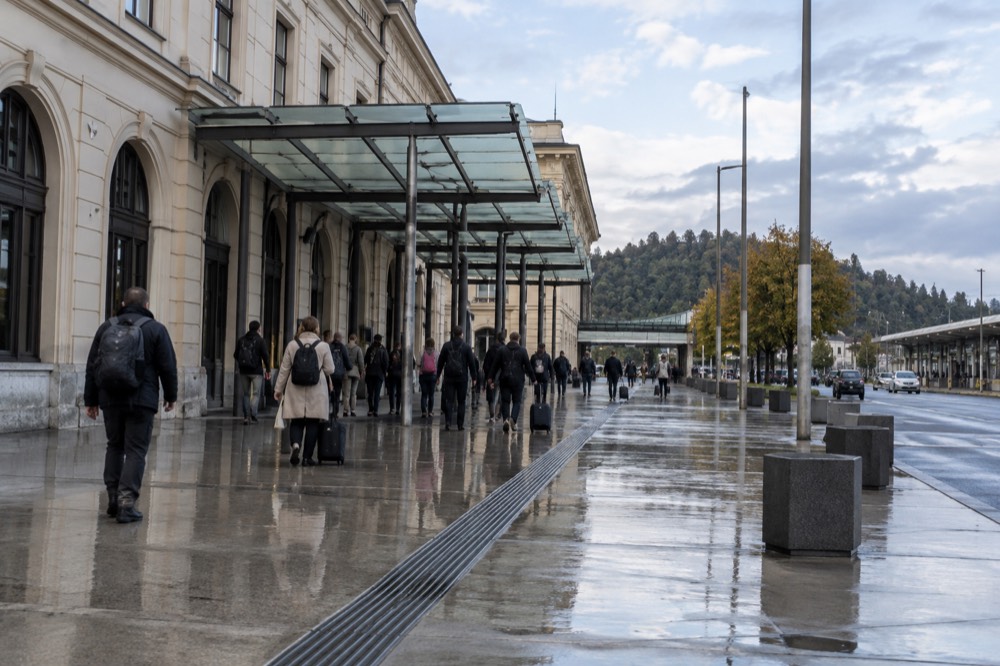
Ljubljana Train Station stands on Trg Osvobodilne fronte, at the northern edge of the city centre, roughly a ten minute walk from Prešeren Square and the Triple Bridge across the Ljubljanica. It is Slovenia's principal station and the hub of the national network, with the main bus station immediately alongside it, which makes it the single most useful transport address in the country for a visitor without a car.
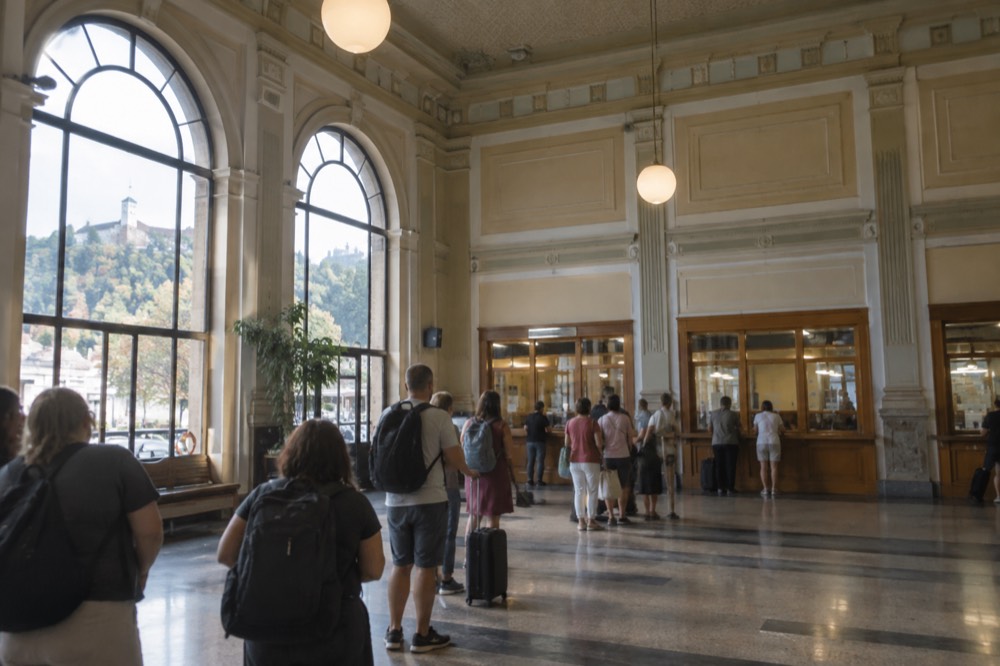
The station building is functional rather than beautiful: a low modernist hall with ticket windows, a left-luggage facility, kiosks and a couple of cafés, fronted by a long canopy over the bus interchange. What matters more than the architecture is the geometry. The old centre is pedestrianised, a car-free zone of roughly 20 hectares that has been progressively expanded since 2007, and the station sits just outside its northern edge. Walk south down Miklošičeva cesta and you are in the middle of it within minutes, passing grand Austro-Hungarian façades before the street spills onto Prešeren Square.
Because the centre is closed to general motor traffic, arriving by train is genuinely the relaxed option. There is no question of driving into the old streets, and the walk from platform to old town crosses no busy junction. If you are planning a car-free city break, the station is effectively your front door; our guide to getting around Ljubljana without a car covers the rest.
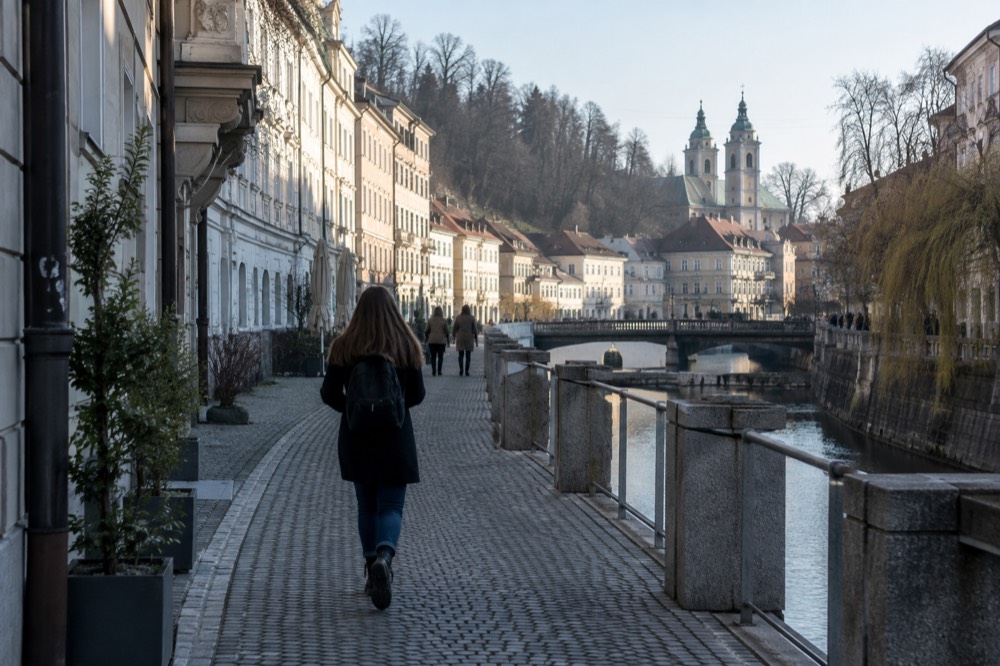
Facilities are modest but adequate. There are ticket counters and machines, an information point, toilets, a left-luggage office, and food options that range from kiosk coffee to a sit-down restaurant. Free Wi-Fi is available in the hall. The immediate area, sometimes called the station district, has been redeveloped in recent years and now carries hotels, offices and the modernist landmark of the Neboticnik skyline a few blocks south, though the rooftop viewing level's visiting rules are not published in any source we could verify, so do not plan around it.
For orientation, one detail saves confusion: the station's Slovenian name is Železniška postaja Ljubljana, and locals often just say "postaja". Taxi stands line the forecourt, and the main bus station shares the same square, which is why almost every long-distance coach departure in the country can be caught within a few minutes' walk of your platform.
Which Rail Routes Leave from Ljubljana?
The main direct routes from Ljubljana are: north to Jesenice and the Austrian border toward Villach and Vienna, northwest toward Lesce-Bled for Lake Bled, west to Postojna and the Italian border toward Trieste and Venice, southwest to the coast at Koper, east to Zidani Most splitting toward Maribor and Zagreb, and southeast toward Novo Mesto. Not every route runs hourly, so a timetable check before travelling matters more here than in larger countries.
Slovenia's network is a modest one by European standards, and Ljubljana is the spider at the centre of its web. The spine of the system runs east to Zidani Most, where the line splits toward Maribor in the northeast and Zagreb in Croatia to the southeast. Because Croatia joined both Schengen and the euro on 1 January 2023, the Zagreb route is now an internal journey too, with no routine border checks and no currency exchange at the far end.
Westward, the line climbs into the karst to Postojna, the station for the famous cave, then continues toward the Italian border and the port of Trieste. This is the route most visitors use for a cave day trip by rail, and it is the one with the most published information at the far end: Postojna Cave is open every day, including holidays, with adult entry at 34.90 EUR and a year-round cave temperature of 10 C, per the operator's own ticket page.
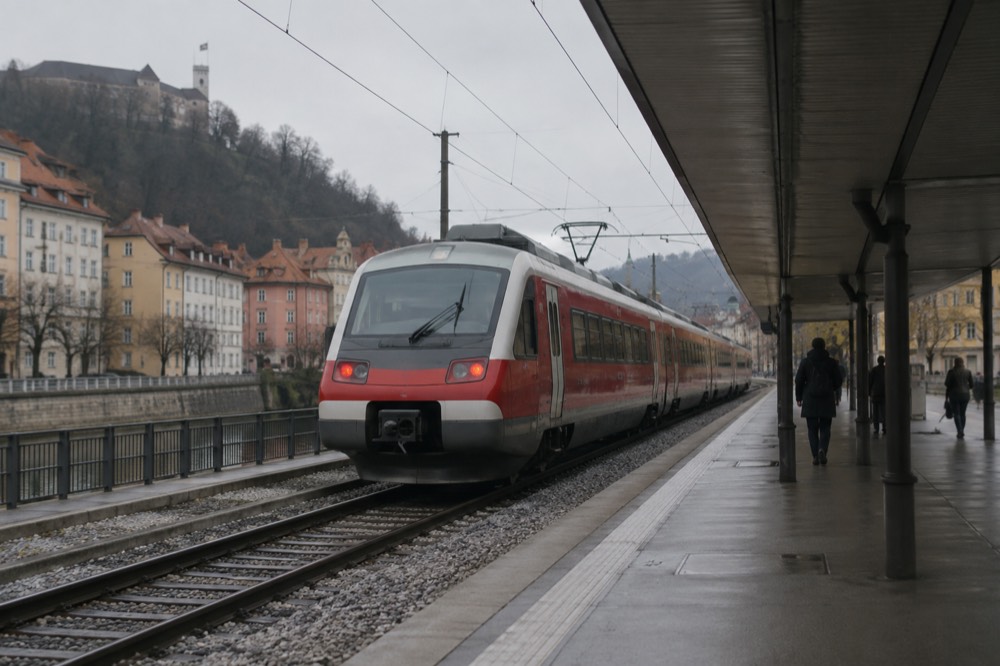
Northward, the line runs toward Jesenice and the Julian Alps, with Lesce-Bled the stop for Lake Bled. This route is covered in detail in its own section below, because the two-station question trips up a remarkable number of visitors. Beyond Jesenice the line crosses into Austria toward Villach, with onward connections toward Salzburg and Vienna.
Here is the route map in table form. Journey times and fares are deliberately omitted where no primary source publishes them: the rail operator's site returns an access error to automated reading, and we do not print numbers we could not verify.
| Direction | Route | Key stops | Notes |
|---|---|---|---|
| Northwest | Ljubljana to Lesce-Bled | Kranj, Naklo | The usual Lake Bled route; station is 4 km from the lake |
| Alternative | Bohinj line to Bled Jezero | Via Jesenice | Bled Jezero station is 1.5 km from the lake |
| West | Ljubljana to Sežana/Trieste | Logatec, Postojna, Sežana | Postojna is the cave stop; cross-border to Italy is internal Schengen |
| Southwest | Ljubljana to Koper | Postojna, Divaca | The coast route; Divaca is the junction for Škocjan Caves |
| East | Ljubljana to Zidani Most | Litera, Zidani Most | Splits toward Maribor and Zagreb |
| Southeast | Ljubljana to Zagreb | Zidani Most, Dobova | Croatia is in Schengen and the eurozone since 1 January 2023 |
| North | Ljubljana to Jesenice and Villach | Kranj, Lesce, Jesenice | Crosses into Austria; onward to Salzburg and Vienna |
A note on planning style: frequencies on the secondary routes drop sharply at weekends and in the low season, and the last departures on some branches leave earlier than you would expect. The full guide to trains from Ljubljana carries the route-by-route detail, and our piece on where Ljubljana trains actually go answers the same question for readers who just want the headline.
If reading timetables in a second language is not your idea of a holiday, the guided alternative is strong. The three options below cover the three most popular rail-adjacent day trips from the city, with a guide and transport handled for you.
How Do You Get from the Station to the City Centre?
The walk from Ljubljana Train Station to the old centre takes about ten minutes along Miklošičeva cesta to Prešeren Square, and it is flat, direct and signposted. City buses also connect the station to the wider city, using the Urbana card at 1.50 EUR a single ride for 90 minutes including transfers, with no cash accepted on board but contactless bank cards and mobile wallets working at the reader.
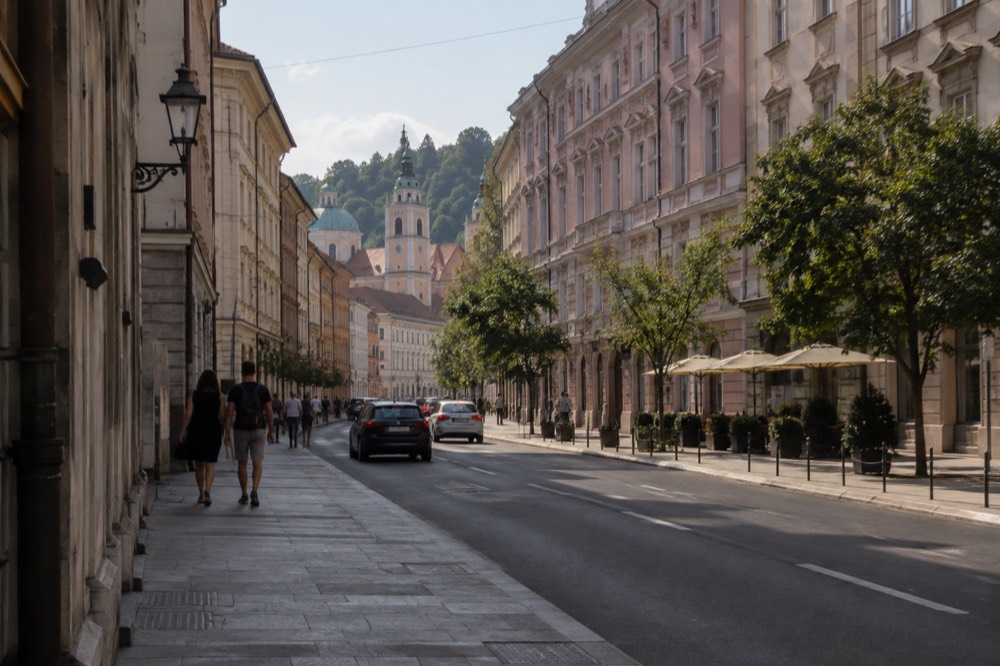
Most visitors simply walk. The station's position at the top of Miklošičeva cesta makes the route self-evident: head south, keep going, and the street delivers you to Prešernov trg with the Franciscan Church facing you across the square. From there the whole old town, the Triple Bridge and the Ljubljanica riverfront are within a couple of minutes on foot, as laid out in our old town walking guide.
If your hotel is further out, or you are carrying luggage, the city bus system is the fallback. The fare mechanics matter here: a single ride in zone 1 costs 1.50 EUR and covers 90 minutes including transfers, an Urbana card costs 2.00 EUR to buy if you want one, and crucially, drivers do not take cash. Contactless Visa, Mastercard and mobile wallets are accepted on board, which removes the old trap of being unable to board without a pre-purchased card. Cards and top-ups are available at the LPP Passenger Centre on Slovenska 56, at Urbanomat machines, kiosks, post offices and tourist information centres.
Taxis line the forecourt, and the airport is a separate matter: Ljubljana Airport (LJU) is about 26 km from the city, but the airport's own site blocks automated access, so we do not publish a bus fare, operator or timetable for that transfer. The safe statement is that an airport bus exists and its times should be checked before travelling; our airport to city centre guide covers the options honestly.
One planning fact that pairs well with a station arrival: tourist tax in Ljubljana is 3.13 EUR per person per night, comprising 2.50 EUR of tax plus a 0.63 EUR promotion surcharge, with a half rate of 1.57 EUR for ages 7 to 18 and children under 7 exempt. It is charged at accommodation, not at the station, but it belongs in any arrival budget.
| From the station to | Distance or fare | Best option |
|---|---|---|
| Prešeren Square and the old town | About a 10 minute walk | On foot, down Miklošičeva cesta |
| Ljubljana Castle | Walk then funicular or climb | Walk to the old town first; funicular details in our castle funicular guide |
| Anywhere in zone 1 by bus | 1.50 EUR per ride, 90 minutes | Contactless card on board; no cash |
| Airport (LJU) | About 26 km | Bus exists, times unverified; check before travelling |
| Main bus station | Same square, a short walk | Walk |
The castle deserves one clarification here because it is the most common first destination from the station: the castle grounds and the castle itself are separate things in every published price list, and the combined castle ticket with funicular is 19.00 EUR for an adult, per the castle's official price page. The full castle guide explains what is free and what is not.
If a morning arrival has you standing on the forecourt wondering what to do with a half-empty afternoon, the guided walk below collects the old town's main sights in two hours and starts close to where you are standing.
Ljubljana to Lake Bled by Train: Which Station Do You Need?
Trains from Ljubljana toward Lake Bled serve Lesce-Bled station, which is 4 km from the lake, while the separate Bohinj line serves Bled Jezero station, just 1.5 km from the water on the lake's western shore. Most rail advice sends everyone to Lesce-Bled, but Bled Jezero is the closer station if your train happens to run on the Bohinj line, and the two are on different routes entirely.
This is the single most useful rail fact in the country, and it is widely got wrong. The main line north from Ljubljana runs through Kranj to Lesce-Bled, a station on the plain south of the lake. From there it is a 4 km hop to the shore, covered by local bus or taxi. But a second line, the Bohinj line, loops around the north of the Julian Alps and carries its own Bled station, Bled Jezero, on the lake's western edge, 1.5 km from the water. Both figures come from the official Bled destination site's own rail page.
The practical consequence: check which line your departure uses before assuming a long walk at the far end. The Bohinj line also continues to Lake Bohinj, one of Slovenia's most beautiful alpine lakes and a destination in its own right; our Lake Bohinj guide and the comparison piece on Bled versus Bohinj cover that decision.
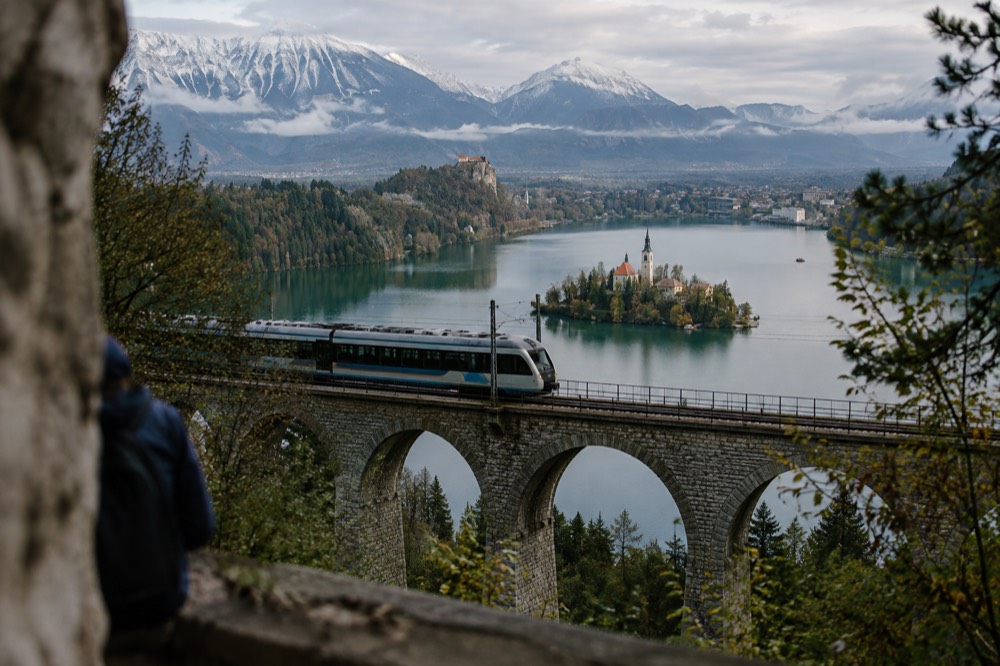
What we deliberately do not print: the Ljubljana-to-Bled train fare and journey time. Neither the rail operator nor any primary source publishes a static, verifiable fare table, and the rail site returns an access error to automated reading. The journey is short and the trains are frequent on the main line, but the numbers belong to the operator's own booking system, so check there.
At the lake end, the published figures are solid. Bled Castle entry is 19.00 EUR for an adult, the traditional pletna boat to the island is 20 EUR per person, and the electric Bled Boat Line is 16 EUR per person, all from official sources. The dedicated Ljubljana to Lake Bled guide and the blog piece on the train from Ljubljana to Lake Bled assemble the full picture.
| Bled rail fact | Figure | Source status |
|---|---|---|
| Lesce-Bled station to lake centre | 4 km | Official destination site |
| Bled Jezero station to lake shore | 1.5 km | Official destination site |
| Ljubljana to Lesce-Bled fare | Not published in a verifiable static source | Check with the operator |
| Ljubljana to Lesce-Bled journey time | Not published in a verifiable static source | Check with the operator |
| Bled Castle, adult | 19.00 EUR | Official castle price list |
| Pletna boat to the island, per person | 20 EUR | Official destination site |
| Bled Boat Line, per person | 16 EUR | Official destination site |
If the two-station dance sounds like more planning than a holiday needs, the guided day trip below handles the whole thing, and there is a fuller comparison of guided versus independent Bled travel in our Lake Bled guide.
What Can You Day Trip to by Train from Ljubljana?
The strongest train day trips from Ljubljana are Lake Bled, Postojna Cave, the Škocjan Caves via Divaca, the coast at Koper, and Zagreb, with Vienna, Trieste and Venice reachable as long day trips or overnight stops. Every one of these routes is an internal Schengen journey, and the caves hold roughly the same temperature year round, which makes them the reliable answer on a wet or sweltering day.
Start with the karst. Postojna is a direct westbound ride, and the cave at the far end is open every day of the year with adult entry at 34.90 EUR and a constant internal temperature of 10 C. That 10 C figure is the most useful sentence in this entire section: visitors arrive in August in shorts and are cold for ninety minutes, so carry a layer. The tour route covers 3.7 km, partly by the underground cave train, and lasts about an hour and a half, with boarding 15 minutes before the stated departure time.
The alternative cave is Škocjan, a UNESCO World Heritage site inscribed on 28 November 1986, reached via Divaca on the coast line. Škocjan is a walk rather than a train ride inside the mountain: the tour runs about 2h30 to 3 hours, covers roughly 2 km and around 400 stairs, and holds at 12 C. Seasonal pricing runs from 16.00 EUR for an adult in the January-to-March and November-December window up to 24.00 EUR in July and August. The honest differentiator is that Postojna is spectacle by rail, Škocjan is a hike through a canyon, and our Postojna and Škocjan guides carry the full comparison.
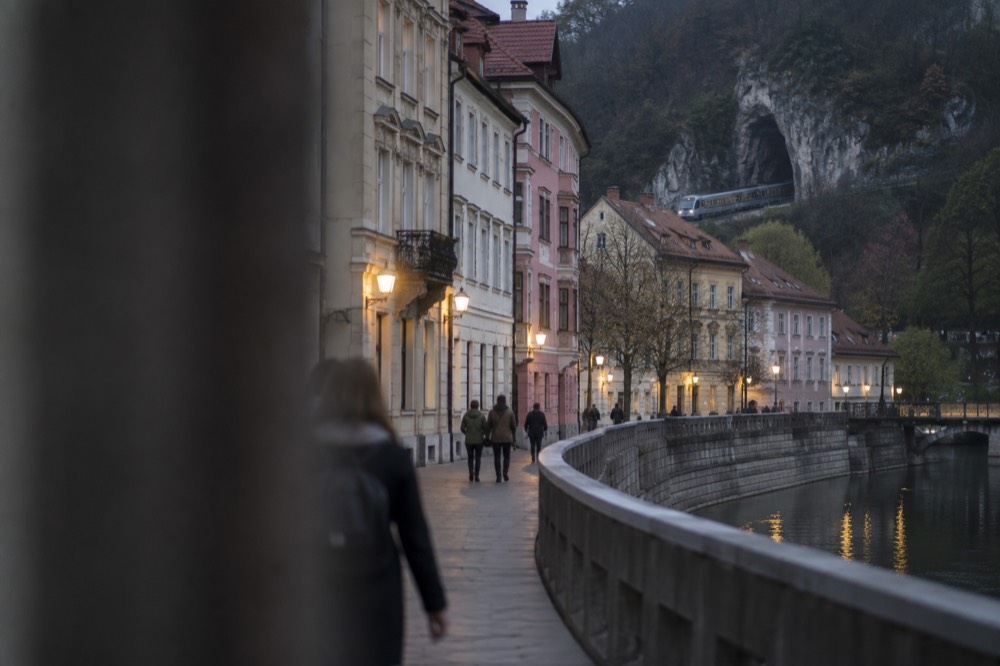
The coast route ends at Koper, a compact Venetian old town that also happens to be the port where cruise passengers arrive; our Koper cruise day guide is written for exactly that arrival. Zagreb, eastbound, is a capital city in a day, and Croatia's adoption of both Schengen and the euro on 1 January 2023 removed the last friction from that route; see Ljubljana to Zagreb.
| Day trip | Rail direction | What waits at the far end | Key published figure |
|---|---|---|---|
| Lake Bled | North via Kranj | Lake, island, castle | Bled Castle 19.00 EUR adult |
| Postojna Cave | West | 3.7 km cave route partly by train, 10 C inside | Adult entry 34.90 EUR |
| Škocjan Caves | Southwest via Divaca | UNESCO gorge walk, about 400 stairs, 12 C | 16.00 to 24.00 EUR by season |
| Koper | Southwest | Venetian old town on the coast | Free to wander |
| Zagreb | Southeast via Zidani Most | Croatia's capital | Schengen internal since 1 January 2023 |
| Trieste | West over the border | Italian port city | Schengen internal, no border checks |
The cave-and-castle trip below is the most popular guided version of the karst day, and it pairs Postojna with the cliff-hung Predjama Castle, whose separate adult entry is 24.00 EUR. A combined ticket price circulates in two conflicting figures, neither confirmed on the official page, so this guide prints only the two separate prices, exactly as the operator's own ticket page does.
For a fuller menu of what is reachable in a day, our day trips from Ljubljana guide and the blog piece on day trips [by train](https://omio.tpk.ro/exV6rGgH) from Ljubljana are the two pages to read next.
When Is the Best Time to Arrive and Travel by Train?
The best months for rail day tripping from Ljubljana are April through June and September, when the city's weather is at its most cooperative and the alpine lines are fully open. The surprise most guides miss is that September and October are the joint wettest months at 147 mm each, above July's 115 mm, and they tie at 12.4 fog days each in the 1971-2000 ARSO normals, level with midwinter.
That last figure deserves its own paragraph because it reframes the whole shoulder season. Everyone assumes Ljubljana's fog is a winter problem, but ARSO's published fog series, which exists only for the 1971-2000 period, gives September 12.4 fog days, October 12.4 and December 12.6, with January lower at 11.3. The same city's 1981-2010 precipitation normals make September and October the joint wettest months of the year at 147 mm each. An autumn visitor planning photography or alpine views should plan around that, not around a generic "September is lovely" assumption.
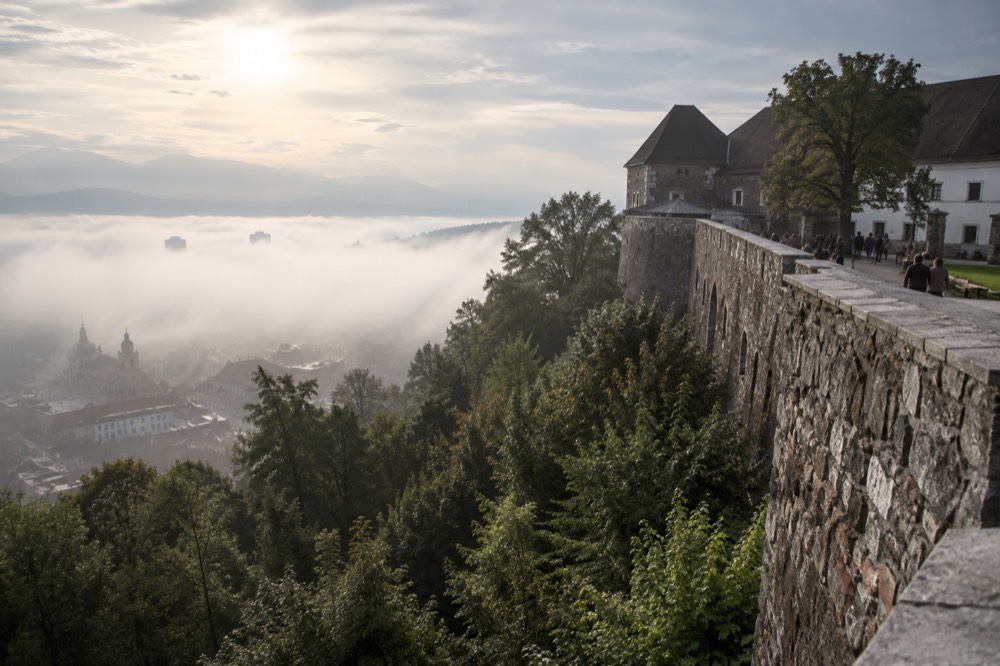
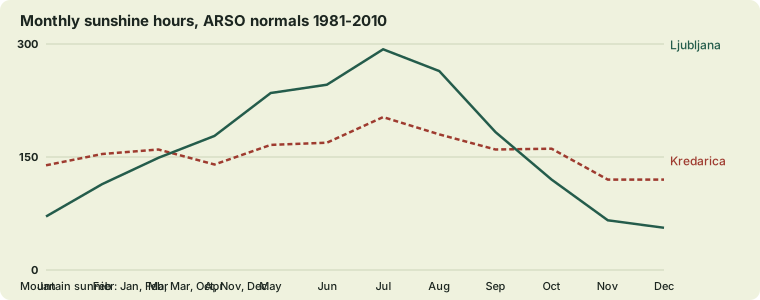
The deeper pattern, and the one that should shape a winter rail itinerary, is the basin inversion. Ljubljana sits on the floor of a basin at 299 m, and in the colder half of the year cold air is trapped under warmer air above, so the city fogs in while the hills a few hundred metres up sit in sunshine. ARSO's 1981-2010 normals put it starkly: Ljubljana gets 56 hours of sunshine in the whole of December against 120 hours at Kredarica, 2514 m up on Triglav, and 71 hours in January against 139. Annually the city averages 37 clear days against 130 overcast. A December visitor staring at grey from a station platform should buy a ticket up, not a museum ticket, and the same physics is why the best time to visit Ljubljana question has a genuinely non-obvious answer.
One caution the data itself imposes: do not write that the mountains are warmer than the city on average, because they are not. Kredarica's January mean is -7.1 C against Ljubljana's +0.3 C. The inversion reverses temperature on individual days, not in the monthly mean; the durable claim is about sunshine, cloud and fog, and that is what the numbers support.
For rail specifically, winter has one more quirk: Vintgar Gorge, the walkable ravine near Bled, is open only between April and October, with the exact closing date depending on conditions and unpublished until the operator announces it. Do not build a December Bled itinerary around it; our Vintgar Gorge guide carries the seasonal hours as the operator publishes them.
Practical Tips for Using the Station and Buying Tickets
Buy tickets at the counter or machine in the station hall, arrive 15 to 20 minutes before departure on mainline routes, and remember that the national rail operator publishes no static fare table that can be verified externally, so prices belong to its own booking system. Left luggage is available at the station, museums are free on the first Sunday of every month at the national institutions, and almost all of them close on Mondays.
Ticket buying is straightforward in person. The hall has both staffed counters and machines, and staff generally speak English. What you will not find anywhere authoritative is a published fare grid to plan against from home: the rail operator's site returns an access error to automated reading, and no secondary source we could verify republishes fares responsibly. Treat any fare you see quoted online as unconfirmed until it appears in the operator's own booking flow.
A few station-adjacent planning facts earn their place in any arrival notes. The national museums and galleries, including the National Gallery, the Museum of Modern Art and the Slovenian Ethnographic Museum, are free on the first Sunday of every month, a rule confirmed on four separate official sites, and nearly all of them close on Mondays. The National Gallery charges 10 EUR for its permanent collection otherwise, open Tuesday to Sunday 10:00-18:00, Thursdays to 20:00.
If a Friday arrival is on the cards, one more verified fact: the Odprta Kuhna open-air food market runs on Pogačarjev trg, roughly March to November, from around 10:00 to 21:00, and the official wording is "every sunny Friday", which is literal. It is cancelled in bad weather, so a soggy September Friday, at 147 mm the joint wettest month of the year, can genuinely mean no market. Our Odprta Kuhna guide explains the format.
| Practical item | The verified answer |
|---|---|
| Ticket purchase | Counter or machine in the hall; no verifiable static fare table exists online |
| Left luggage | Available at the station |
| Museums on a rainy platform wait | Free first Sunday monthly at national institutions; most close Mondays |
| City bus from the station | 1.50 EUR, 90 minutes, no cash, contactless accepted |
| Tourist tax | 3.13 EUR per person per night at accommodation |
| Friday food market | Pogačarjev trg, roughly March to November, cancelled in bad weather |
| Currency | The euro, since 1 January 2007 |
For anyone whose trip is a short one, the honest summary is that Ljubljana behaves as a two-night city: 2,844,129 overnight stays across 1,392,728 arrivals in 2025 works out to an average of about 2.04 nights, per the national statistics office. A station arrival, a walk into the pedestrianised centre, one day trip by rail and a museum morning fits that rhythm exactly, and our two days in Ljubljana itinerary is built around it.
If reading this has convinced you that a guided day out beats a timetable, these three are the strongest picks from the city: the cave and castle trip for the karst, the Bled and castle tour for the lake, and the free tips-based walk for the city itself.
For travellers who prefer to keep one foot on the platform, the Ljubljana Travel Guide homepage collects every rail, bus and day-trip page in one place, and it is the fastest way to plan the rest of a car-free route through the country.
Common Questions About Ljubljana Train Station and Rail Routes
How far is Ljubljana Train Station from the city centre?
About a ten minute walk from Prešeren Square and the old town, straight down Miklošičeva cesta. The historic centre is pedestrianised, so walking from the station is the normal and easiest way in.
Can you get to Lake Bled by train from Ljubljana?
Yes. Trains serve Lesce-Bled station, 4 km from the lake, while the Bohinj line serves Bled Jezero station, 1.5 km from the water. Check which line your departure uses before travelling. The fare and journey time are not published in any verifiable static source, so confirm them with the operator.
Do you need a passport to take the train from Ljubljana to Zagreb, Trieste or Vienna?
No routine border checks apply. Slovenia has been in the Schengen area since 21 December 2007, with air checks lifted on 30 March 2008, and Croatia joined Schengen and the eurozone on 1 January 2023. Carry ID as required by law, but there is no border stop on these routes.
Can you visit Postojna Cave by train from Ljubljana?
Yes, Postojna is a direct westbound ride. The cave is open every day, adult entry is 34.90 EUR, the inside holds at 10 C year round, and the route covers 3.7 km partly by underground train in about an hour and a half. Arrive 30 minutes before your tour time.
Is Ljubljana Train Station the same as the bus station?
They share the same square. The main bus station stands immediately alongside the rail station on Trg Osvobodilne fronte, so coach and rail connections are only a short walk apart.
Can you pay cash on Ljubljana city buses from the station?
No. Drivers do not accept cash. A single zone 1 ride costs 1.50 EUR for 90 minutes including transfers, payable by contactless bank card or mobile wallet on board, or by Urbana card, which costs 2.00 EUR to buy.