Breakfast and Brunch in Ljubljana: Where to Eat and What to Order
Ljubljana is a two-night city of about 2.04 average stays, which means most visitors only get one or two breakfasts here. This guide makes them count: what Slovenians actually eat in the morning, which neighbourhoods do café culture best, when the Central Market opens, and where to find brunch before a day trip.
Short answer
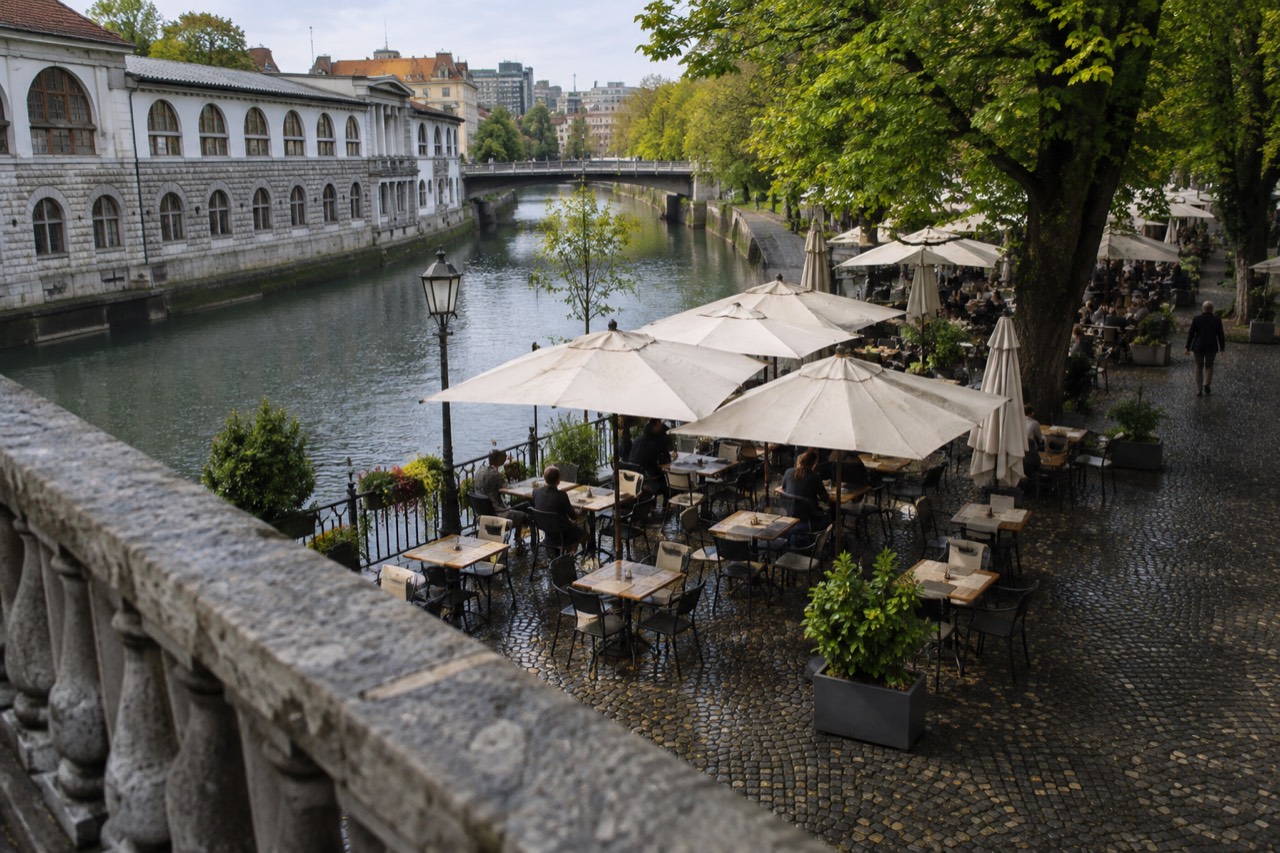
Breakfast in Ljubljana runs from market stalls and bakery windows at 06:00 to leisurely brunch spots opening around 09:00. Traditional morning food is simple: bread, cheese, cured meats, eggs and coffee. The Central Market's outdoor stalls run roughly 06:00-18:00 in summer, and Open Kitchen runs Fridays on Pogačarjev trg from March to November, weather permitting.
Ljubljana mornings start earlier than most visitors expect. The outdoor stalls at the Central Market begin trading around 06:00, the bakery queues form before office hours, and by nine the café terraces along the Ljubljanica are filling with people who plan to sit a while. This Ljubljana Travel Guide page walks through the whole morning food scene: what a Slovenian breakfast actually is, which neighbourhoods do it best, and how to fit brunch around day trips that leave the city before most brunch menus open.
One planning fact shapes everything. SURS recorded 1,392,728 tourist arrivals and 2,844,129 overnight stays in the Municipality of Ljubljana in 2025, which works out to an average stay of about 2.04 nights. Most readers of this page have one or two breakfasts to get right. There is no room for a bad one.
Where Do Locals Actually Eat Breakfast in Ljubljana?
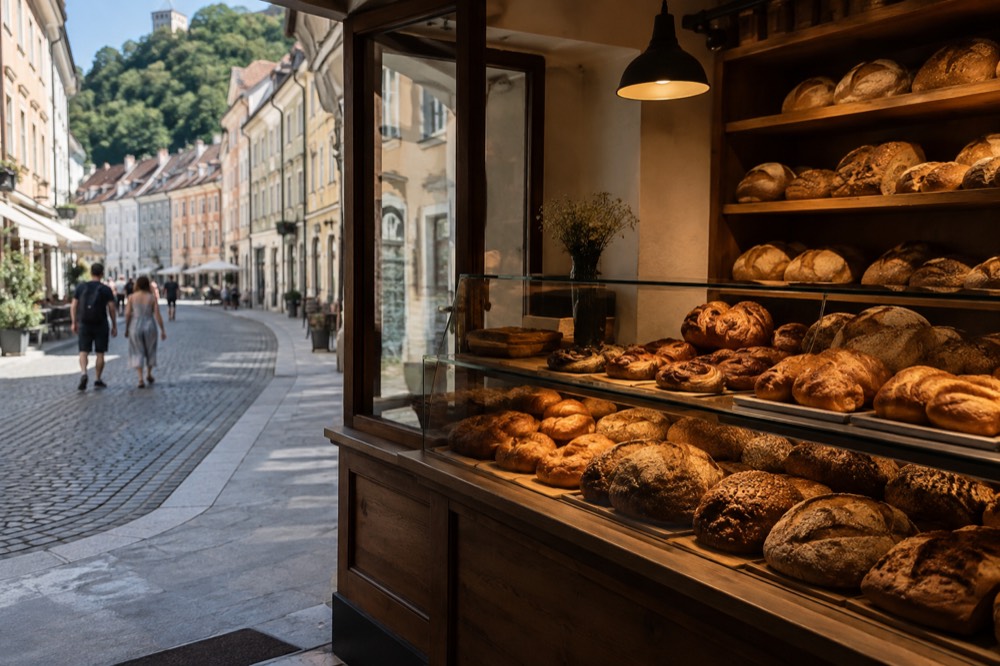
Locals mostly eat breakfast standing up, on the way to work, at bakery counters and market stalls rather than in sit-down cafés. The sit-down breakfast scene exists and is good, but it is aimed at weekends and visitors. If you want to eat like a Ljubljanan on a weekday, buy a burek or a slice of štrukelj at a bakery window and take it to a bench by the river. The sit-down brunch culture has grown quickly, and the best of it is concentrated in a few streets, but the default local breakfast remains fast, cheap and handheld. That distinction matters when you are choosing where to spend your one morning.
The historic centre is pedestrianised, a car-free zone of roughly 20 hectares that has been progressively expanded since 2007, which makes a walking breakfast crawl genuinely pleasant. You can cross from the market to a café on the far side of the Ljubljanica in ten minutes without ever sharing a pavement with a car. Start at the market, work through a bakery, and finish sitting down.
For a deeper run at the city's food culture beyond the morning, our Ljubljana food tour guide covers the full eating day, and where locals eat in Ljubljana goes into the neighbourhood places that never make a top-ten list.
| Type of breakfast | Where | Rough start time | Who it suits |
|---|---|---|---|
| Bakery window (burek, štrukelj, bread) | City-wide, densest in the centre | 06:00-07:00 | Early risers, day-trippers |
| Central Market stalls | Vodnikov and Pogačarjev trg | 06:00 | Anyone who wants fruit, cheese, bread |
| Classic café (coffee + pastry) | Old Town, Trnovo | 07:00-08:00 | Slow starters |
| Sit-down brunch | Centre and Trnovo | 09:00-10:00 | Weekend visitors |
| Open Kitchen street food | Pogačarjev trg | Fridays from 10:00 | Everyone, weather permitting |
What Does a Traditional Slovenian Breakfast Look Like?
A traditional Slovenian breakfast is bread with things on it: cheese, cured meats, butter, honey, and eggs, accompanied by coffee or tea. It is a farmer's morning, not a hotel buffet, and the items that define it, potica, štrukelj, kranjska klobasa and buckwheat dishes, all appear on Ljubljana menus in breakfast form. Expect simple food made from good ingredients rather than an elaborate cooked spread. The country's food identity leans on dairy, pork, buckwheat and orchard fruit, and the breakfast table shows all four.
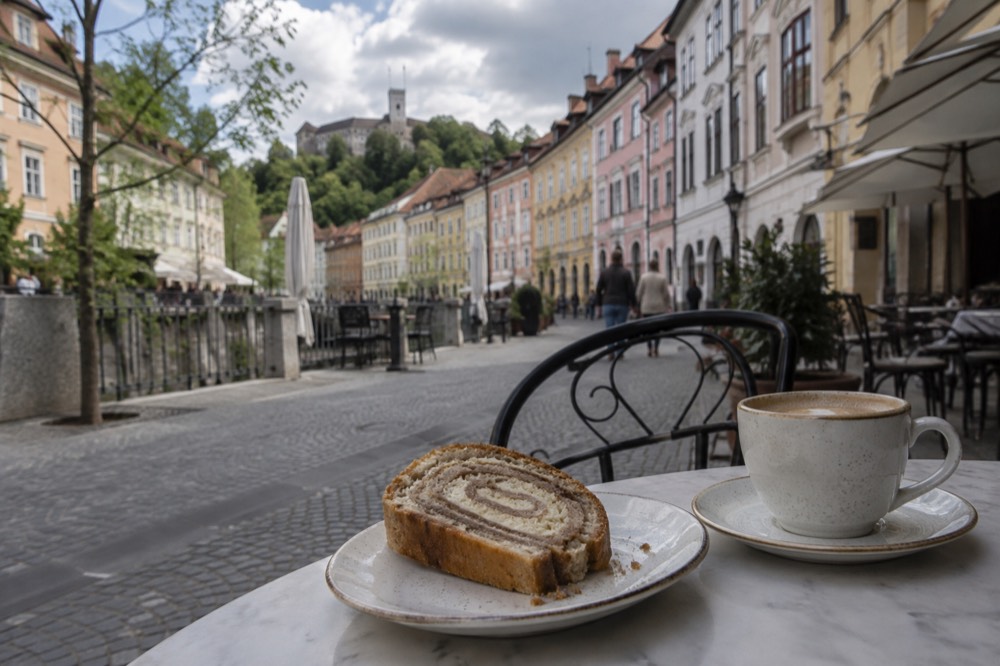
The classics, briefly. Potica is a rolled yeast dough wrapped around walnuts, tarragon or poppy seeds, sliced into spirals. Štrukelj is a rolled pastry, often savoury with cottage cheese or sweet with apples, and it is common enough as a breakfast item that there is a hands-on cooking class in the city devoted to making it. Kranjska klobasa, the protected Slovenian sausage, is more of a lunch item but appears on larger breakfast boards. Buckwheat žganci, a porridge-like dish topped with cracklings, is the old-school rural version. If you read a menu and see "zajtrk", that is simply the Slovenian word for breakfast.
Coffee culture is strong and Italian-influenced. Espresso is the default order, and asking for a large filter coffee will sometimes get you a puzzled look. Café terraces are used for sitting, not just drinking, and nobody will hurry you off a table, which is why breakfast in Ljubljana can easily stretch to two hours if you let it.
For background on the national table beyond the morning, read typical Slovenian breakfast foods and our guide to Slovenian food in Ljubljana. If potica and štrukelj sound worth learning rather than just eating, the Slovenian cuisine walking tour below runs tastings across the city and covers several of these items in one morning's walk, with a local explaining each one.
That tasting walk is a four-hour commitment, rated 4.8 from 552 reviews and starting from $104, so it works best on a day with no bus to catch. On mornings when a day trip is calling, the picture changes, and the three options below are the ones most breakfast-skippers in Ljubljana end up weighing.
The trio above is the shape of most visitors' time here: a cave day, a Bled day, and a free city walk to orient yourself. The free walk, Ljubljana Unveiled, runs on GuruWalk and is pay-what-you-think-it-was-worth, covering the Old Town from Roman remains to the Dragon Bridge in about two hours, which pairs neatly with a late bakery breakfast beforehand.
Which Neighbourhoods Have the Best Breakfast and Brunch?
The Old Town and the Trnovo side of the river carry the densest concentration of breakfast spots, with Metelkova and Bežigrad quieter in the mornings and better for coffee than food. The centre wins on atmosphere, Trnovo wins on local feel, and the area around the market wins on speed and price. Choose by mood, not by a single best café. Each neighbourhood has a distinct morning character, and the city is small enough that you can sample two in one morning.
The Old Town, with its lanes around Prešeren Square and the Triple Bridge, is where most visitors stay and where the café terraces face the river. Breakfast here leans international: eggs, granola, avocado toast, good coffee. Prices run higher than a bakery window, and tables on the water go first on sunny mornings. The pedestrianised centre means every café street is a walking street.
Trnovo, south of the centre across the river, is the student and local quarter. Cafés here are cheaper, slower and less polished, and the regulars are reading newspapers rather than photographing plates. If your ideal breakfast is a long espresso and no agenda, cross the river.
Around the Central Market and the Old Town market edges, breakfast is functional and fast. This is where you assemble a picnic breakfast from stalls: bread from one, cheese from another, fruit from a third, eaten on a bench with the castle above you.
| Neighbourhood | Morning character | Best for | Trade-off |
|---|---|---|---|
| Old Town (centre) | Terraces, river views, international menus | Sit-down brunch, atmosphere | Highest prices, busiest |
| Trnovo | Local, student, unhurried | Coffee, long mornings | Fewer brunch menus |
| Around Central Market | Fast, cheap, handheld | Picnic breakfasts, early starts | Nowhere to sit down |
| Metelkova / Šiška edge | Quieter, more residential | A real local café stop | Thin on breakfast food |
When Should You Go to the Central Market for Breakfast?
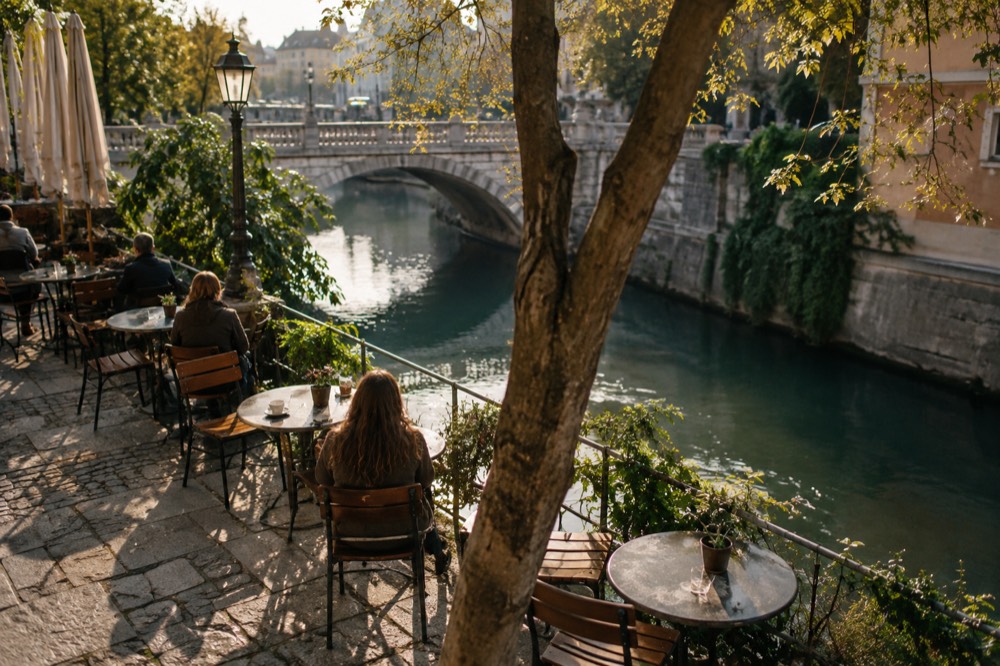
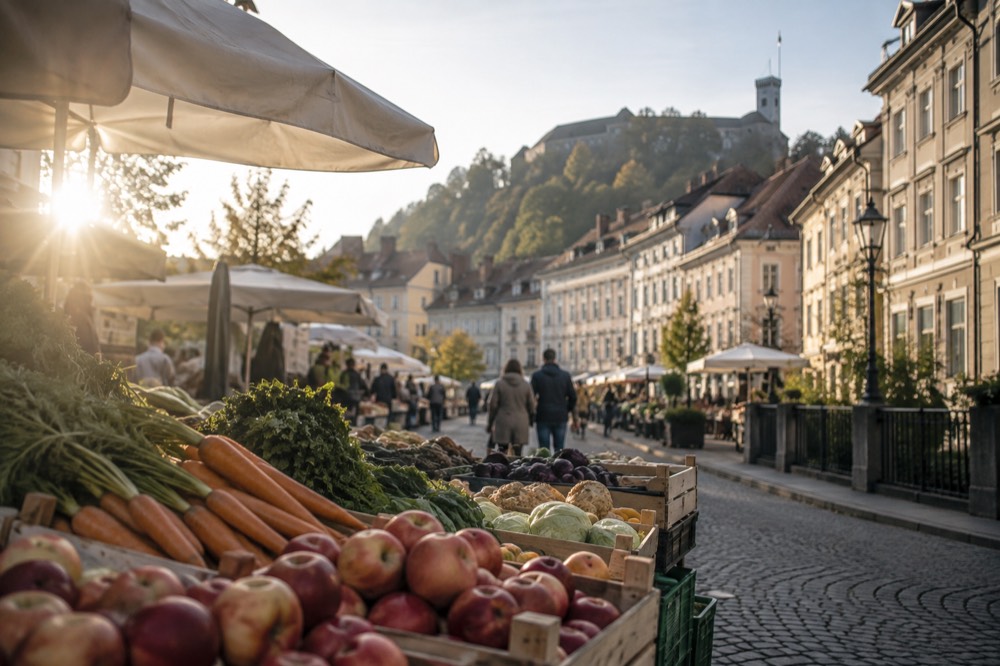
Go early: the outdoor market on Vodnikov and Pogačarjev trg runs roughly 06:00-18:00 Monday to Saturday in summer and 06:00-16:00 in winter, with the covered halls open Monday to Friday 07:00-16:00 and Saturday 07:00-14:00. Before nine you get the freshest produce and the local crowd; after ten you get the tour groups. The operator, JP LPT, publishes the full hours on its official market page, and it is worth checking before an early trip, because Sunday and holiday opening is limited and only runs April to November.
The market is Ljubljana's real breakfast venue. Plečnik's colonnade along the river gives the covered halls their famous arches, and the outdoor stalls spread across both squares. A breakfast assembled here, bread, a wedge of cheese, some cured meat, fruit, and something from a bakery window, costs a fraction of a brunch menu and tastes better for being eaten outdoors.
Two timing details worth knowing. First, the covered halls close mid-afternoon on weekdays and early afternoon on Saturday, so the market is a morning place, full stop. Second, on Fridays from roughly March to November, Pogačarjev trg turns over to Open Kitchen, the street-food market, from 10:00 until 21:00 and later on warm evenings. The official wording is that it runs "every sunny Friday", which is literal: bad weather cancels it. The tourist board's Open Kitchen page carries the current dates. Open Kitchen is not breakfast, but on a Friday it extends the market square's food day from six in the morning to late evening, and it is the single best food event in the city. Our Open Kitchen guide covers it in full.
Is Brunch in Ljubljana a Weekend Thing?
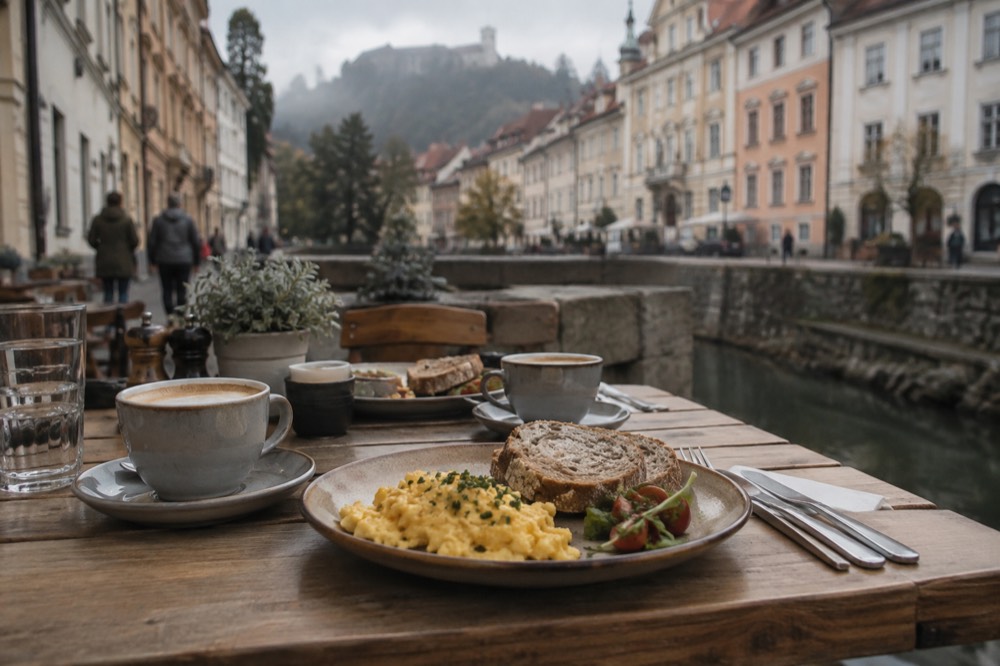
Yes, mostly. Sit-down brunch menus concentrate on Saturdays and Sundays, when locals have the time and cafés staff their kitchens for eggs and pancakes. On weekdays most kitchens open around eight with pastry and coffee only, and the full brunch menus appear from nine or ten, weekend or not. Plan a proper brunch for a weekend morning and treat weekday breakfasts as bakery-and-coffee affairs. If your stay includes a Saturday, spend it on brunch and then walk it off in Tivoli Park.
The weekend brunch scene has grown with the city's café culture, and the strongest cluster is in and around the pedestrianised centre. Expect the international brunch repertoire, eggs Benedict, shakshuka, pancakes, granola, done with Slovenian ingredients, and expect to wait for a terrace table on a sunny Sunday. The Slovenian touches are what lift it: buckwheat porridge, local honey, potica as a sweet option, and seasonal fruit from the market a street away.
A useful weekend pattern, given that most national museums close on Mondays but are free on the first Sunday of every month: brunch late on Sunday, then a museum afternoon. Or reverse it in winter, when the morning is the grey part of the day and sunshine arrives later.
What About Breakfast Before a Day Trip?
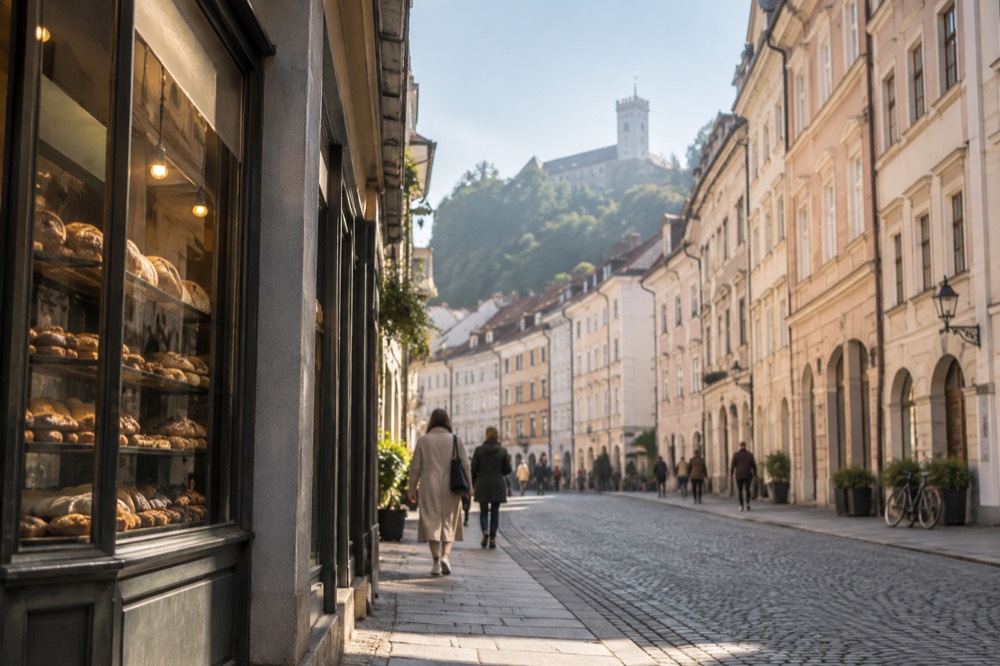
Eat at 06:30 or 07:00, not at nine, because the big day trips leave in the morning and Postojna Cave tours board 30 minutes before their stated departure. A bakery stop on the way to the pickup point is the standard move, and most tours return to Ljubljana in the mid-to-late afternoon, in time for a late lunch rather than breakfast. The day-trip breakfast is a logistics problem, and the city solves it well because bakery counters open before dawn.
The cave trip is the one most worth eating early for. The Postojna Cave and Predjama Castle tour from Ljubljana runs six hours, holds a 4.8 rating from 2,802 reviews, and starts from $132, with cave tickets handled for you. The cave itself holds about 10 C year round, which makes it the reliable answer to bad weather as well as a morning commitment: you will want a proper breakfast before a 3.7 km underground route that ends with a 90-minute chill. The official Postojna ticket page is the source for the entry prices if you go independently.
The Bled day trips leave similarly early. The Lake Bled and Bled Castle trip runs six hours, rates 4.7 from 1,641 reviews and starts from $86, and there is a cheaper guided option, the Lake Bled Day Tour, from $57 with a 4.8 rating from 888 reviews. Both return in time for a late lunch in the city, and our Ljubljana to Lake Bled guide covers the independent alternatives. If you would rather eat at Bled than before the bus, note that the town's famous Bled cream cake is a mid-morning or afternoon item, not a breakfast.
Can You Do Breakfast in Ljubljana for Free or Almost Nothing?
Almost free, yes: the cheapest real breakfast is a burek or a slice of štrukelj from a bakery window, eaten standing, and the free option is the breakfast you assemble from a supermarket bakery counter, which opens as early as any café. Truly free sit-down breakfasts do not exist, but the free GuruWalk walking tours cost nothing up front and a morning walk plus a two-euro pastry is the cheapest full morning in the city. The free walks are pay-what-you-think-it-was-worth, so they are free only in the sense that you decide the price afterwards.
The best breakfast-adjacent free walk is the Snacking Love Walk, a small-group walk on GuruWalk, rated 4.93 from 1,324 reviews, that pairs the city's sights with Slovenian snack stops over about 1 hour 45 minutes. One honesty note from its listing: the tastings carry a fixed extra cost, so it is not a free breakfast, and the walk itself is the pay-what-you-want part. If you want a genuinely free orientation before spending on brunch, the Ljubljana Unveiled walk, 4.91 from 1,496 reviews on GuruWalk, runs about two hours from Roman roots to the Dragon Bridge and leaves your whole morning budget for food afterwards. Our free walking tour guide lists all eight.
For the broader no-spend day, Ljubljana for free covers the castle grounds, the bridges and the parks that cost nothing, and Ljubljana on a budget puts the cheap eating in context. The castle grounds are free to enter, though the funicular and the tower are not, so a free morning can still include the hill.
How Does Ljubljana's Weather Shape Your Breakfast Plans?
Ljubljana sits in a basin and fogs in: ARSO's 1971-2000 normals record 91.2 days with fog a year, with September and October at 12.4 fog days each, level with midwinter, and the city averages just 37 clear days a year against 130 overcast. Plan terrace breakfasts loosely and have an indoor fallback, because a sunny-looking forecast at your hotel window is not the same as sun at river level. The useful trick is that the fog sits in the basin while the hills above are in sunshine, so a foggy morning is a reason to go up, not to stay in.
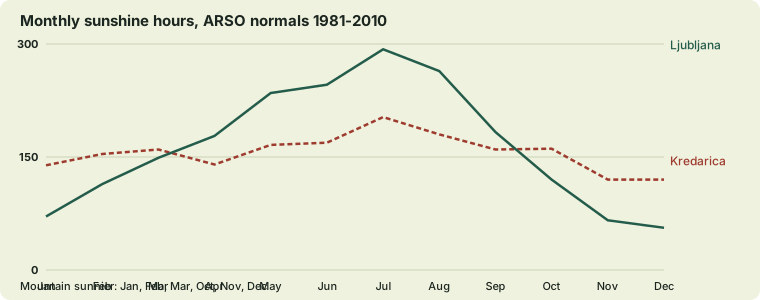
The numbers explain a lot about local breakfast habits. ARSO's 1981-2010 normals give Ljubljana just 56 hours of sunshine in the whole of December and 71 in January, while Kredarica, the high station on Triglav at 2,514 m, gets 120 and 139 hours over the same months. The lines cross: the city wins April to September and loses October to March. In practical breakfast terms, from late autumn to early spring you want a café with glass doors and heating, and from April to September you want the terrace and the river side.
Rain matters as much as fog. September and October are the joint wettest months at 147 mm each under the 1981-2010 normals, above July's 115 mm, so the autumn shoulder season everyone assumes is dry is not. Open Kitchen, which is cancelled in bad weather, sits right in that window, and a wet Friday kills it. Check the forecast and the tourist board page together.
What Should You Budget for Breakfast in Ljubljana?
Treat bakery-and-coffee as a few euros per person, a market picnic breakfast as a little more with better food, and a full sit-down brunch as a proper restaurant-level spend. Ljubljana is not a cheap city but breakfast is its cheapest meal of the day, and the gap between the floor and the ceiling is wide enough that the choice is yours rather than the city's. For context on the whole cost picture, our Ljubljana prices guide and the write-up on whether Ljubljana is expensive for tourists go into detail.
The ranges below are planning ranges, the kind of spread a visitor should expect across the centre, not promises from any operator. Individual cafés set their own prices and they move with the season.
| Breakfast style | Typical planning range per person | Time needed | Notes |
|---|---|---|---|
| Bakery window (burek, štrukelj, pastry) | A few euros | 5-10 minutes | Eaten standing or walking |
| Coffee + pastry at a counter | A few euros more | 15-30 minutes | Espresso is the default order |
| Market picnic breakfast | Between the two | 30-45 minutes | Best value for quality |
| Sit-down brunch | A restaurant-level spend | 1-2 hours | Concentrated on weekends |
| Cooking class morning | From $70 per the listing | 3 hours | The štrukelj class, breakfast you make |
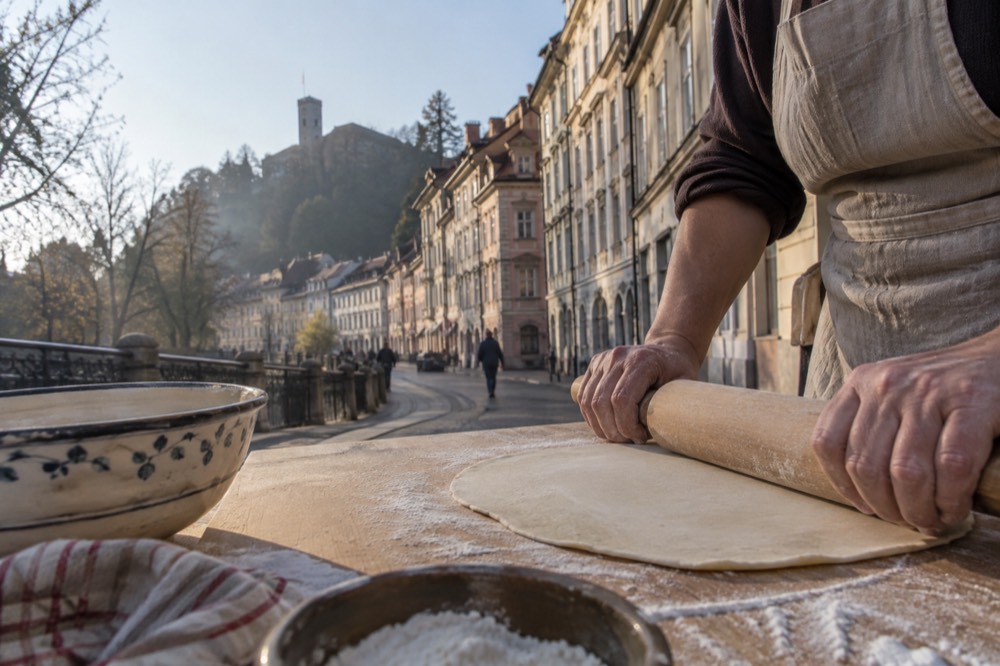
One way to convert breakfast money into an experience rather than a meal: the Traditional Slovenian štrukelj Cooking Class, three hours, rated 4.9 from 90 reviews, from $70, teaches the rolled pastry that appears in half the city's bakery windows. It is a late-morning commitment rather than breakfast, but it explains the food the city eats at breakfast better than any café menu does.
How Do You Fit Breakfast Into a Short Ljubljana Stay?
With an average visitor stay of about 2.04 nights, plan one bakery-market morning and one sit-down brunch, and let the day trips dictate which is which: a trip morning means eating at 06:30 from a bakery, a city morning means brunch at nine and a slow walk after. Two breakfasts is enough to cover both halves of the scene, and the city is compact enough that neither needs more than a 15-minute walk from anywhere central. The one-day and two-day itineraries on this site already build this rhythm in.
If you have a single day, follow what to see in Ljubljana in one day: bakery at seven, market at eight, and brunch folded into a mid-morning stop only if the day is long enough. With two days, the pattern is a market breakfast before the day trip and a proper brunch on the city day, and our two-day itinerary sequences exactly that. Weekend visitors should read the weekend in Ljubljana guide for how brunch slots around the Friday Open Kitchen and the Saturday market at its fullest.
A final ordering note: the covered market halls close at 14:00 on Saturday, and most national museums close on Monday but open free on the first Sunday of the month, so the week has a shape. Market early, brunch late, museum on the free Sunday, and if it fogs over, which it does on 91.2 mornings a year, take the hint and go up the hill where the sun is.
Common Questions About Breakfast in Ljubljana
What time do cafés in Ljubljana open for breakfast?
Counter service at bakeries starts from around 06:00-07:00, cafés open from about 07:00-08:00 with coffee and pastry, and full brunch kitchens tend to start around 09:00 or 10:00. The Central Market's outdoor stalls run from roughly 06:00.
What is a traditional Slovenian breakfast?
Bread with cheese, cured meats, honey and eggs, with potica and štrukelj as the classic baked items, and coffee or tea alongside. It is a simple farmer's morning rather than a cooked hotel buffet.
Where do locals eat breakfast in Ljubljana?
Mostly standing at bakery windows and market stalls on the way to work. Sit-down brunch is more of a weekend habit, and Trnovo is the neighbourhood where locals linger over coffee.
Is breakfast in Ljubljana expensive?
Breakfast is the cheapest meal of the day in Ljubljana. A bakery breakfast costs a few euros, a market picnic a little more, and only full sit-down brunch reaches restaurant-level spending.
Can you get brunch in Ljubljana on a weekday?
Yes, but the choice narrows. Weekend brunch menus concentrate on Saturday and Sunday; on weekdays most kitchens open with pastry and coffee and bring out the full menus later in the morning.
Is Open Kitchen a breakfast event?
No. Open Kitchen is a Friday street-food market on Pogačarjev trg, running roughly March to November from 10:00, and it is cancelled in bad weather. It extends the market square's food day, but breakfast there is still a morning-market affair.