What Language Is Spoken in Ljubljana?
Slovene is the official language of Ljubljana, but English is widely used across the city's tourism, dining and transport. A practical guide to what you will actually hear on the street.
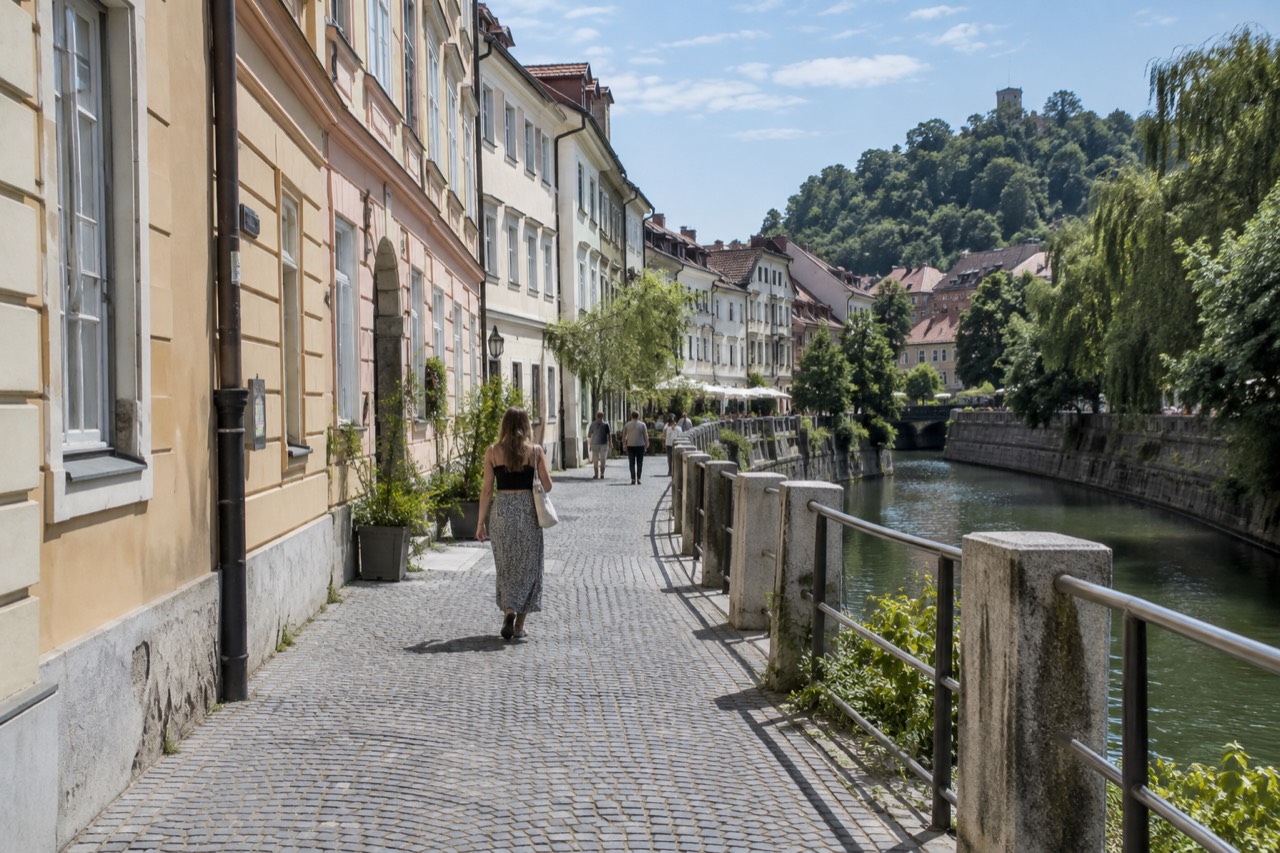
What Language Is Spoken in Ljubljana?
The language spoken in Ljubljana is Slovene, the official language of Slovenia, used in government, schooling, signage and daily conversation across the city. In practice, visitors hear English almost everywhere that matters to them: hotels, restaurants, museums, tour desks and the tourist information centre. Ljubljana is a university capital and a tourism city, so the streets carry a mix of Slovene, English and the languages of visiting tour groups. You do not need a word of Slovene to enjoy the city, though a few opening phrases earn genuine smiles.
Slovene, or slovenščina, is a South Slavic language written in the Latin alphabet with three extra letters: č, š and ž. If you have read anything about Ljubljana, Prešeren Square or the architect Plečnik, you have already met the diacritics. They are not decorative. Čevljarski most and Cevljarski most are different-looking words for the same bridge, and only one is correct.
The city's own name is the first place visitors stumble. The "Lj" at the start is a single sound in Slovene, nothing like the English "Lub". For the full breakdown of how to say it, and why the j is there at all, see our guide to how to pronounce Ljubljana.
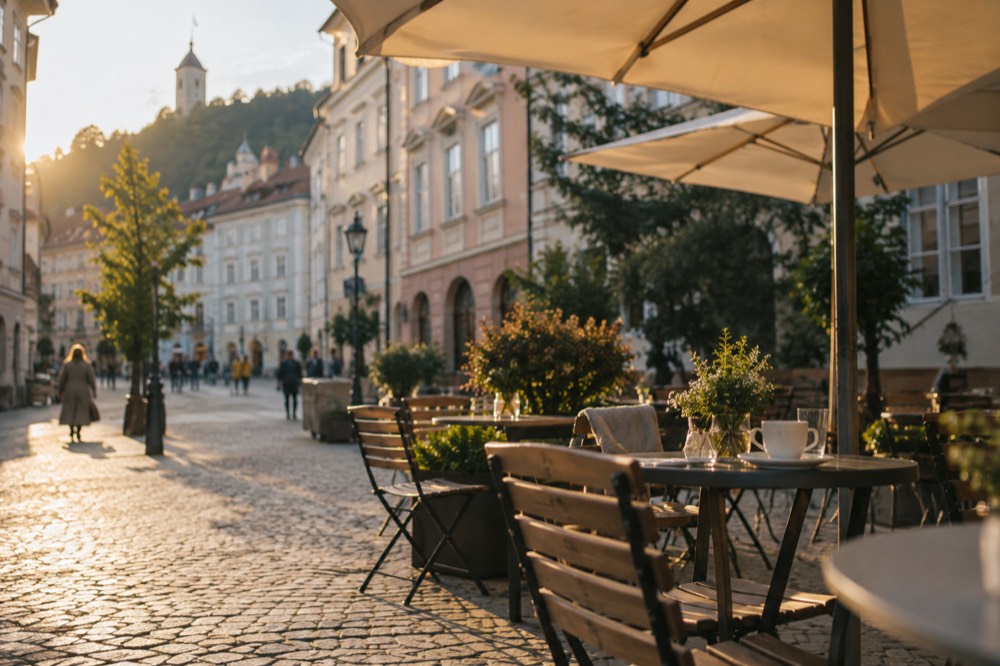
Do You Need Slovene to Visit Ljubljana?
No, you do not need Slovene to visit Ljubljana. English is the working second language of the city's tourism economy, and staff at hotels, restaurants, ticket desks, museums and tour meeting points use it routinely. Menus in the centre are frequently bilingual, museum captions are usually in Slovene and English, and the tourist information staff switch languages all day. A visitor who speaks only English can book, order, ask directions and sort out problems without a phrasebook.
This is not a coincidence of geography. Slovenia is a small country in the middle of Europe, and its tourism industry is built around international guests. The city recorded 1,392,728 tourist arrivals in the municipality in 2025, according to the national statistics office, and those visitors arrive from across Europe and beyond. A capital that size cannot function in one language alone.
The one place English thins out is off the tourist map. In a neighbourhood bakery, a suburban bus or a small shop in Šiška or Bežigrad, you may meet staff whose English is limited or absent. Pointing, smiling and a Slovene greeting solve nearly all of it. The centre itself is pedestrianised, which slows everything down in the best way, and makes asking a question on foot easy.
Slovenia is also a member of the European Union and the eurozone, so there is no currency to change coming from the euro area, and no routine border check arriving from Italy, Austria, Hungary or Croatia; the government's own pages confirm Schengen membership dates from 21 December 2007. Language, money and borders are all friction you can simply forget about. That ease is exactly why a guided product is often less about the language and more about the logistics: a day trip with tickets and transport prearranged removes the only real planning burden.
Is English Widely Spoken in Ljubljana?
Yes, English is widely spoken in Ljubljana, especially among younger people and anyone working in tourism, hospitality or the university sector. Restaurant staff, hotel receptionists, museum attendants, taxi drivers and guides in the centre generally speak it confidently. Outside the centre and among older residents, English is less uniform, and German or Italian sometimes fills the gap instead. For a visitor, the practical answer is that English works nearly everywhere you will actually go.
Two things shape this. First, Ljubljana is a university city, and student-age Slovenes learn English from primary school onward. Second, the country's tourism is international by default: the same statistics office counted 2,844,129 overnight stays in the municipality in 2025, an average stay of roughly two nights, which means a constant turnover of foreign guests who all need to be served in something other than Slovene.
If you want a deeper read on how far English carries, including where it does not, our post on whether Ljubljana is English friendly covers the same question from the other side.
What Other Languages Will You Hear in Ljubljana?
Beyond Slovene and English, Ljubljana's streets regularly carry Italian, German, Croatian, Serbian and Bosnian, plus the tour-group languages of the season. Italian and German are common second languages among hospitality staff, and Croatian and Serbian are close enough to Slovene that speakers understand each other across the counter. In practice the city sounds like what it is: a small Central European capital whose neighbours are an hour away in every direction.
Slovene shares its language family with Croatian, Serbian, Bosnian and other South Slavic languages, so regional visitors get by with almost no translation at all. Italian and German arrive with the two biggest neighbouring tourism markets. You will also hear the languages of the day-trip and cruise economy, since Ljubljana sits within easy reach of Venice, Trieste, Zagreb and the Adriatic coast; our guides to Trieste and Zagreb cover those routes.
For visitors, the useful takeaway is that menus, signs and tour listings in the centre are built for multiple languages. Museum captions are typically Slovene and English. Ticket websites and tour listings default to English. The free GuruWalk walks, which are tips-based and run by local guides, are conducted in English as standard, which is part of why they work so well as a first-day orientation. More of these guides are collected on Ljubljana Travel Guide.
Which Slovene Words Are Worth Learning?
Learn a handful of words and you will cover 90 percent of daily interactions: hvala for thank you, prosim for please and you're welcome, dober dan for good day, and živjo or zdravo for an informal hello. Add oprostite for excuse me and račun, prosim for the bill, and you have the full toolkit. Slovenes do not expect visitors to speak their language, which is exactly why the effort lands so well.
| Slovene | Roughly sounds like | Means | Use it when |
|---|---|---|---|
| Dober dan | DOH-bair dahn | Good day | Greeting anyone, any time of day |
| Hvala | HVAH-lah | Thank you | Every transaction, every kindness |
| Prosim | PROH-seem | Please / you're welcome | Offering and accepting alike |
| Oprostite | oh-PROHS-tih-teh | Excuse me | Passing through a crowd, getting attention |
| Račun, prosim | RAH-choon, PROH-seem | The bill, please | Ending a restaurant meal |
| Nasvidenje | nahs-VEE-den-yeh | Goodbye | Leaving a shop or café |
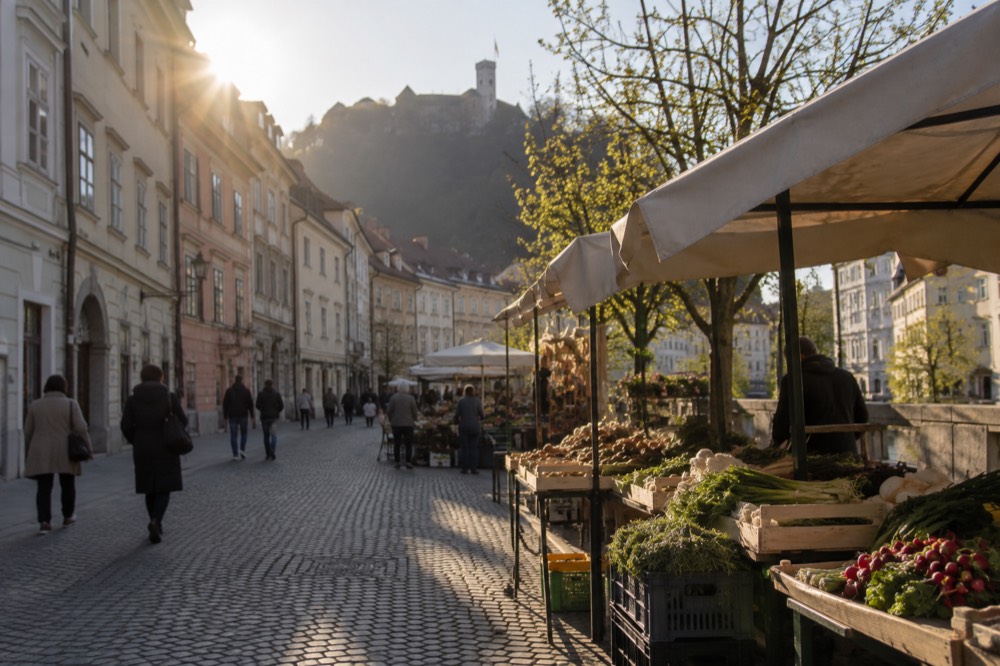
The Central Market is one of the best places to try these out. The outdoor stalls on Vodnikov and Pogačarjev trg run roughly Monday to Saturday, and the covered halls open Monday to Friday and Saturday mornings, so a morning visit fits any itinerary; our guide to the Central Market has the hours and the layout. Stallholders deal with foreigners all day and are patient with a mangled hvala.
One pronunciation note that doubles as sightseeing advice: the j in Slovene sounds like the y in yes, and the diacritics change sounds rather than decorate them. Once you can read č, š and ž, the street signs stop being noise. Prešernov trg, Tromostovje and Čevljarski most all become sayable, and the city reads differently once they are.
How Does Language Work on Tours and Day Trips?
On tours and day trips from Ljubljana, guiding is done in English as the default, with the live listing stating the available languages for each departure. Guides on the major cave, lake and Alps routes narrate in English, and the larger operators add other languages seasonally. Booking pages, safety briefings and printed materials follow the same pattern, so a visitor who reads English can take any mainstream tour without a language concern. The only real decision is which tour, not which language.
The cave routes illustrate how little language matters to the logistics. Postojna Cave holds about 10 degrees Celsius year round, which is why it is the standard wet-weather and heatwave answer, and the cave's own visitor route covers 3.7 km partly by underground train with tours lasting about an hour and a half. Predjama Castle, the cliff fortress on the same ticket site, is open year round. None of that requires Slovene; the guide handles the talking.
The Cave and Castle Tickets and Tour from Ljubljana bundles both into one six-hour day, rated 4.8 across 2,802 reviews and starting from $132, and it is a good example of the pattern: everything is arranged, transport included, and the guiding is in English.
For a first-day city orientation, the free GuruWalk walk Ljubljana Unveiled is the natural counterpart. It is a tips-based two-hour walk from Roman roots to the dragon bridge, rated 4.91 from 1,496 reviews, guided in English by a local, and it costs nothing up front: you pay what you think it was worth. Our guide to the free walking tours in Ljubljana compares the options.
If you are planning the wider trip rather than a single day, the Ljubljana City Card is worth a look: the 24-hour tier costs 41.00 EUR and includes the castle funicular, the river cruise, city buses and more than 30 museums, which beats paying separately for those alone. Every included attraction operates happily in English.
Common Questions About Language in Ljubljana
What Language Is Spoken In Ljubljana?
Slovene is the official language of Ljubljana and the language of daily life in the city. English is very widely used in tourism, hospitality and anywhere visitors go, so a visitor who speaks only English can manage the whole city comfortably.
Do people in Ljubljana speak English?
Yes, extensively. Staff in hotels, restaurants, museums and tour operators use English routinely, and younger residents generally speak it well. Outside the centre and among older residents it is less uniform, but the tourist areas of the city are effectively bilingual in practice.
Is Slovene hard to learn for a short visit?
You do not need to learn it at all, and nobody expects you to. A few words, hvala, prosim and dober dan, cover almost every polite interaction. Slovene is a South Slavic language with diacritics, so reading signs takes a moment of adjustment, but pronunciation is more regular than English.
What does the j in Ljubljana sound like?
The j is pronounced like the y in yes, and the initial Lj is a single palatal sound. This is why the city's name is so hard to read for English speakers and so easy once explained. Our pronunciation guide breaks the whole word down syllable by syllable.
Are tours in Ljubljana given in English?
Yes, English is the default guiding language for the mainstream city walks, day trips and cave tours, and the live listing for each product states its available languages. Free GuruWalk walks, including Ljubljana Unveiled, are conducted in English by local guides on a pay-what-you-think-it-was-worth basis.
Can I get by in Ljubljana with German or Italian?
Often, yes. Both are common second languages in the hospitality sector, and Slovene's closeness to Croatian and Serbian means regional visitors are understood too. English remains the most reliable single language for a visitor, but German and Italian open doors in the centre.