Is Ljubljana English Friendly?
Yes. English is widely spoken in Ljubljana, especially by younger residents and in tourism. Here is what to expect in restaurants, transport, museums and day trips.
Is Ljubljana English Friendly?
Yes, Ljubljana is genuinely English friendly. English is the default second language of the city: staff in restaurants, museums, hotels and ticket offices routinely switch to it, guided tours run in it, and museum wall text is bilingual. A visitor with no Slovene at all can order food, ride public transport, buy castle tickets and take day trips without a phrasebook, and most will finish their trip having needed nothing else.
That is not a marketing claim, it is a structural one. Slovenia is a country of two million people whose own language is spoken almost nowhere else, so foreign languages are taught seriously and early. The tourism economy that recorded 1,392,728 arrivals and 2,844,129 overnight stays in the municipality in 2025 runs substantially in English because it has to. The average stay works out at about two nights, which means a constant turnover of first-time visitors who will never learn Slovene, and the city has built itself around serving them.
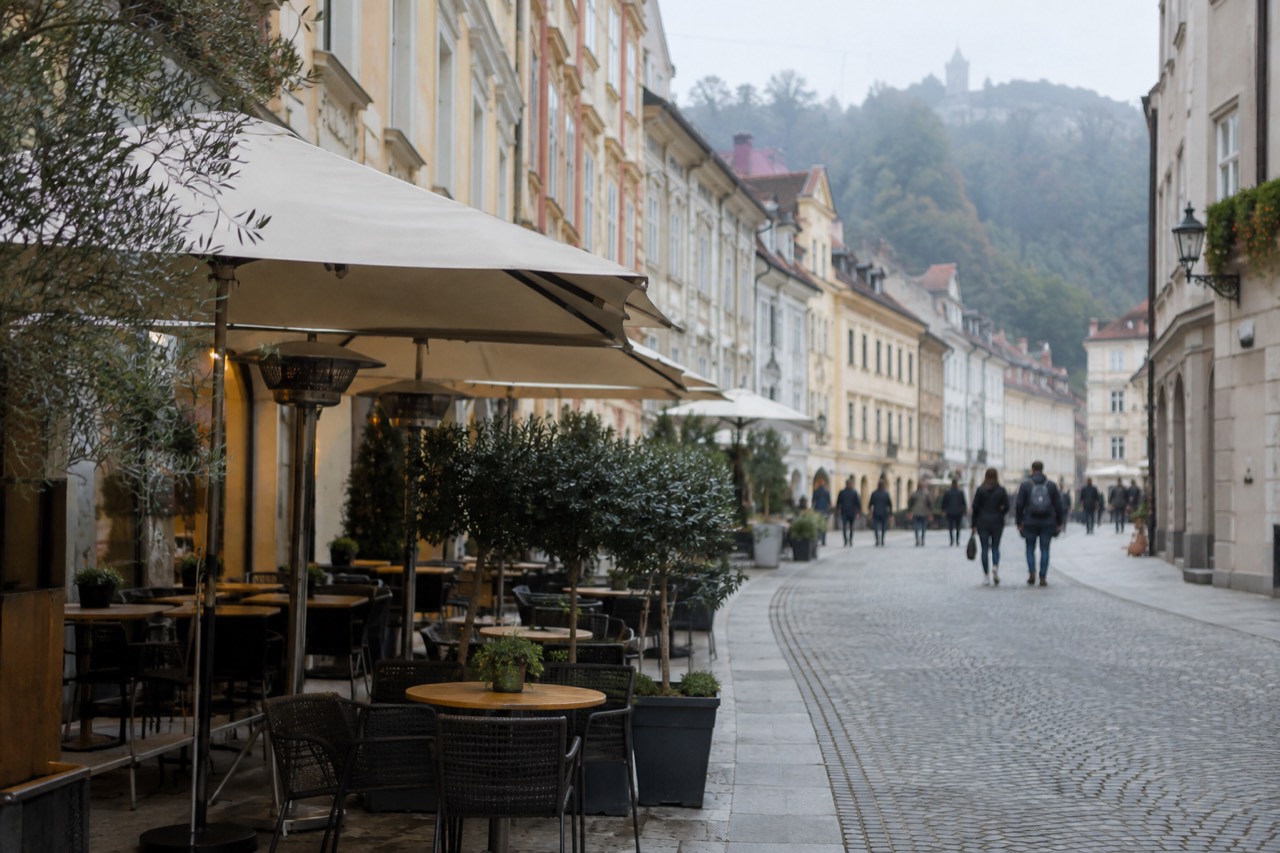
It also helps that the practical infrastructure assumes foreign visitors. The historic centre is pedestrianised, roughly 20 hectares closed to general traffic, so the usual chaos of reading foreign road signs simply does not arise. Signage at the sights is bilingual, the tourist information centre sits on the edge of the old core, and the official tourist board's own pages are published in polished English.
There are limits, and they are predictable ones. Outside the centre, in residential neighbourhoods and among older residents, English thins out exactly as it does everywhere in Europe. A market trader at the Central Market may prefer German to English. But the question a visitor is really asking, can I manage a city break here without the local language, has a straightforward answer, and it is yes.
How Widely Is English Spoken in Ljubljana?
English is spoken by a large majority of people a tourist will actually deal with. Anyone under about 45 in the centre will almost certainly speak it well, bar staff and waiters switch to it unprompted, and it is the working language of the hostel, tour and museum sectors. It weakens with age and distance from the centre, so a suburban bakery or a phone call to a taxi firm is where a few Slovene words start to earn their keep.
The pattern follows education. English has been the first foreign language in Slovenian schools for decades, and Slovenian television subtitles imported programming rather than dubbing it, which is the same exposure pattern that makes the Dutch and Scandinavians so fluent. The result is a capital where a visitor can be served in English at every point of the standard tourist loop: Prešeren Square, the Triple Bridge, the funicular, the castle, the riverside restaurants.
Where it gets patchy is worth knowing in advance:
| Situation | English level | What helps |
|---|---|---|
| Restaurants and cafés in the centre | Excellent, menus often bilingual | Nothing needed |
| Museums and galleries | Excellent, wall text in English | Nothing needed |
| City buses | Announcements and stops displayed, drivers vary | Have your stop written down |
| Central Market stalls | Variable, some traders prefer German | Pointing works, numbers help |
| Neighbourhood shops outside the centre | Patchy among older staff | A greeting in Slovene goes far |
| Emergency and medical services | Good, younger staff strongest | Hotel reception can assist with calls |
The one genuinely useful courtesy is the greeting. "Dober dan" for good day, "hvala" for thank you, "prosim" for please. Nobody expects a visitor to conjugate Slovene, which is a famously complex language, but opening in Slovene before switching to English changes the tone of almost every interaction in the smaller shops. Locals are direct about appreciating it.
For orientation on a first day, the free GuruWalk walks are an efficient English fix: the Old Town Walk, Romans to Dragons runs two hours with a local guide, rated 4.91 across 1496 reviews, and the whole free-walk model means the guide is working for tips in a language the group shares. A paid alternative with fixed depth is the Classic Group Walking Tour, which covers the Old Town's main sights in English.
Can You Get by in Ljubljana with No Slovene at All?
Yes, entirely. Every step of a standard visit, buying bus tickets, ordering food, entering museums, booking tours, works in English, and the systems are built so that even the moments with no conversation at all, contactless payment, timed e-tickets, run themselves. The two places to prepare slightly are cash-only corners of the markets and any phone call to a small local operator, where having an address written down matters more than grammar.
Public transport is the best example of how little language a visitor needs. City buses do not accept cash at all, but they do take contactless Visa, Mastercard and mobile wallets directly on board, per the operator's own payment page, so a visitor can board, tap and ride without a single word exchanged. The Urbana card costs 2.00 EUR and a single zone 1 ride is 1.50 EUR for 90 minutes including transfers, and the ticket machines and Passenger Centre on Slovenska street handle English prompts. The practical detail is not linguistic: it is that cash never works on a Ljubljana bus.
Museums are similarly frictionless. Wall text at the National Gallery, the City Museum and the Slovenian Ethnographic Museum is in English as standard, and the state institutions offer free admission on the first Sunday of every month, a fact each of them publishes on its own site. The one planning fact that outranks language is the calendar: nearly every museum in the city closes on Monday, so an English-speaking visitor with a Monday to fill should head for the castle or the river instead.
Booking tours is where English matters most, and it is the strongest case of all. Every bookable tour from the city runs its commentary in English, and the operators' live listings state the language upfront. The Cave and Castle Tickets tour to Postojna Cave and Predjama Castle is a good example of how far the language support goes: six hours door to cave and back, rated 4.8 across 2802 reviews from $132, with the underground train and the cliff castle explained in English by a guide, and separate entry at 34.90 EUR for the cave and 24.00 EUR for the castle if you go independently. The one piece of English that genuinely matters on that trip is the instruction to arrive 30 minutes before the stated tour time, because train boarding closes 15 minutes before departure.
That same language coverage extends across the whole day-trip roster, which is worth knowing before committing to a longer itinerary. Whether the plan is caves, lakes or the coast, the guided options all publish their commentary language on the live listing, and English is the default on every one of them.
Is English Enough on Day Trips from Ljubljana?
Yes. The day-trip belt around Ljubljana, Lake Bled, Postojna, Škocjan, Piran, the Soča Valley, is served by guided tours that run in English end to end, and at the sights themselves the ticketing, safety briefings and signage are bilingual. Independent travel by coach or train needs a bit more care with timetables, but the stations and operators publish English pages, and the sights are used to foreign visitors arriving without a word of Slovene.
The guided option removes the question entirely. The Lake Bled and Bled Castle day trip runs six hours from the city, rated 4.7 across 1641 reviews from $86, with the lake, the island and the castle explained in English. The same is true further afield: the Soča and Kranjska Gora tour, ten and a half hours into the Julian Alps, is rated 4.9 across 911 reviews, and the UNESCO Škocjan Caves and Piran day trip, nine and a half hours, carries 4.7 from 382 reviews. Commentary language is stated on each live listing, and English is the default on all of them.
Independent travel is only slightly more work. Bled's own tourism pages are published in English, Bled Castle publishes an English price list with adult entry at 19.00 EUR, and the pletna boat to the island is a fixed 20 EUR per person that you pay on the spot with gestures if needed. The caves are the same: Postojna's ticket and timetable pages are fully in English, and the single most important sentence on them, that the cave holds 10 C year round, is one every English-speaking visitor should read before going underground in August shorts.
The honest caveat is rural Slovenia. In the villages of the Vipava Valley, on alpine farms or at a small gostilna in the hills, English is thinner and goodwill does the rest. The Velika Planina guided hike, six hours to the alpine herdsmen's village rated 4.8 from 74 reviews, is a case where the guide bridges the gap: the herdsmen you meet may speak little English, but the person translating the whole day for you does.
Where Does English Fall Short in Ljubljana?
In three places: phone calls to small local operators, some older family-run shops away from the centre, and anything administrative or medical beyond the basics. A pharmacy can handle a simple request in English, a hospital appointment may not, and a taxi dispatcher at midnight speaks whatever he speaks. None of these touch a normal city break, and each has a workaround, written addresses, translation apps, hotel reception making the call.
The pattern is age and sector, not geography alone. The student-heavy bar scene along the Ljubljanica and the Metelkova area's alternative venues are as anglophone as any in Europe. A suburban bakery at 7am staffed by someone who finished school decades ago is a different matter. The workaround is cultural rather than linguistic: Slovenes who do not speak English will often hand you to a colleague who does, and nobody is offended by a slow, simple exchange.
| Moment | Expectation | Best move |
|---|---|---|
| Ordering at a riverside restaurant | English menu, English service | None needed |
| Buying a castle or funicular ticket | English at the desk, bilingual signage | Book ahead for skip-the-line |
| Asking directions on the street | Usually fluent, sometimes shy | Younger passers-by |
| Central Market produce stalls | Mixed, some German preference | Numbers and pointing |
| Calling a restaurant to book | Variable | Ask hotel reception to call |
| Pharmacy basics | Generally fine | Bring the packet, not a description |
One thing that surprises visitors: Slovenes often understate their own English. A guide who says "I speak a little" will then conduct a flawless two-hour tour. The reticence is politeness, not a warning, and pressing on in English is never taken as rude.
Do Slovenes Mind Speaking English in Ljubljana?
No, and the evidence is that they volunteer it. Service staff in Ljubljana routinely open in English the moment they hear a foreign accent, guides work in it all day, and there is no detectable resentment of the kind you occasionally meet in larger capitals. The one expectation that does exist is courtesy: a Slovene greeting before the English switch is noticed and appreciated, and Slovenes are protective of their language precisely because so few outsiders ever learn it.
That protectiveness never turns into hostility. Slovenian is one of the few official EU languages with essentially no second-language speakers abroad, and locals are openly delighted by any attempt at it, however mangled. A visitor who manages "hvala" at a market stall gets a warmer transaction than one who does not, not because the trader cannot manage English but because the effort signals something.
The comparison worth making is with much bigger tourist cities. Ljubljana's visitor volume, 1.39 million arrivals across the year in a municipality of 293,244 people, is heavy but not crushing, so the people serving you are not burned out on tourists. English in Ljubljana is delivered as a normal part of the job rather than a performed script, which is a real difference in how the city feels.
For anyone who wants the language question settled before arrival, the practical reading is in speaking English in Slovenia, and the broader reassurances are in is Slovenia friendly to tourists. If the trip is still being shaped, the Ljubljana Travel Guide homepage lays out the full set of things to do in Ljubljana by season, the free walking tour options are the cheapest possible test of how well the city's English holds up on day one, and whether the city is walkable matters more than any phrasebook once you realise how compact the centre is.
Whichever way the itinerary leans, the cave trip, the lake, or a first-day walk with a local, the language will not be the thing that slows you down.
Common Questions About English in Ljubljana
Is Ljubljana English Friendly?
Yes. English is spoken by most people a tourist interacts with, menus and museum text are bilingual, and guided tours run in English as standard. A visitor needs no Slovene for a normal city break.
Do they speak English in Ljubljana?
Widely, especially among under-45s and across the whole tourism sector. It thins among older residents and outside the centre, but the standard visitor loop, restaurants, museums, transport, tours, works in English throughout.
Can I visit Ljubljana without learning any Slovene?
Yes, entirely. Even the moments that need no conversation, contactless payment on buses and e-tickets for sights, run themselves. A greeting like "dober dan" and "hvala" is appreciated but never required.
Is English enough for day trips from Ljubljana?
Yes. Guided tours to Lake Bled, Postojna Cave, Škocjan and Piran run their commentary in English, and the sights themselves publish English ticket pages and bilingual signage.
Where does English fall short in Ljubljana?
Phone calls to small operators, some older neighbourhood shops, and involved administrative or medical conversations. Hotel reception or a translation app covers almost all of it.
Do Slovenes mind speaking English?
No, they volunteer it. Staff switch to English unprompted, and the only local expectation is a courteous Slovene greeting before the switch, which is noticed and appreciated.