What Cities Fly Direct to Ljubljana?
An honest answer to which cities fly direct to Ljubljana, why the route list changes every season, and the overland alternatives from Zagreb, Trieste and Venice.
What Cities Fly Direct to Ljubljana?
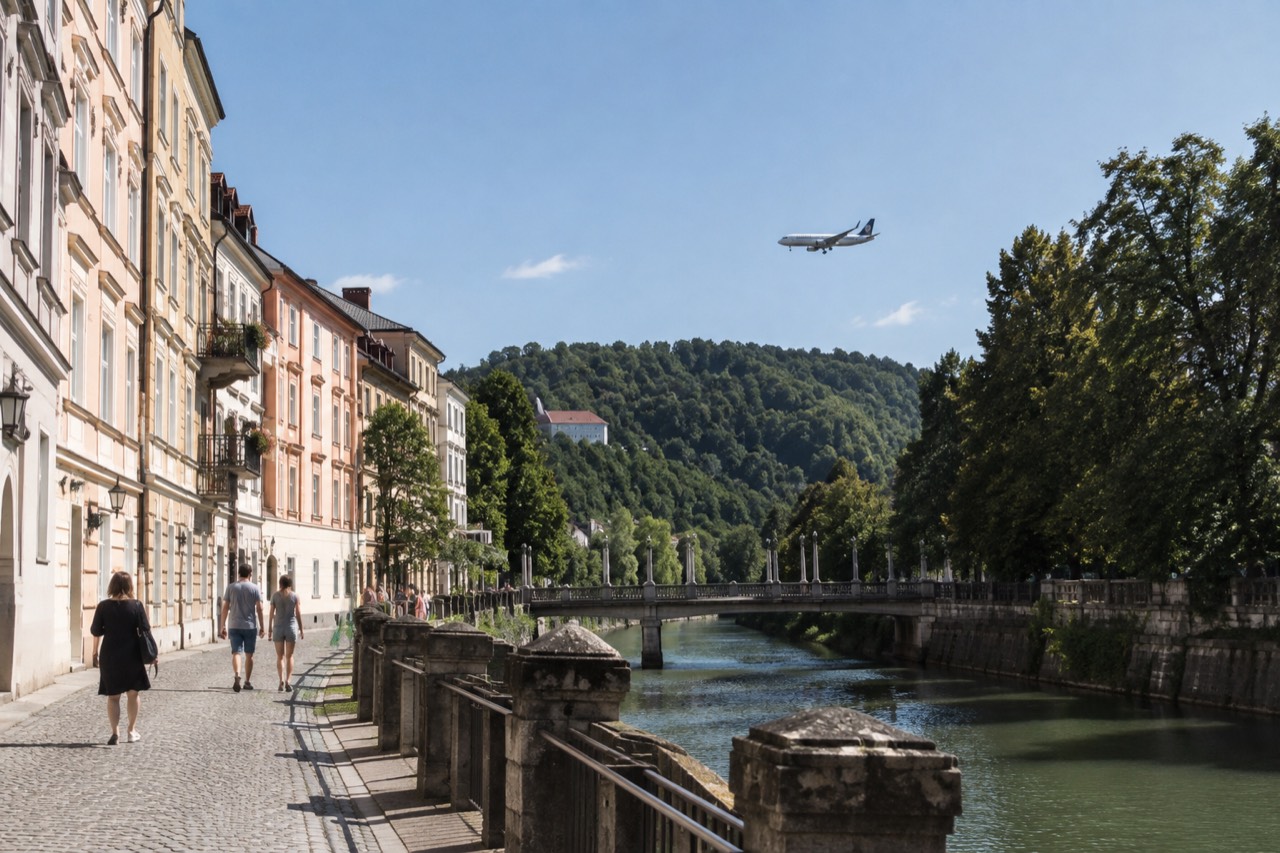
Ljubljana is served by a single commercial airport, Jože Pučnik Airport (LJU), about 26 km from the city, and its direct routes run almost entirely to other European cities. There is no fixed list worth printing: airlines add summer-only routes each spring, drop them each autumn, and shuffle year-round services between hubs, so the answer genuinely depends on the month you fly. The live timetable is the only source that does not go stale.
That is an honest opening rather than a deflecting one. Plenty of pages publish a tidy city list for this question, and those lists are usually wrong within a season, because the writers copied a timetable snapshot and moved on. Slovenia's flag-carrier history, the shape of the national market and the airport's size all mean the network is thin: a small capital in a country of under three million people, sitting between three much bigger hub airports, will never carry the route map of Vienna or Munich.
What can be stated with confidence is the pattern. Year-round services connect Ljubljana to a handful of major European hub cities, the kind of airports with their own long-haul banks, so a traveller from outside Europe almost always connects once. On top of that sits a seasonal summer layer, leisure routes that appear for the warm months, serve the Adriatic and Alpine holiday traffic, and vanish in October. In midwinter the choice narrows to the year-round core.
So the practical answer to the question is a method, not a list. Check the live timetable for your travel month through the airline or the airport's own channels, and if the month is winter, expect the summer routes to be gone. If your route question is really about which airport to use at all, the companion page on which airport to use for Ljubljana covers the alternatives in detail.
Why the List of Direct Flights Keeps Changing
Seasonality is the whole story: Ljubljana's leisure routes are built for the Slovenian summer, roughly April to October, and are withdrawn when the holiday traffic ends. Year-round hub services stay, but their frequency rises and falls with the same calendar. Any city list published in spring is partially obsolete by November, which is why this page refuses to print one and tells you where to check instead.
Slovenia's visitor economy is strongly seasonal, and airlines plan capacity against it. A route that exists to carry holidaymakers to the coast and the lakes has no winter reason to fly, so it is cut, and the announcement cycle repeats every year. This is not a Slovenian peculiarity, but Ljubljana feels it more than most capitals because the airport is small enough that a single route withdrawal visibly changes the map.
The winter reduction also collides with local weather in a way most travel pages never mention. December in the Ljubljana basin averages just 56 hours of sunshine across the whole month, against 120 hours at Kredarica on Triglav at 2514 m, per ARSO's 1981-2010 climate normals: the city sits under an inversion cap while the mountains above it are in sun. Fog follows the same rhythm, which matters for winter departures and is covered in full below.
The checking method, then: look at the live departure and arrival boards for your exact dates, not a summary article, and not a booking aggregator's marketing page. If a route exists in summer but you are travelling in February, assume it does not. And if your dates are flexible, midweek departures at a small airport are usually the cheapest and least crowded of the week.
How Far Is Ljubljana Airport from the City Centre?
Jože Pučnik Airport sits about 26 km northwest of the centre, and the transfer is short: a shuttle or taxi covers it comfortably inside half an hour outside peak traffic. A public bus service exists between the airport and the city, but its timetable and fare should be checked rather than quoted, because the airport's own site blocks automated reading and this desk does not publish numbers it cannot verify.
That last clause is deliberate. Plenty of sites print a confident airport bus fare for Ljubljana, and the honest position is that no primary source currently publishes one where it can be read and confirmed. The bus exists; treat everything else about it as a live question and check on the day. Taxis and pre-booked transfers fill the gap, and for a group the transfer cost per person closes most of the difference.
| Practical item | What is actually known |
|---|---|
| Airport code and name | LJU, Jože Pučnik Airport, Brnik |
| Distance to the centre | About 26 km |
| Airport bus | Exists; timetable and fare not published in a readable primary source, check on the day |
| Currency on arrival | The euro, adopted by Slovenia on 1 January 2007 |
| Border formalities from the EU | None; Slovenia is in the EU and the Schengen area |
| Driving into the centre | The historic centre is a pedestrian zone of roughly 20 hectares, park outside it |
One row of that table deserves its own sentence. The centre of Ljubljana is closed to general motor traffic, a pedestrianised zone progressively expanded since 2007, so no transfer vehicle will drop you at a hotel door on Prešernov trg. Plan the last few hundred metres as a walk with luggage, or choose accommodation on the edge of the zone. The full page on getting around Ljubljana handles the centre's transport picture, and the detailed transfer walkthrough lives at Ljubljana Airport to the city centre.
If you are still choosing how to arrive at all, three of the most useful things to do on the ground can be booked before you land, and one of them, the free GuruWalk walking tour, costs nothing upfront.
Whichever of those you take, book the day after arrival rather than the day of it. Flights into a basin city in the colder half of the year can land late, and the first evening is better spent on the Ljubljanica than on a coach heading underground.
Can You Reach Ljubljana Without a Direct Flight?
Yes, and for many travellers it is the better plan: fly into a larger hub such as Zagreb, Trieste or Venice and continue overland, because Slovenia sits inside the Schengen area, so there are no routine border checks arriving from Italy, Austria, Hungary or Croatia, and no currency to change anywhere in the region. Croatia joined Schengen and the euro on 1 January 2023, so the Zagreb route is now an internal one too.
That single fact changes the arithmetic of this whole question. A visitor weighing a connecting flight against a landing in a neighbouring capital is not weighing a border crossing; both are border-free. The overland legs are short by European standards, and the rail and coach links into Ljubljana are covered on the page about direct trains to Ljubljana, which lists where the city's trains actually run to.
Zagreb deserves a special mention for two reasons. First, as a Croatian capital with a larger airport, it often carries routes Ljubljana does not, and the transfer between the two capitals is an internal Schengen move since Croatia's 2023 accession. Second, the Zagreb leg itself can be turned into part of the trip: there is a full-day guided trip from Ljubljana to Zagreb in the tour roster, which runs the route in the opposite direction and shows how manageable the distance is. Everything else covered here is indexed on Ljubljana Travel Guide.
Trieste works the same way from the Italian side. The reaching Ljubljana via Trieste page covers the Italian border route, and Venice, with its big hub airport, is a recognised overland gateway too. The British side of the question, which airports actually serve the route from the UK, has its own dedicated page on UK airports flying to Ljubljana.
The Schengen detail, for the record, has a two-date structure that most summaries flatten. Slovenia abolished checks at its internal land and sea borders on 21 December 2007 and at its internal air borders on 30 March 2008, per the Slovenian government's own EU membership page. The practical consequence in either direction is the same: arriving from a neighbouring Schengen country involves no stop at all.
Once you are on the ground, the arrival day stops being a logistics problem. The Postojna Cave and Predjama Castle tour turns a spare half day into the single most reliable wet-weather or any-weather excursion in the country, because the caves hold roughly the same temperature year round.
Does Winter Fog Affect Flights Into Ljubljana?
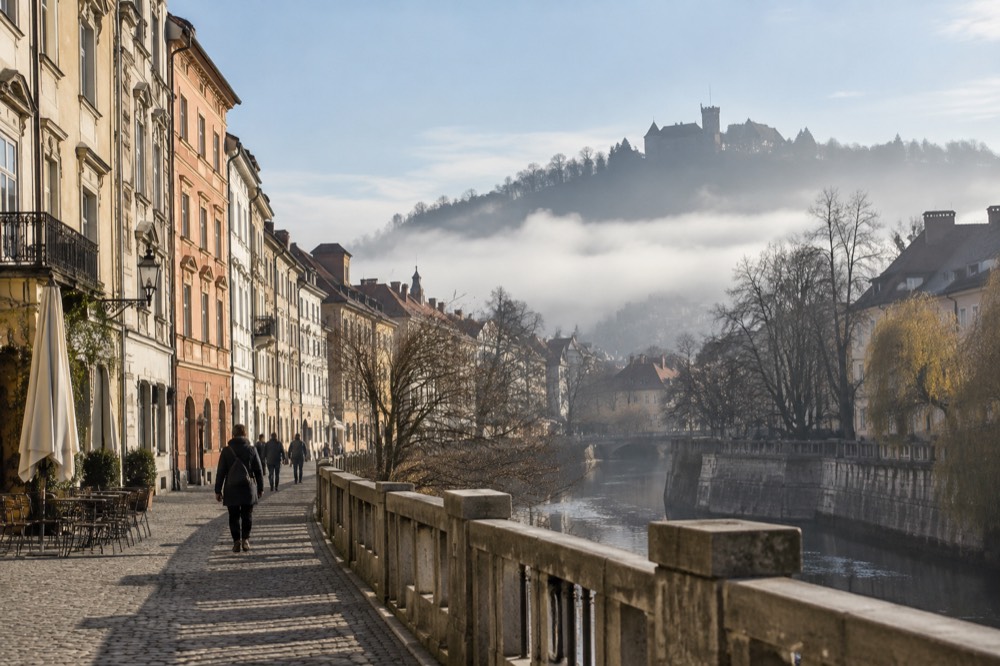
Yes, materially. Ljubljana sits on the floor of a basin, and in the colder half of the year cold air is trapped under warmer air above it, so the city fogs in while hills a few hundred metres up sit in sunshine. ARSO's 1971-2000 normals put the city at 91.2 fog days a year, with December the peak at 12.6 and September and October nearly level at 12.4 each, above January's 11.3.
That September and October figure is the one that surprises people, and it is double-checked rather than folklore: the same series shows September as the most humid morning of the year at 94 percent relative humidity at 07:00, ahead of October at 93. The early-autumn shoulder in Ljubljana is not the crisp dry season visitors assume; it is joint-wettest and joint-foggiest. ARSO's 1981-2010 table, a different reference period that must never be mixed into the same sentence, shows September and October tied as the wettest months at 147 mm each, above July's 115 mm.
| Month | Average days with fog (ARSO, 1971-2000) |
|---|---|
| December | 12.6 |
| September | 12.4 |
| October | 12.4 |
| January | 11.3 |
| November | 10.4 |
| Whole year | 91.2 |
For a flyer, the consequences are practical. Winter and early-autumn arrivals should build slack into any same-day plans: a morning landing followed by an afternoon tour is a tighter connection than it looks on paper when the basin is capped. And when fog does close in, the surrounding hills are frequently in clear air, which is why the site's strongest planning advice for a grey Ljubljana day is to go up rather than to wait it out, whether that means the castle funicular, Šmarna gora or a day trip into the Alps.
The sunshine numbers behind that advice are primary-sourced. ARSO's 1981-2010 normals give Ljubljana 56 hours of December sunshine and 71 in January, against 120 and 139 at Kredarica on Triglav. The lines cross: the city wins April to September and loses every winter month. A December visitor who heads for the mountains can double their sunshine; one who stays on the basin floor will not.
What Is Worth Booking Once You Land?
Three things repay booking ahead: a cave day trip, because Postojna's timed tours fill first in peak season; a Lake Bled excursion, because the lake carries more search demand than the entire city and coach and tour capacity follows that demand; and a free GuruWalk walking tour, which costs nothing upfront and is the cheapest possible orientation on day one. Leave the arrival day itself empty.
The Postojna Cave and Predjama Castle tour from Ljubljana is the workhorse of that list. It packs the cave train ride, the underground route and the cliff castle into one day, and it is the trip this desk points at for bad weather of any kind, since the cave temperature is steady whatever the sky above is doing. You can see the details and current times on the Postojna Cave and Predjama day tour page, or go straight to the live listing: Check availability.
Lake Bled is the second booking, and it is a bigger draw than most visitors expect before they arrive: people search for Bled more than they search for the capital, and day-trip capacity reflects that. The planning a day at Lake Bled guide covers the lake itself, including the seasonal Vintgar Gorge, which closes for winter between roughly April and October, so its opening window should be checked before it is counted on in an itinerary.
The third booking is the free one. GuruWalk runs a tips-based Old Town walk covering the route from Roman roots to the dragon bridge, and because it is pay-what-you-think-it-was-worth, it fits day one when budgets are still theoretical. Between those three, an arrival week in Ljubljana fills itself, and the rest of what the city offers is close enough to walk to.
If you are still deciding between the city and the lake as a base, that comparison has its own page, and it is a genuine dilemma rather than a formality: the two answer different itineraries.
Common Questions About Direct Flights to Ljubljana
What Cities Fly Direct To Ljubljana?
Ljubljana's single airport, Jože Pučnik (LJU), about 26 km from the centre, is served mainly by direct routes to other European cities, split between a small year-round hub core and seasonal summer services. Because the seasonal routes are added in spring and dropped in autumn, no printed city list stays correct; check the live timetable for your travel month.
Does Ljubljana have two airports?
No. Ljubljana is served by one commercial airport, Jože Pučnik at Brnik, about 26 km from the city. Some travellers use nearby airports in other countries, such as Zagreb, Trieste or Venice, and continue overland, which is border-free within the Schengen area.
Do I need to change money arriving in Ljubljana?
Not if you hold euros. Slovenia adopted the euro on 1 January 2007, so cash machines and cards in Ljubljana work in euros, and visitors from the eurozone need no currency exchange at all.
Is there a border check travelling to Ljubljana from Croatia or Italy?
No. Slovenia has been in the Schengen area since 21 December 2007, when it abolished checks at its internal land and sea borders, with air borders following on 30 March 2008. Croatia joined Schengen and the euro on 1 January 2023, so arriving from Zagreb, Trieste or Venice involves no routine border stop.
How do I get from Ljubljana Airport to the city centre?
The airport is about 26 km from the centre. Taxis and pre-booked transfers run the transfer, and an airport bus exists, but its fare and timetable should be checked on the day rather than taken from a printed source. Note that the historic centre is pedestrianised, so any vehicle drops you at the edge of the zone.
Can fog disrupt a winter flight into Ljubljana?
Yes. Ljubljana sits in a basin where fog is frequent in the colder half of the year, averaging 12.6 fog days in December and 12.4 in both September and October per ARSO's 1971-2000 series. Build slack into same-day plans when landing in those months.