Škofja Loka from Ljubljana: A Medieval Town Day Trip
Škofja Loka is the medieval town most Ljubljana visitors never meet, sitting close enough for an easy half-day escape and quiet enough that you will have its squares largely to yourself.
Short answer
Škofja Loka is a small medieval town a short bus or car ride north-west of Ljubljana, small enough to see properly in half a day. Go in the morning, walk the old town and the castle hill, and be back in the capital by late afternoon. Buses run from Ljubljana's main station and the fare is a couple of euros.
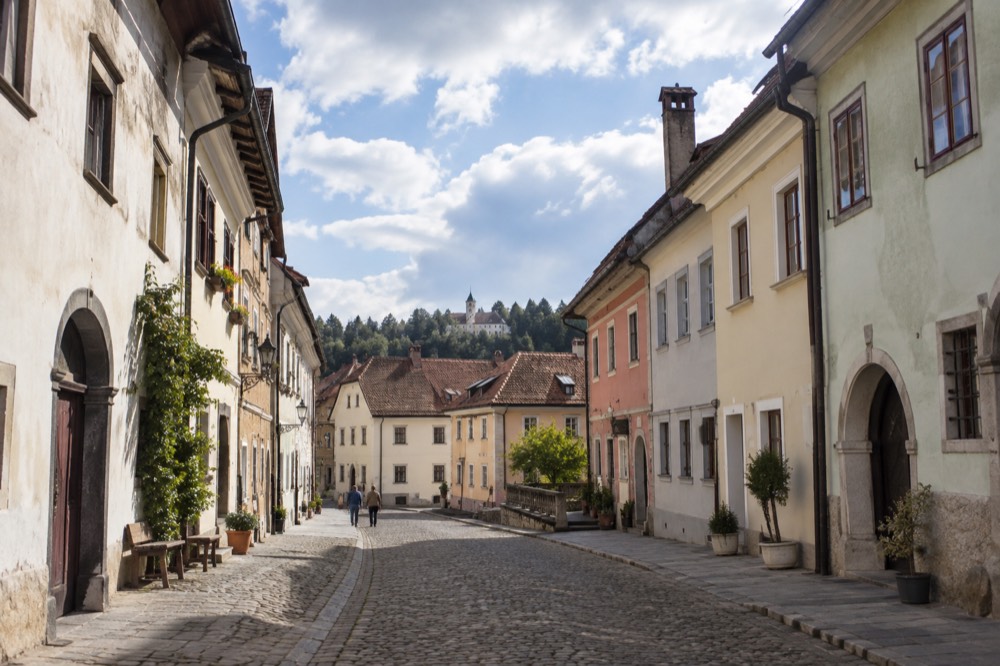
Škofja Loka does the thing most day-trip destinations cannot: it feels far from the capital while being close to it. The town is one of the best-preserved medieval settlements in Slovenia, a cluster of coloured facades, cobbled lanes and a castle hill, and it sits within easy reach of Ljubljana. Where Bled arrives with crowds attached, Škofja Loka mostly arrives with silence, which is exactly why people who live in Ljubljana speak of it the way Parisians speak of their own small-town escapes.
The name helps nobody at first. Loka means "meadow by the water" in old Slovene, and the town sits where the Selška Sora and Poljanska Sora rivers meet before continuing on as one. That river junction shaped the town, and it still shapes a visit: the old core is compact, walkable end to end in twenty minutes at a stroll, and surrounded by water on three sides. This Ljubljana Travel Guide page covers the practical side of the trip, the sights worth your morning, the weather logic behind the timing, and how to fold the town into a wider day-trip plan.
How Do You Get from Ljubljana to Škofja Loka?
Škofja Loka is reached by regional bus or by car from Ljubljana, and the journey is short enough that you need not plan around it the way you would for Bled or the coast. Buses leave from Ljubljana's main bus station, tickets cost a few euros each way, and no reservation is needed: this is a commuter route, not a tourist service. The drive takes roughly half an hour to forty minutes.
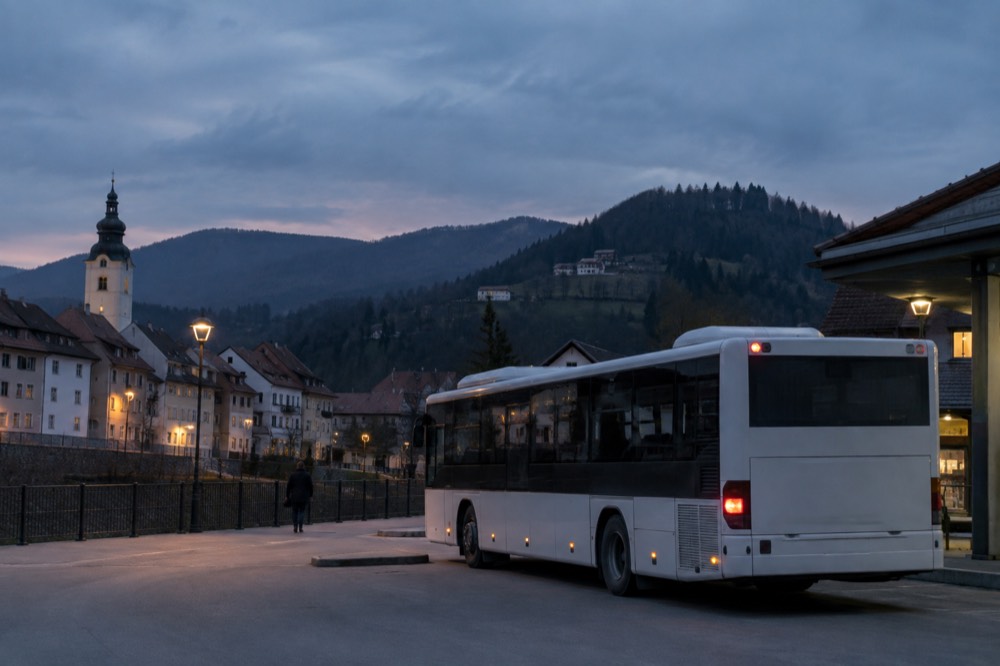
The bus is the honest recommendation for most visitors. Ljubljana's centre is pedestrianised, roughly twenty hectares closed to general traffic and progressively expanded since 2007, so a car buys you nothing in the capital itself and only convenience on the road out. If you do drive, the logic is the same as for any day trip from Ljubljana: park at the edge of the old town, walk in, and leave the car until you leave. For more on the city's car-free core and what it means for arriving drivers, see the Ljubljana centre and Old Town guide.
One point on payment, because it catches visitors out elsewhere in the country: on Ljubljana's city buses cash is not accepted at all. You either hold an Urbana card, which costs 2.00 EUR to buy and covers a 90-minute zone 1 ride at 1.50 EUR including transfers, or you tap a contactless bank card or phone on board. Regional coaches are a different system and do take cash, but if your day starts with a city bus to the main station, the no-cash rule applies. The full detail is in paying for public transport in Ljubljana.
| Option | Where it starts | Best for | Watch out for |
|---|---|---|---|
| Regional bus | Ljubljana main bus station | Most visitors; cheap, frequent, no booking | Fewer departures on Sundays and holidays |
| Rental car | City pickup points | Combining Škofja Loka with villages in the Poljane valley | The old town itself is closed to through traffic |
| Taxi or transfer | Anywhere in the city | Groups and tight schedules | Costs far more than the bus for a solo traveller |
| Guided day trip | Hotel pickup points | Visitors who want the day fully arranged | Check the itinerary actually stops in Škofja Loka |
What Is There to See in Škofja Loka?
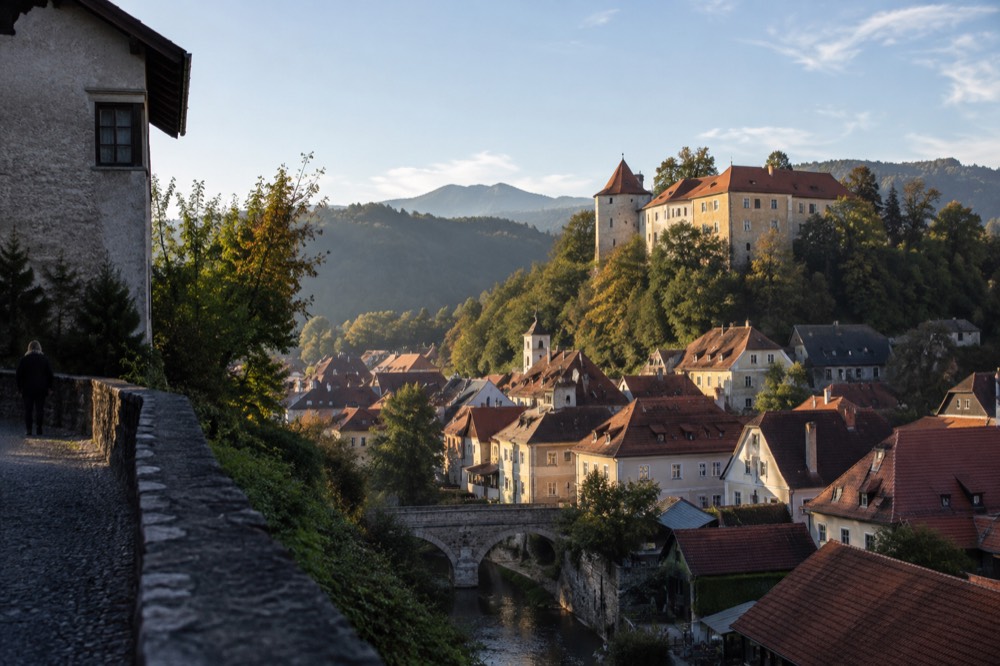
The old town itself is the sight: a compact core of medieval squares, painted houses and riverside walks, with the castle on the hill above it. You wander rather than queue. The castle houses the town museum and gives you the best view over the red roofs and the two Soras, and the whole visit, castle included, fits comfortably into a morning. Add a riverside loop and a slow lunch and you have used the town well.
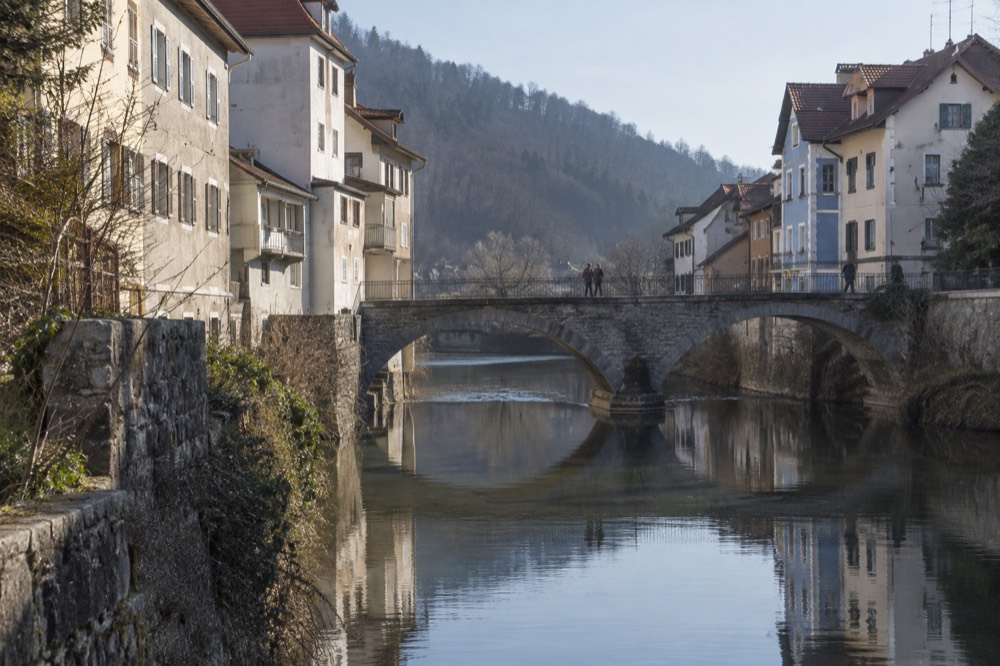
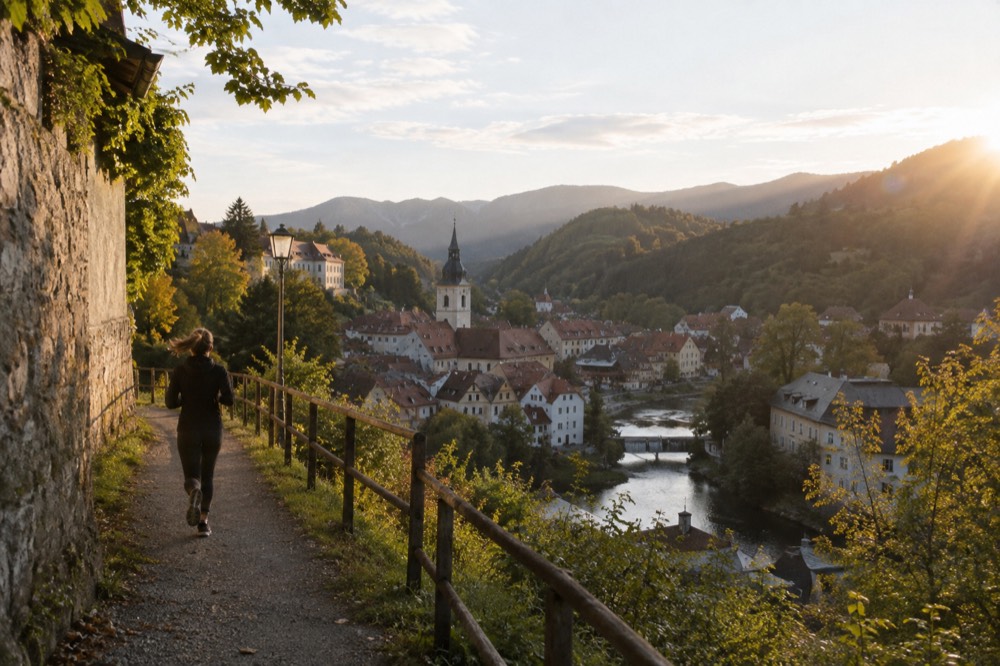
Start at the lower square and let the streets decide the route. The town's layout has barely changed since its medieval period, which is the whole appeal: the squares, the lanes between them and the bridges over both rivers form a loop you can walk without a map and still end up where you started. The painted facades, some carrying frescoes, are the signature look, and the riverside paths below the town are where the postcard angles are.
The castle above is the one structured stop. It sits on a hill a short climb from the old core, and its museum covers the town's history and the surrounding region. Views from the grounds take in the whole basin, the meeting of the two rivers and the hills of the Poljane and Selca valleys beyond, which is a useful preview if you plan to drive further. Give the castle an hour and a half at a generous pace, less if you only want the viewpoint.
A useful pairing, if you want structure on your first day in the capital before or after this trip: the free Ljubljana Unveiled walk on GuruWalk, rated 4.91 from 1,496 reviews, is a tips-based two-hour walk from the city's Roman roots to the dragon bridge. It costs nothing up front, you pay what you think it was worth, and it orients you in the capital in a way that makes the contrast with Škofja Loka's quiet squares sharper. See the free walking tour guide for how these walks work in practice.
The two experiences sit well next to each other in a single itinerary. One gives you the capital's stories at a guide's pace, the other gives you a town small enough that no guide is needed, and together they cover both halves of what the region does best: a lively small capital and the quiet country within an hour of it.
When Is the Best Time to Visit Škofja Loka?
Go in the morning, and go between late spring and early autumn if you have the choice. The town is a basin settlement like Ljubljana itself, and the same fog logic applies: September and October average 12.4 fog days each in the region's published normals, level with December, so the early-autumn shoulder is not the crisp clear season people assume. Winter visits are atmospheric but grey; the clearest, most reliable light runs May through August.
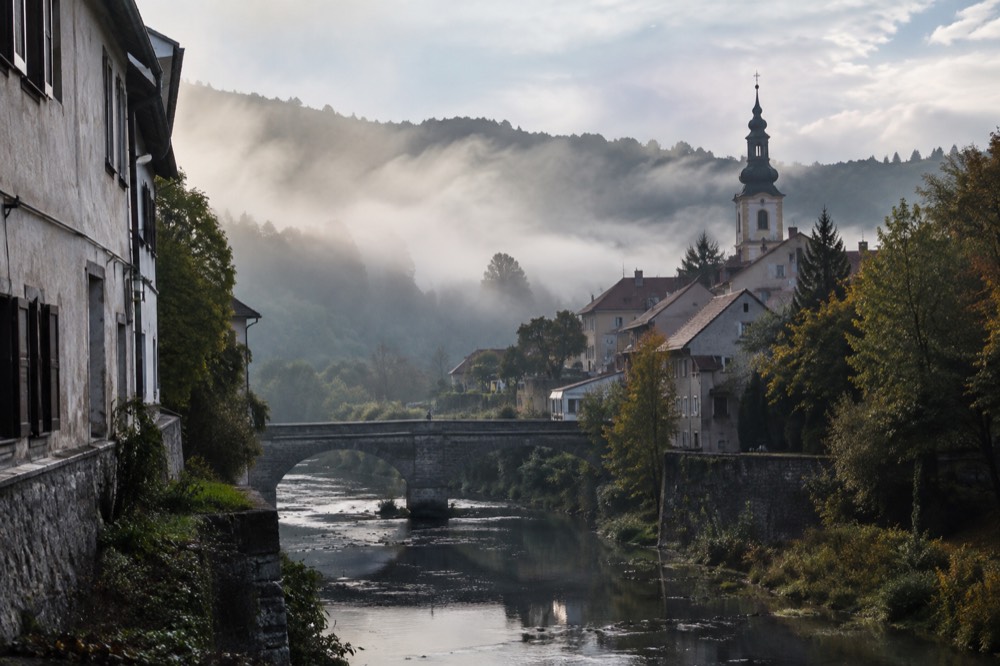
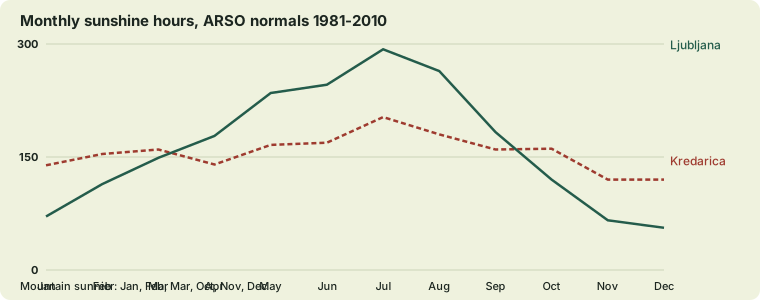
This is where the local climate data earns its place in your planning. Ljubljana sits on the floor of a basin at 299 m, and in the colder half of the year a temperature inversion caps the basin: cold air is trapped under warmer air above, the city fogs in, and the hills a few hundred metres up sit in sunshine. ARSO's 1981-2010 normals give Ljubljana just 56 hours of sunshine in the whole of December against 120 hours at Kredarica, 2,514 m up on Triglav, and 37 clear days a year against 130 overcast. Škofja Loka shares the basin: on a December morning the town can be under grey while the hilltop above the castle is in light.
The counterintuitive detail, and one most guides get wrong: the foggiest months here are not midwinter. ARSO's 1971-2000 series, the only period in which fog is published, gives Ljubljana 12.4 fog days in September and 12.4 in October, above January's 11.3 and within a rounding step of December's 12.6. The same 1981-2010 table makes September and October the joint wettest months at 147 mm each, above July's 115 mm. Autumn is not the dry shoulder season people imagine, so if you visit then, plan for the possibility of a grey, damp morning and treat a clear one as a gift.
| Season | What to expect | Why it matters for this trip |
|---|---|---|
| May to August | The sunniest stretch; Ljubljana's July mean is 21.3 C | Best light for photos, warm riverside walking |
| September to October | 147 mm of rain each month, 12.4 fog days each | Lovely when clear, grey when not; pack a layer |
| November to February | 56-71 hours of sunshine a month in the basin | Atmospheric, quiet, but expect grey and fog |
| March to April | Warming fast, mixed skies | Fewer visitors, changeable weather |
If the weather turns against you entirely, the honest answer is to swap the outdoor day for an underground one. Caves hold roughly the same temperature year round, which is why they are the reliable wet-weather and heatwave option anywhere in Slovenia. The Postojna Cave and Predjama Castle trip from Ljubljana runs six hours, is rated 4.8 across 2,802 reviews, and costs from $132 with entry tickets included. The cave holds 10 C whatever the month, so a jumper is the only planning item that matters.
The swap works in both directions, which is worth knowing before you commit to a date. A forecast of heavy rain turns Škofja Loka's riverside loop into a soggy half hour, but the cave barely notices weather at all, and a heatwave that makes the old town's cobbles glare does nothing to a chamber that has held the same temperature through every Slovenian summer on record.
How Long Do You Need in Škofja Loka?
Half a day is the honest answer, and a full day is the generous one. The old town walks in under an hour, the castle museum adds ninety minutes, and lunch with a riverside loop fills the rest of a morning. Most visitors arrive mid-morning and leave by mid-afternoon, which is exactly the right shape for a trip this close to Ljubljana, and it leaves your evening free for the capital.
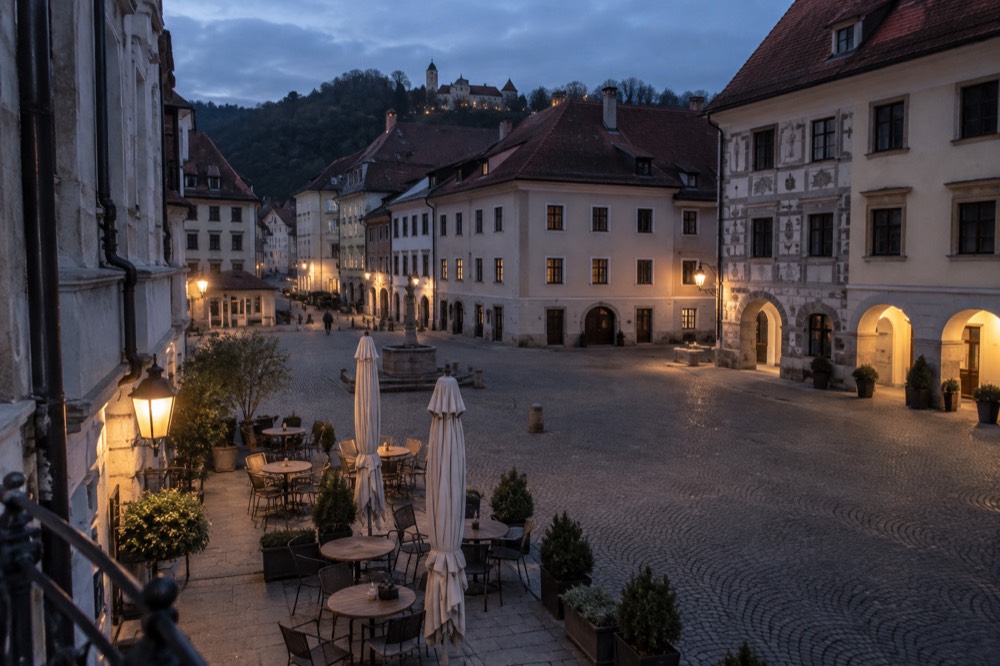
The half-day shape works like this: take a mid-morning bus, walk the lower square and the lanes between the rivers first while the light is still good on the facades, climb to the castle before lunch, eat in the old town, and walk one riverside loop before catching a bus back. That is a full and unhurried visit. The full-day version adds the wider valley, either [by bus](https://busbud.tpk.ro/4kLAIElq) deeper into the Poljane valley or by car along the river roads, and turns the trip into a proper country day.
What you should not do is treat Škofja Loka as a one-hour photo stop sandwiched between two bigger destinations. The town's whole value is its pace. If your itinerary only allows an hour, you will see the squares and miss the town, because the thing you came for, the quiet, needs a slow coffee to work on you. The one day in Ljubljana guide shows how to split a single day between the capital and one short escape, and Škofja Loka is the easiest escape to bolt on.
| Time budget | What fits | Verdict |
|---|---|---|
| 2 hours | Lower square, one bridge, back to the bus | Too short; you see a street, not the town |
| Half day | Old town loop, castle museum, lunch | The sweet spot for most visitors |
| Full day | Everything above plus the Poljane valley | Worth it with a car or on a fine day |
| Overnight | Town after the day visitors leave | Only for slow travellers; the town is small |
How Does Škofja Loka Compare with the Other Day Trips from Ljubljana?
Škofja Loka is the quiet, closest and cheapest of the classic day trips, and the one that depends least on weather and booking. Bled is the headline scenery, Postojna is the underground spectacle, and the coast is the long-haul option; Škofja Loka is the town you visit when you want medieval streets rather than nature, and when you want to decide on the morning itself rather than a week ahead.
The comparison that matters is with Bled, because Bled carries more search demand than the entire city of Ljubljana and is the default day trip for almost everyone. Bled deserves that: the lake, the island church and the castle cliff are a genuine spectacle, and the Lake Bled guide covers it properly. But Bled in summer is busy in a way Škofja Loka never is, and the two answer different moods. If your Ljubljana days are already heavy on organised trips, Škofja Loka is the antidote; if this is your one big day out, Bled is the stronger single memory.
The underground option works differently again. Postojna Cave costs 34.90 EUR adult and Predjama Castle 24.00 EUR when you buy direct, and the six-hour combined tour from Ljubljana, rated 4.8 from 2,802 reviews and from $132, folds both into one handled day with transport and tickets arranged. The cave's year-round 10 C makes it the trip that cannot be rained off. The Postojna Cave guide has the full detail on timings and what the tour inside involves.
| Day trip | Travel effort | Weather dependence | Best for |
|---|---|---|---|
| Škofja Loka | Low; a short bus ride | Low; it is a town, not a viewpoint | Medieval streets, quiet, spontaneity |
| Lake Bled | Moderate; coach or tour | High; the lake is the point | The signature Slovenian image |
| Postojna Cave and Predjama | Moderate; 6-hour tour | Very low; the cave holds 10 C year round | Rainy days, families, guaranteed spectacle |
| Piran and the coast | High; the longest ride | High; you go for the sea | Coastal atmosphere, seafood |
| Soča Valley | High; a 10-hour day | High; you go for the water and the peaks | Alpine drama, active travellers |
What Should You Know Before You Go?
Slovenia uses the euro, sits inside the Schengen area and the European Union, and Škofja Loka is a cash-and-card town like anywhere else in the country, so there is no border, currency or paperwork dimension to this trip at all. What actually matters is smaller: Sunday timetables thin out, most museums in the region close on Mondays, and the town's restaurants fill at local lunch hours rather than tourist ones.
Practicalities first. The euro has been Slovenia's currency since 1 January 2007, and Schengen's internal land and sea border checks were abolished on 21 December 2007, with air checks following on 30 March 2008, so a visitor coming from Italy, Austria, Hungary or Croatia crosses nothing that resembles a border. Cards are accepted almost everywhere; carry a few euros in coins only for small purchases at market stalls.
Timing matters more than money. If your Škofja Loka day is a Monday and you want museums, check openings before you commit, because Monday is the standard closing day across Slovenian museums, including the National Gallery and the City Museum in the capital. A useful capital-side tip for museum lovers: the national institutions in Ljubljana, including the National Gallery and the Slovenian Ethnographic Museum, admit visitors free on the first Sunday of every month, which pairs neatly with a paid day trip later in the week.
Eating in the town is part of the visit rather than a break from it. The old town's restaurants serve the same Slovenian repertoire you meet in the capital, and the where to eat in Ljubljana guide explains what to look for, from štrukelj to river fish, if you want to recognise the dishes on a Škofja Loka menu. Lunch here runs on local hours: kitchens fill around noon and quieten by two, which suits the half-day shape perfectly.
Should You Book a Tour or Go Independently?
Go independently for Škofja Loka itself, because the bus is simple, the town needs no guide and the freedom to linger is the whole point. Book tours for the trips where logistics actually bite: the long alpine days, the cave combinations, and anything where you would otherwise spend your holiday studying timetables. A mixed plan, one or two booked days plus independent ones, is usually the right answer for a week in the region.
The economics are simple. A bus ticket to Škofja Loka costs a few euros each way; a full-day guided tour from Ljubljana runs from around $57 for the basic Lake Bled day tour, rated 4.8 from 888 reviews, to $141.97 for the twelve-hour Triglav National Park tour at 4.9 from 205 reviews. You pay that premium for transport, a guide and the removal of decision fatigue, not for access, since the Triglav National Park guide shows how much of that landscape is free to enter on your own.
| Approach | Typical cost | What you get | When it wins |
|---|---|---|---|
| Independent bus to Škofja Loka | A few euros each way | Total freedom, local pace | Short trips, tight budgets, spontaneous days |
| Lake Bled day tour from Ljubljana | From $57 | Coach, guide, the headline lake | First-time visitors, no-car travellers |
| Postojna and Predjama combined tour | From $132 | Transport plus both entry tickets | Rainy days, families, anyone short on time |
| Full-day Triglav National Park tour | From $141.97 | Twelve hours of alpine scenery, guided | Confident walkers who want the peaks handled |
If you do book, book the day trips that are hard to improvise and walk the rest. The Lake Bled and Bled Castle trip, six hours at 4.7 from 1,641 reviews and from $86, is the classic booked day; the free GuruWalk city walks are the classic unbooked one. And if your Škofja Loka afternoon leaves you with energy for the capital, the Ljubljana Castle entry ticket with optional funicular, from $17 and rated 4.3 from 993 reviews, is the easy evening add-on: the castle grounds are free to wander, and the funicular and tower are the paid parts.
One last planning thought. Ljubljana is, on the numbers, a two-night city: 2,844,129 overnight stays across 1,392,728 arrivals in 2025 works out to an average stay of about 2.04 nights. That means most visitors have room for exactly one or two day trips, not five. Choose Bled or the caves for the big booked day, and give Škofja Loka the spare morning, because it is the one destination on this list that asks nothing of you in advance.
That low-commitment quality is the town's real selling point, and it is worth protecting. The big day trips reward planning and punish hesitation, with booked coaches, fixed departure times and itineraries that eat a whole daylight block. Škofja Loka asks only that you turn up at a bus station with a couple of euros and a free morning, and it hands back a medieval town in exchange, which is a trade very few destinations anywhere in Europe still offer.
Common Questions About a Škofja Loka Day Trip from Ljubljana
How do you get to Škofja Loka from Ljubljana?
Regional buses run from Ljubljana's main bus station to Škofja Loka, with tickets costing a few euros each way and a journey of roughly half an hour to forty minutes. It is a commuter route, so there is no need to book ahead, though Sunday and holiday timetables are thinner. Driving is also straightforward, with parking at the edge of the old town.
How much time do you need in Škofja Loka?
Half a day is the honest answer. The old town walks end to end in under an hour, the castle museum adds about ninety minutes, and lunch with a riverside loop fills a morning comfortably. A full day lets you continue into the Poljane valley, but the town itself is small.
Is Škofja Loka worth visiting compared with Bled?
They answer different moods. Bled is the signature Slovenian spectacle and the busier for it; Škofja Loka is the quiet medieval town with barely any crowds. If you have time for only one big day trip, Bled or the Postojna caves are the stronger single memories, but Škofja Loka is the better second trip and the better spontaneous one.
When is the best time of year to visit Škofja Loka?
Late spring through summer gives the most reliable light, May to August being the sunniest stretch in the basin. Autumn is lovely when clear but statistically greyer than people expect: September and October average 12.4 fog days each in the published 1971-2000 series and 147 mm of rain each in the 1981-2010 normals. Winter visits are atmospheric but expect fog and short grey days.
Do you need a tour for Škofja Loka?
No. The bus is simple, the town is compact and the pleasure of the place is wandering it at your own pace. Tours earn their price on the harder logistics, the cave combinations and the long alpine days, where transport and timing genuinely bite. Škofja Loka is the trip you can decide on over breakfast.
What should you eat in Škofja Loka?
The old town's restaurants serve the standard Slovenian repertoire, so expect štrukelj, river fish and hearty stews rather than a distinct local menu. Lunch runs on local hours, kitchens filling around noon and quietening by two, which suits the half-day visit perfectly.