Is It Expensive to Eat Out in Ljubljana?
An honest answer to whether eating out in Ljubljana is expensive, with the real costs that shape a food budget and the cheap routes locals actually use.
Is It Expensive to Eat Out in Ljubljana?
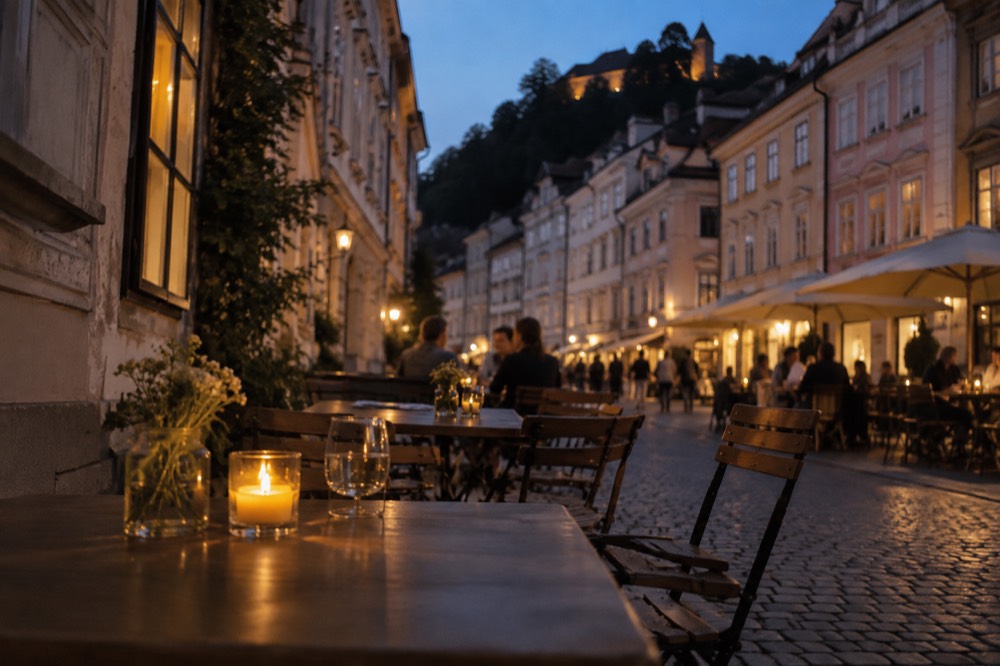
No, not by the standards of Western Europe, though it is not the bargain corner of the Balkans either. Ljubljana uses the euro, restaurant prices sit well below Paris, Amsterdam or Vienna, and the tourist board's own figures show the average visitor stays about two nights, which is a short window in which to spend much. The real variable is not the city but the table: a riverside terrace in the pedestrianised centre prices differently from a neighbourhood bistro ten minutes' walk away.
The short version is that Ljubljana is a mid-priced European capital for food, cheaper than the big western cities, pricier than Zagreb or Belgrade, and full of cheap routes that most visitors never find because they never leave the prettiest three streets. The historic centre is pedestrianised, which concentrates everyone into a small, attractive zone, and anywhere that pretty and that walkable will carry a premium on the terrace.
That premium is the single biggest lever on your budget. Walk five minutes off Prešeren Square and the same kitchen traditions cost less. The city is compact, flat and safe to wander after dark, so moving one neighbourhood over for dinner costs you nothing but ten minutes, and it is the difference between a mid-priced meal and a cheap one.
One structural cost is easy to forget because it is not on the menu: the tourist tax. Ljubljana charges 3.13 EUR per person per night, a 2.50 EUR tax plus a 0.63 EUR promotion surcharge, with a half rate of 1.57 EUR for ages 7 to 18 and under-sevens exempt. It is small, but it is part of the true cost of a food-focused stay, and it is charged at the accommodation, not the restaurant.
How Does Eating Out in Ljubljana Compare with Other Cities?
Ljubljana prices food like a mid-tier eurozone capital: clearly cheaper than the western giants, broadly level with Prague or Kraków once you are out of the tourist core, and more expensive than non-eurozone capitals to the south and east. No official source publishes a restaurant-price comparison between European capitals, so this page does not invent one, and any site quoting a precise euro figure for an average Ljubljana dinner is guessing. What can be stated is the currency, the structure and where the money goes.
Slovenia has been in the European Union since 1 May 2004 and adopted the euro on 1 January 2007, so there is no currency conversion to pad the bill and no exchange-rate surprise for eurozone visitors. That matters for perception as much as for cost: prices are printed in the same euros a visitor from Berlin or Vienna already thinks in, which makes Ljubljana feel more expensive than a city where the menu is in a smaller-numbered currency.
The structure of the bill is also visitor-friendly by regional standards. Service is included in the printed price rather than added at the end, and a tip is a rounding-up gesture rather than an expected percentage. Nobody will chase you for 15 to 20 percent, and the printed price is the price. That is a genuine cost difference against the United States and a perceptual one against cities where the menu price is only two-thirds of the story.
| Cost factor | How it works in Ljubljana | Effect on your food budget |
|---|---|---|
| Currency | Euro, since 1 January 2007 | No conversion padding for eurozone visitors |
| Service | Included in the menu price | The printed price is close to the final price |
| Tourist tax | 3.13 EUR per person per night at accommodation | Small, but part of the real cost of staying |
| Location premium | Highest in the pedestrianised centre | Falling fast a few streets out |
| Cheap routes | Central Market, Open Kitchen, self-catering | Can cut daily food spend sharply |
The comparison question is really a location question. If you need a fuller city-wide cost picture, the Ljubljana prices guide breaks down transport, attractions and food together, and the broader question is Ljubljana expensive for tourists covers the whole budget, not just the table.
How Do You Eat Well in Ljubljana Without Overspending?
The cheapest good food in Ljubljana is not in a restaurant at all. The Central Market's outdoor stalls on Vodnikov and Pogačarjev trg run roughly 06:00 to 18:00 Monday to Saturday in summer, the covered halls open Monday to Friday 07:00 to 16:00 and Saturday 07:00 to 14:00, and on Fridays from about March to November the Open Kitchen street-food market takes over Pogačarjev trg from 10:00 until late.
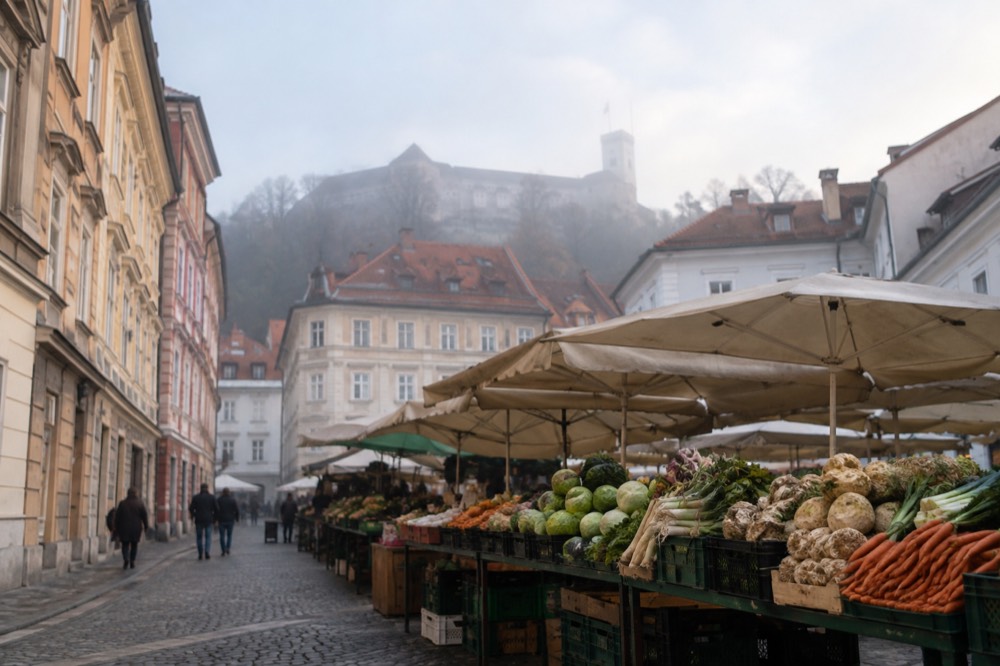
The Central Market, the work of architect Jože Plečnik, is the city's food engine and it sits inside the pedestrian zone, so it costs nothing to reach on foot. The operator's published hours are the planning detail: outdoor stalls roughly 06:00 to 18:00 Monday to Saturday in summer and 06:00 to 16:00 in winter, with limited Sunday and holiday opening April to November, and the covered halls on a shorter weekday clock. Arrive in the morning for the full spread, because the market thins well before the posted closing time. The wider set of guides lives on Ljubljana Travel Guide.
Open Kitchen, Odprta Kuhna, is the single best-value eating event in the city. It runs on Fridays on Pogačarjev trg, roughly March to November, from 10:00 to 21:00 and later on warm days, with chefs cooking across a dozen stalls. One caveat the official page states plainly and most guides miss: the wording is "every sunny Friday", which is literal. The market is cancelled in bad weather, so check the forecast before you build a Friday around it. The tourist board's own event page carries the current season's details.
Beyond the market, the cheap-eating playbook is the same as anywhere in Central Europe: eat where the tables are not facing a view, take the lunch menus that Slovenian restaurants run on weekdays, and treat the riverside terraces as an occasional treat rather than a default. The where to eat in Ljubljana guide maps the neighbourhoods worth walking to, and the Open Kitchen guide goes deeper on the Friday market.
Self-catering is a genuinely good option here, not a consolation prize, because the market makes it easy and the tourist infrastructure supports it. If you are weighing a sightseeing pass against food spending, the [Ljubljana Card guide](/guides/ljubljana-card/) runs the numbers on the 41 EUR, 49 EUR and 54 EUR tiers: the card covers transport, the castle funicular, the river cruise and museums, but food is never in it, so your restaurant budget sits outside the pass entirely.
Do Food Tours Pay for Themselves in Ljubljana?
A food tour in Ljubljana is not a money-saving device, it is a money-explaining one. The Slovenian Cuisine Walking Tour with Tastings runs four hours, is rated 4.8 from 552 reviews and costs from $104, and the Food and Wine Tour runs three hours, is rated 4.9 from 282 reviews and costs from $112.32. Both convert a food budget into context you can reuse for the rest of the stay.
The case for a tour early in the trip is that Ljubljana's food is unfamiliar to most first-time visitors. Štrukelj, the rolled pastry that has its own hands-on cooking class, rated 4.9 from 90 reviews and from $70, is not something most people can order with confidence on night one. A guided tasting walk names the dishes, the regions they come from and what a fair price looks like, which is exactly the knowledge that keeps the rest of your restaurant spending honest.
The wine angle deserves its own mention because Slovenian wine barely exports, so the only way to try it is here. The Wine Tasting Experience with Appetizers, a two-hour tasting rated 4.8 from 226 reviews and from $64, pairs Slovenian glasses with appetizers, and the Vipava Valley Wine Express, rated 4.9 from 140 reviews and from $126, takes the whole idea out to the vineyards for five hours. If your question is really about drinking costs, the Slovenian food in Ljubljana guide covers the everyday dishes and where they come from.
One honesty note that matters on this specific topic: the small-group Snacking Love Walk on GuruWalk is free in the tips-based sense, but its listing states the tasting carries a fixed extra cost, so it should not be planned as a zero-cost food experience. It is a good cheap walk with snacks attached, not a free lunch.
What Should You Budget per Day for Food in Ljubljana?
No official source publishes an average restaurant spend for Ljubljana, so this page does not print one, and any figure you read elsewhere should be treated as a guess dressed as data. What can be budgeted from real published numbers is the surrounding structure: 1.50 EUR for a 90-minute city bus ride, 3.13 EUR per night in tourist tax, and free entry to the national museums on the first Sunday of every month.
The honest framing is that your food budget is a choice between three modes, and Ljubljana supports all three well. The market-and-street-food mode is the cheapest and the centre makes it effortless. The neighbourhood-restaurant mode is mid-priced and is where most locals eat. The riverside-terrace mode is the expensive one, and it is a choice, not an inevitability, because the pedestrianised centre means everything is a short flat walk from everything else.
| Spending mode | What it looks like | What sets the price |
|---|---|---|
| Market and street food | Central Market stalls, Open Kitchen on Fridays | Market prices, published hours |
| Neighbourhood restaurants | Weekday lunch menus a few streets off the centre | Location premium avoided |
| Riverside terraces | The postcard tables on the Ljubljanica | The view, the pedestrian zone, the footfall |
Two practical facts round out the budget picture. City buses do not take cash: a single zone 1 ride is 1.50 EUR for 90 minutes including transfers, on a 2.00 EUR Urbana card or by contactless bank card and phone on board, so getting to a cheaper dinner neighbourhood costs almost nothing. And if you are stretching a whole city budget rather than just a food one, the Ljubljana on a budget guide collects the free and cheap options in one place.
Common Questions About Eating Out Costs in Ljubljana
Is It Expensive To Eat Out In Ljubljana?
No, not by Western European standards. Ljubljana is a mid-priced eurozone capital where service is included in the printed price, tips are optional rounding-up, and the main cost driver is whether you sit in the tourist core or walk a few streets out. No official average restaurant spend exists, so plan from your own habits rather than a quoted city figure.
Is service included in Ljubljana restaurant prices?
Yes. The printed menu price is close to the final bill, and a tip is a small rounding-up gesture rather than an expected percentage. This is a real cost difference against countries where service is added at the end.
What is the cheapest way to eat well in central Ljubljana?
The Central Market and the Friday Open Kitchen street-food market on Pogačarjev trg. The outdoor market runs roughly 06:00 to 18:00 Monday to Saturday in summer, and Open Kitchen runs Fridays about March to November from 10:00, weather permitting, because the official wording is literally "every sunny Friday".
Does the Ljubljana Card cover food?
No. The card, at 41 EUR for 24 hours up to 54 EUR for 72 hours, covers transport, the castle funicular, the river cruise, a guided walk and museum entries, but no meals or drinks, so your restaurant budget sits entirely outside it.
Are food tours a good way to spend a food budget in Ljubljana?
They are a good way to explain one. The Slovenian Cuisine Walking Tour with Tastings, four hours and rated 4.8 from 552 reviews, and the three-hour Food and Wine Tour, rated 4.9 from 282 reviews, turn unfamiliar dishes and Slovenian wines into knowledge you can reuse at every later meal.
Are the free GuruWalk food walks actually free?
Mostly, but not always entirely. The Snacking Love Walk on GuruWalk is tips-based, yet its listing states the tasting carries a fixed extra cost, so plan it as a cheap walk with a paid tasting rather than a zero-cost meal.