Is Slovenia Very Expensive?
Is Slovenia very expensive? An honest breakdown of Slovenian prices in euros: tourist tax, buses, castle tickets, cave entry, food and day trips, with ways to keep costs down.
Is Slovenia Very Expensive?
No, Slovenia is not very expensive, but it is the priciest corner of the former Yugoslavia. Prices run clearly below Austria and Italy and modestly below Germany, while sitting above Croatia and Hungary. The euro is the currency, the tourist tax is 3.13 EUR per person per night in Ljubljana, a city bus ride is 1.50 EUR, and a castle ticket with the funicular is 19.00 EUR. Budget travellers manage comfortably; luxury travellers will find plenty to spend on.
Slovenia joined the European Union on 1 May 2004 and adopted the euro on 1 January 2007, so there is no currency to change and no border to clear arriving from Italy, Austria, Hungary or Croatia. That last point matters for the money question more than people expect: the whole country is inside the Schengen area, land and sea checks lifted on 21 December 2007 and air checks on 30 March 2008, so a two-country itinerary carries no border friction or visa cost.
The honest framing is this. Slovenia is inexpensive by Western European standards and mid-priced by regional ones. A coffee and a pastry in the centre of Ljubljana costs what you would pay in a secondary Austrian town, not what you would pay in Zagreb. Where the country genuinely saves you money is transport and entry fees at the state-run attractions, which are flat, published and low.
What Everyday Things Actually Cost in Ljubljana?
The core costs are small and published: 3.13 EUR per night in tourist tax, 1.50 EUR for a 90-minute city bus ride with transfers, 19.00 EUR for the castle ticket with the funicular both ways, and 15 EUR for a 50-minute river cruise. Museum entry runs 6.50 to 12 EUR, and state museums are free on the first Sunday of every month. Food is where budgets drift: a market lunch is cheap, a riverside dinner is not.
The tourist tax is the one cost nobody sees coming, because it is added to your accommodation bill rather than advertised. Ljubljana charges 3.13 EUR per person per night, which is the 2.50 EUR tax plus a 0.63 EUR promotion surcharge. Children under 7 are exempt and ages 7 to 18 pay a half rate of 1.57 EUR, per the official tourist tax page.
City transport is a bright spot. A single zone 1 ride on LPP buses is 1.50 EUR and covers 90 minutes including transfers. The one trap: buses do not take cash at all, though contactless bank cards and phones now work on board, per LPP's payment page. The historic centre is pedestrianised, roughly 20 hectares of it, so much of a short visit needs no bus at all. Our guide to Ljubljana Travel Guide prices covers the day-to-day picture in more depth, and the getting around Ljubljana guide explains the Urbana card mechanics.
| Everyday cost | Price |
|---|---|
| Tourist tax, per person per night | 3.13 EUR (half rate 1.57 EUR, ages 7–18) |
| City bus, single ride, 90 min with transfers | 1.50 EUR |
| Urbana card purchase | 2.00 EUR |
| Castle ticket including funicular, adult | 19.00 EUR |
| Funicular only, single, adult | 3.30 EUR |
| Ljubljanica river cruise, 50 min | 15 EUR |
| National Gallery, permanent collection | 10 EUR |
| Museum of Modern Art | 7 EUR |
| Central Market outdoor stalls (summer) | Mon-Sat, 06:00–18:00 |
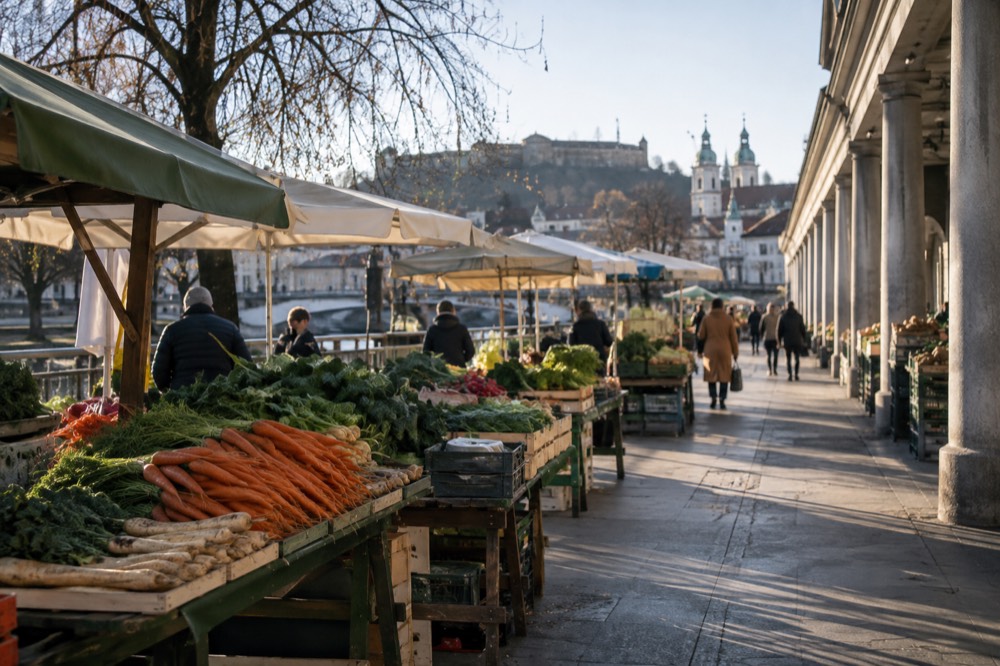
Food is the variable. The Central Market on Vodnikov and Pogačarjev trg sells produce at prices locals pay, and a burek or a market snack keeps lunch in the low single digits. A sit-down dinner on the riverside stretches the budget in the other direction. If eating well is the point of the trip, the Slovenian food in Ljubljana guide maps the affordable traditional places against the tourist-priced ones.
How Much Do the Big Attractions and Day Trips Cost?
The headline attractions are cheaper than their equivalents almost anywhere in the Alps: Postojna Cave is 34.90 EUR, Predjama Castle 24.00 EUR, Škocjan Caves 16.00 to 24.00 EUR by season, Bled Castle 19.00 EUR and the pletna boat to Bled Island 20 EUR per person. A booked day trip bundles transport and entry into one price, which is where the real comparison sits.
Caves are the signature Slovenian splurge and the prices are published plainly. Postojna Cave charges adults 34.90 EUR, students 27.80 EUR and children 6 to 15 at 20.70 EUR, per the official ticket page. The cave holds about 10 C year round, which is also why it doubles as the reliable bad-weather option. Predjama Castle, the one built into a cliff face, is 24.00 EUR separately. There is no confirmed combined ticket price we can publish, so treat those two figures as the honest baseline. Škocjan, the UNESCO-listed cave, is cheaper at 16.00 EUR in the low months rising to 24.00 EUR in July and August, but it is a three-hour walk with roughly 400 stairs rather than a train ride.
Lake Bled, which draws more search demand than the entire city, is gentler on the wallet than its postcard reputation suggests. Bled Castle is 19.00 EUR, the traditional pletna boat to the island is 20 EUR per person, and the lake path itself is free. Vintgar Gorge is 15.00 EUR but only open April to October, closing for winter, so check the season before you plan a winter itinerary around it. The Lake Bled guide and the Postojna Cave guide both break these down attraction by attraction.
Booked tours change the arithmetic rather than the price. A six-hour Postojna and Predjama trip from Ljubljana includes both entries and the drive, and the listing carries its current rating and price. Check availability before comparing, because the separate-ticket route only wins if you have a car.
The bundled logic is worth spelling out. Two separate entries plus the roughly one-hour drive each way, plus parking, plus the fuel, plus the hour and a half inside the cave itself: the tour price has to beat all of that at once, and for most visitors without a hire car it does. For anyone weighing the two caves against each other, the Škocjan Caves guide covers the price seasons in full.
Is Ljubljana an Expensive City to Stay In?
Accommodation is the hardest cost to generalise about, because nightly rates are date-specific and no reliable published figure exists. What can be said firmly: the tourist tax is capped and small, the Ljubljana Card at 41 EUR for 24 hours beats buying the castle, cruise and museums separately, and the city is compact enough that a cheaper room outside the centre costs little in time or bus fares.
The card deserves its own arithmetic. A castle ticket with funicular is 19.00 EUR and a river cruise about 15 EUR, so those two alone are roughly 34 EUR before a single museum. The 24-hour card at 41 EUR, 48 hours at 49 EUR and 72 hours at 54 EUR covers the funicular, the boat cruise, city buses, a guided walking tour, four hours of BicikeLJ bike share and more than 30 museums and galleries, one entry each. For a two-day museum-heavy visit it pays for itself; for a day-trip-only visit it does not. The Ljubljana Card guide runs the full comparison.
On hotels, be sceptical of any article quoting a "typical" nightly rate: those numbers are dynamic and sit behind booking walls. What is static is the structure of the city. It is a two-night city by the measured data, 2,844,129 overnight stays across 1,392,728 arrivals in 2025 works out to about 2.04 nights per visitor, so most people are not paying for many nights in the first place. The where to stay in Ljubljana guide sorts the neighbourhoods by price character.
How Do You Keep Slovenia Cheap?
The savings are structural rather than hidden: the free GuruWalk tips-based walking tours cost nothing up front, state museums are free on the first Sunday of every month, the castle grounds cost nothing to walk into, the centre is pedestrianised so bus fares barely figure, and the free attractions list is long enough to fill two days without a ticket.
Start with the walks. GuruWalk runs several free, pay-what-you-think-it-was-worth tours in Ljubljana, and the best-known, Ljubljana Unveiled, rates 4.91 from 1496 reviews over two hours from the Roman roots to the dragon bridge. The Snacking Love Walk pairs sights with snack stops and rates 4.93 from 1324 reviews, though note its tasting carries a fixed extra cost on top of the tips basis, so it is not free in the strict sense. The free walking tour guide compares all of them.
Then the museums. Admission at the national institutions is free on the first Sunday of every month, confirmed on the National Gallery, the National Museum, MSUM and the Ethnographic Museum's own sites. Time a city break to the first weekend and two days of museum-going costs nothing. Note that most museums close on Mondays, so the free Sunday is also the better-planned day.
| Saving | What it works out to |
|---|---|
| GuruWalk tips-based tours | Free to join, tip what you choose |
| First Sunday of the month | Free entry at national museums and galleries |
| Castle grounds | Free to walk in; only the funicular and tower attractions are ticketed |
| Pedestrianised centre | Most sights walkable, minimal bus spend |
| Central Market produce | Local prices, cheapest lunch in the centre |
| Bled lake path | Free circuit of the lake, about 6 km |
The weather even helps the budget, in a specific way. A foggy day is a cave day, and the caves hold roughly the same temperature year round, so the 10 C at Postojna is as reliable in August as in February. The rainy day in Ljubljana guide lists the indoor options that cost nothing against the ones worth paying for.
One more structural saving: Slovenia is small. Bled is close enough that a day trip barely dents a budget, and the Ljubljana on a budget guide assembles the full cheap itinerary. Distances are short, the trains and coaches reach every headline destination, and nothing on the standard route demands an internal flight or a long transfer.
Common Questions About Slovenia's Costs
Is Slovenia very expensive?
Not by Western European standards. The euro is the currency, a bus ride is 1.50 EUR, the castle ticket with funicular is 19.00 EUR and Postojna Cave is 34.90 EUR. It is pricier than Croatia but clearly cheaper than Austria or Italy for the same kind of day out.
Is Slovenia more expensive than Croatia?
Generally yes, modestly. Slovenia adopted the euro in 2007 while Croatia adopted it only in 2023, and Slovenian restaurant and attraction prices sit above Croatian ones outside the Croatian coast in peak season.
How much is tourist tax in Ljubljana?
3.13 EUR per person per night, made up of a 2.50 EUR tax plus a 0.63 EUR promotion surcharge. Children under 7 are exempt and ages 7 to 18 pay 1.57 EUR.
Can you visit Ljubljana cheaply?
Yes. The GuruWalk tips-based tours are free to join, national museums are free on the first Sunday of every month, the castle grounds cost nothing and the centre is pedestrianised, so a full two days can run on very little beyond food and a bed.
Is the Ljubljana Card worth the money?
For a museum-heavy visit, usually. The 24-hour card is 41 EUR and covers the funicular, the river cruise, buses, a guided walk and more than 30 museums. The castle and cruise alone come to about 34 EUR bought separately.
What is the cheapest time of year to visit?
Winter, outside the Christmas market period. Cave prices do not change but cave temperatures never do either, at about 10 C at Postojna year round, so a low-season visit loses little. Note that Vintgar Gorge closes from November to March.