What Do They Eat for Breakfast in Slovenia?
Slovenian breakfast explained: bread, potica, štrukelj, cold cuts and coffee, plus where to eat it in Ljubljana.
What Do They Eat for Breakfast in Slovenia?
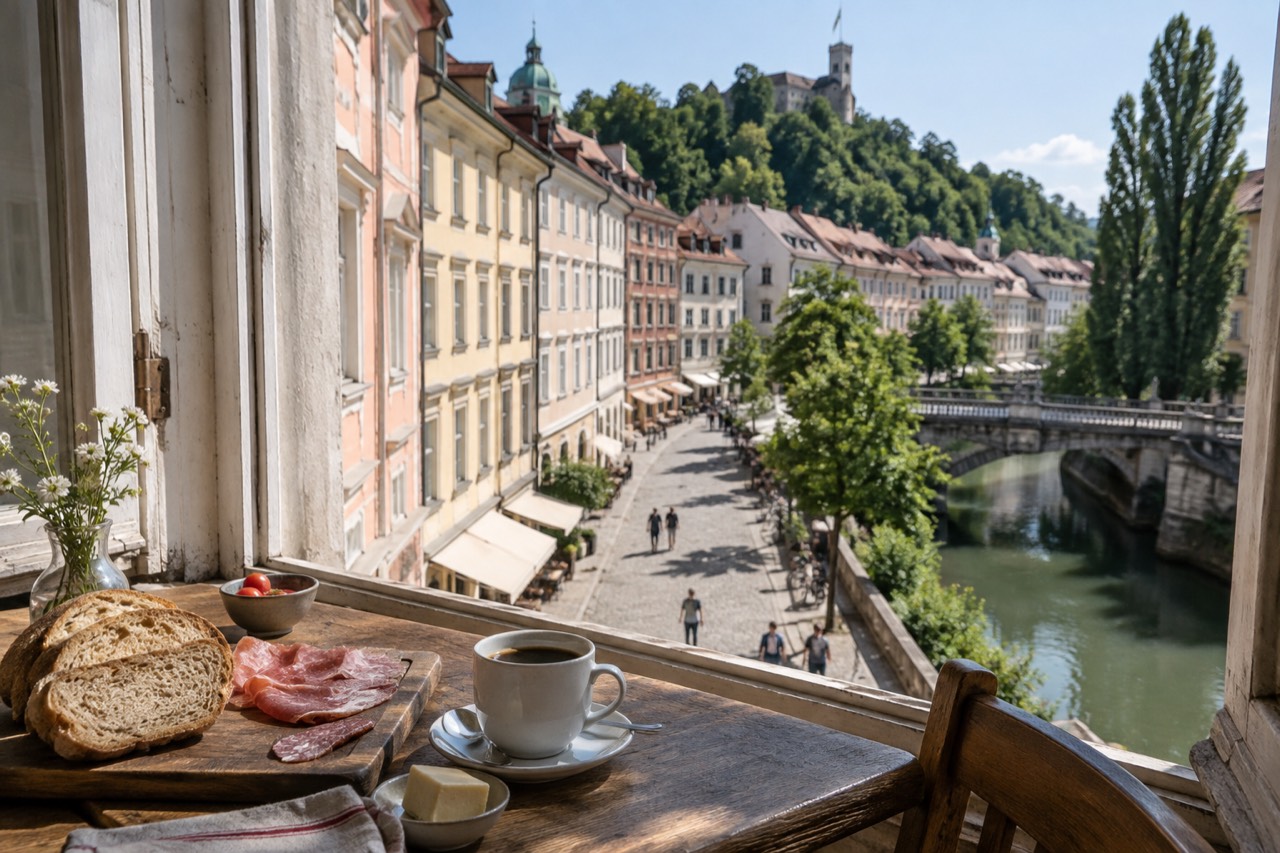
The short answer is bread with things on it. A typical Slovenian breakfast is sliced bread or fresh rolls with butter, honey, cheese and cured meats such as prosciutto, washed down with coffee, milk or tea. Sweet options include potica, a rolled walnut bread, and štrukelj, a rolled pastry that can be eaten at any hour of the day. It is a cold, assembled meal rather than a cooked one, closer to a generous continental breakfast than a fry-up.
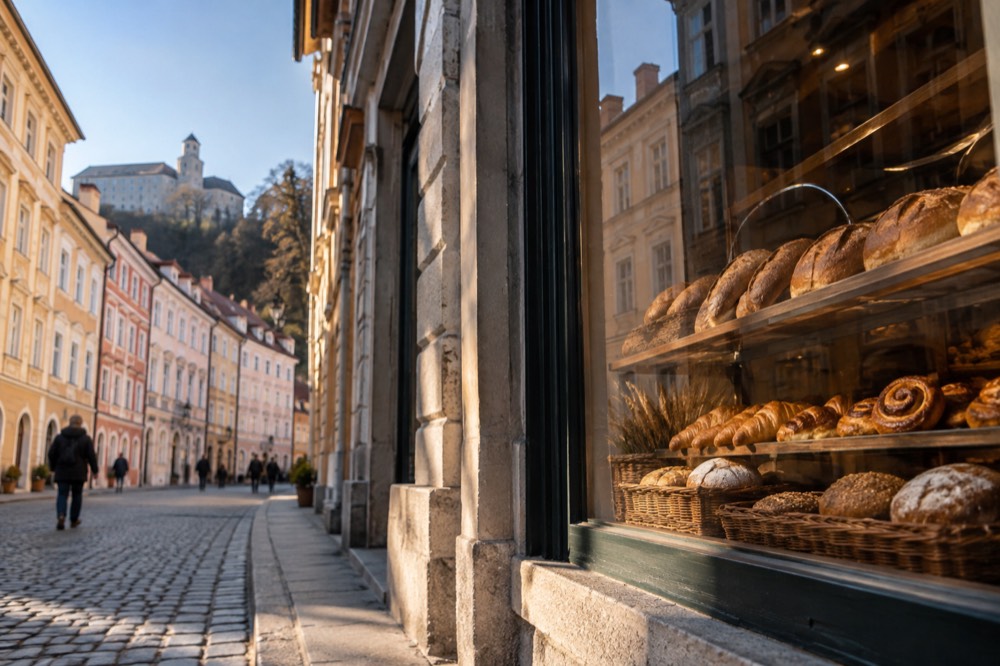
That description surprises visitors from Britain or the United States, who often arrive expecting eggs and bacon. The cooked English-style plate does exist in Ljubljana's hotel restaurants and in a handful of cafés aimed squarely at tourists, but it is not what the country eats at home. What locals reach for is good bread, and Slovenia takes its bread seriously: the morning bakery run is a genuine institution, and the queue at a neighbourhood pekarna before work is as reliable a sight as the morning fog rolling off the Ljubljanica.
The other thing to understand is that breakfast has historically been the smallest meal of the Slovenian day. The old rhythm was a light morning, the main cooked meal at midday, and a lighter supper in the evening. That pattern has loosened, especially among younger people in the capital, but it explains why the breakfast offering outside hotels can look modest. It is not neglect. It is a different set of priorities, with the best food energy saved for lunch.
What Does a Typical Slovenian Breakfast Look Like?
A typical Slovenian breakfast centres on bread and accompaniments: white or mixed-flour bread, butter, honey, soft and hard cheeses, salami, ham and prosciutto, with coffee or tea alongside. Sweet options are equally common, especially potica with walnut, hazelnut or poppy seed filling, and the rolled pastry štrukelj. Yogurt, muesli and fruit appear on weekday tables, while weekends bring more time and more courses.
The bread-and-spreads core is sometimes called a farmer's breakfast, and it reflects the country's rural history. Slovenia was a land of small farms until well into the twentieth century, and a morning meal that could be assembled from what the household had, bread, cured pork, cheese, honey and preserved fruit, made practical sense. Those items are still the backbone of what you will be offered.
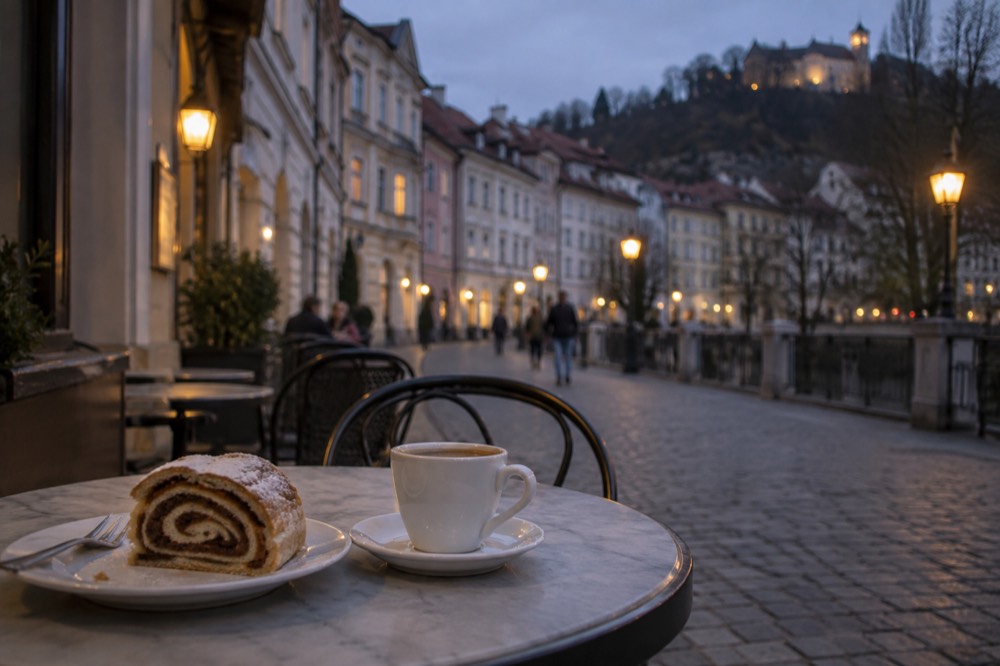
Potica deserves its own sentence. It is a yeast dough rolled around a filling, most traditionally ground walnuts, and it is the country's celebration cake, served at Easter and Christmas but also sliced at breakfast year round. Štrukelj is its cousin: a rolled pastry that can be savoury or sweet, and it is eaten as a dessert, a side dish or a morning slice with coffee. If you want to learn to make it by hand, there is even a hands-on štrukelj cooking class in Ljubljana, rated 4.9 from 90 reviews.
Here is how the common items stack up:
| Item | What it is | When it is eaten |
|---|---|---|
| Kruh (bread) | White or mixed-flour loaves and rolls, bought fresh daily | Every morning, the base of the meal |
| Potica | Yeast dough rolled around walnut, hazelnut, poppy seed or tarragon filling | Breakfast slice, holidays, with coffee |
| Štrukelj | Rolled pastry, sweet or savoury, often with cottage cheese or apple | Breakfast, dessert or side dish |
| Pršut | Air-dried prosciutto, thinly sliced | Weekend breakfasts, special occasions |
| Sir | Soft fresh cheese and aged cheeses | Daily, with bread |
| Med | Honey, Slovenia is proud of its beekeeping | Daily spread |
| Kava | Coffee, usually a strong espresso-style cup | Several times a day |
If you would rather taste your way through these traditions than read about them, two walking tours do exactly that, and both pair the food with the city.
The first of those three, the Slovenian Cuisine Walking Tour with Tastings, is the one most relevant to breakfast foods, because it introduces the breads, cured meats and dairy products in the list above in their proper setting, the places that sell them.
Where Do Locals Actually Eat Breakfast in Ljubljana?
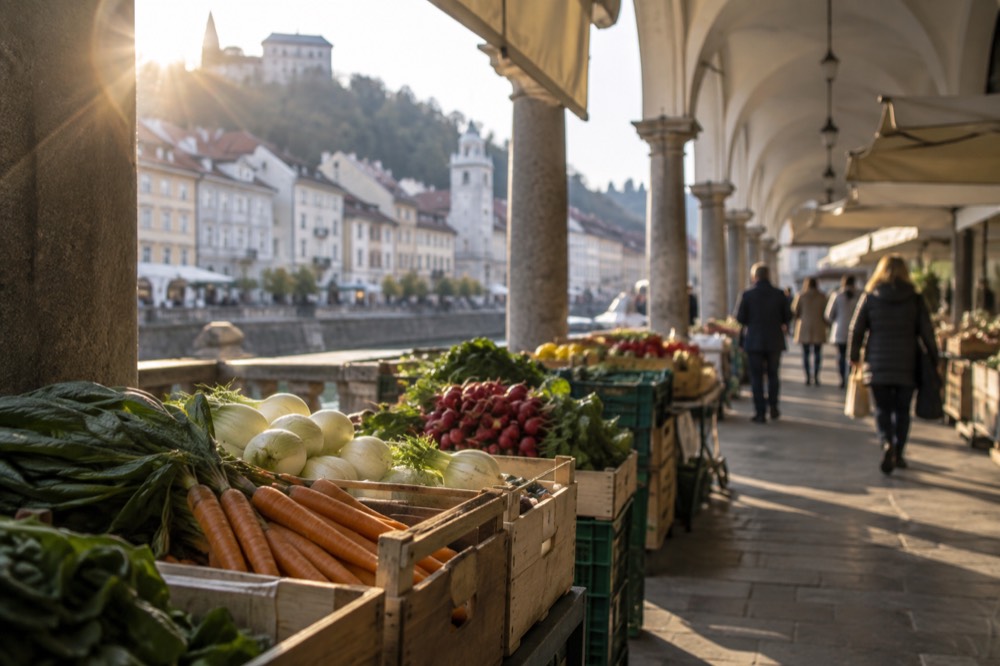
Most locals eat breakfast at home or standing at a bakery counter, not in cafés. The exceptions are weekend mornings, when the centre's café terraces fill up, and the Central Market on Vodnikov and Pogačarjev trg, where the covered halls open at 07:00 on weekdays and the outdoor stalls from about 06:00. For a visitor, the market and a traditional kavarna are the two best bets.
The Central Market is the honest answer for anyone wanting to eat like a local. The covered halls run Monday to Friday 07:00 to 16:00 and Saturday 07:00 to 14:00, while the outdoor stalls on Vodnikov and Pogačarjev trg run roughly 06:00 to 18:00 in summer and 06:00 to 16:00 in winter, with limited Sunday and holiday opening from April to November, according to the operator's published hours. You can buy bread, cheese, cured meat and honey from separate stalls and assemble the exact breakfast described above, then eat it by the Ljubljanica or on the steps near the Triple Bridge. The market's operator, JP LPT, publishes the full hours on its marketplace information page.
The café tradition matters too. Ljubljana's kavarne are old, wood-panelled rooms where coffee comes with a glass of water and nobody rushes you out. A coffee and a slice of potica in one of them is a completely legitimate Slovenian breakfast, and on a Friday from roughly March to November you can time it with Odprta Kuhna, the open-air food event on Pogačarjev trg. The tourist board's own wording is that it runs "every sunny Friday", which is literal: bad weather cancels it, so check before you plan a Friday around it on the official event page.
For choosing between the options:
| Place | Best for | Opening pattern |
|---|---|---|
| Central Market, covered halls | Bread, cheese, cured meats, honey | Mon-Fri 07:00-16:00, Sat 07:00-14:00 |
| Central Market, outdoor stalls | Produce, early start | Roughly 06:00, summer to 18:00, winter to 16:00 |
| Neighbourhood bakery | Fresh rolls and potica to take away | Early morning, busiest before work |
| Traditional kavarna | Coffee and a pastry, sitting down | Morning through afternoon |
| Hotel restaurant | Cooked and continental options | Fixed morning window |
Do Slovenian Hotels and Bakeries Serve Breakfast?
Yes, hotels in Ljubljana serve breakfast, and the better ones lean into the local version: a buffet of breads, cheeses, cured meats, honey, eggs and pastries rather than a cooked-to-order plate. Bakeries serve only take-away items, rolls, potica slices and štrukelj, and they are the cheapest and most local morning option. Neither is hard to find in the centre, which is compact and pedestrianised.
The hotel buffet is where most visitors first meet Slovenian breakfast, and it is a decent introduction because it lays out the whole repertoire at once. Look for the local items rather than the international ones: the honey, which in Slovenia is a point of national pride, the cured meats, and any potica on the pastry table. If your hotel serves a cooked plate as well, that is aimed at international guests rather than tradition. More of these guides are collected on Ljubljana Travel Guide.
Bakeries are the other half of the answer, and they are everywhere. The morning routine of buying a fresh roll or a filled burek, the flaky pastry that arrived with the Balkan culinary tradition and is eaten at any hour, is cheaper and faster than any café. One practical note for anyone staying outside the centre: the historic core is closed to general motor traffic, a pedestrian zone of roughly 20 hectares, so if you are driving to a bakery in the centre, park at the edge and walk in.
What About Coffee and the Café Culture?
Coffee is central to the Slovenian morning, drunk espresso-style and several times a day, and the café is where breakfast most often happens outside the home. A kava and a pastry at a standing counter is a complete breakfast by local standards. The café culture is Austrian and Italian in feel, a legacy of the country's position between the two.
Ordering is simple. A kava gets you an espresso-strength black coffee; a kava z mlekom is with milk. The macchiato-style short coffee is the default rather than the long filter cup, and filter coffee is the thing you have to ask for specially, not the other way round. Coffee with a glass of water, unhurried, at a table on a square, is the local way to start a slow morning, and Prešeren Square and the streets running off it are lined with exactly those tables.
The sweet side of the café counter is where you will meet the desserts that double as breakfast. Beyond potica and štrukelj there is the famous Bled cream cake, a vanilla-and-puff-pastry slice from Lake Bled that is eaten mid-morning or afternoon rather than at breakfast proper, but which belongs to the same family of coffee-accompanying sweets. If your trip includes Bled, the cake is worth the detour on its own; a day trip from Ljubljana is straightforward, and the Lake Bled day tour, rated 4.8 from 888 reviews, is one way to do it without a car.
Can You Try Slovenian Breakfast Foods on a Tour?
Yes, and it is a good idea, because the foods are easier to understand with context. The Slovenian Cuisine Walking Tour with Tastings runs four hours through Ljubljana, is rated 4.8 from 552 reviews and costs from $104, and it introduces the breads, cheeses, cured meats and sweets in their proper places. A free tips-based walk, the Snacking Love Walk on GuruWalk, pairs the sights with snack stops, though its tasting carries a fixed extra cost.
The guided option is the one this site points food visitors at most often, because four hours with a local guide answers questions a bakery counter cannot. You can Check availability on the operator's live listing, and the same tour appears in our fuller Ljubljana food tour guide.
The free option works differently. The Snacking Love Walk on GuruWalk is a small-group walk rated 4.93 from 1324 reviews, pay what you think it was worth, but be clear that the snack stops themselves carry a fixed tasting cost on top, so it is not a free meal. For an evening angle instead of a morning one, the Ljubljana craft beer scene tells the other half of the drinks story, and the traditional food journey walk, rated a perfect 5 from 54 reviews, covers the same ground at dinner time.
One last angle worth naming: the weather. Ljubljana sits in a basin, and ARSO's records show the city averages 56 hours of sunshine in the whole of December against 120 hours at Kredarica, up on Triglav at 2514 m, because winter inversions trap the city under fog while the hills above sit in sun. On a grey morning, a market-and-café breakfast indoors is the right plan; on a bright one, take the pastries to the river. A morning food walk, in other words, is the rare plan that works in both.
If you are still choosing, these are the three food and drink experiences that fit best around a Slovenian breakfast theme:
Common Questions About Breakfast in Slovenia
What Do They Eat For Breakfast In Slovenia?
Bread with butter, honey, cheese and cured meats, plus coffee. Sweet options include potica, a rolled walnut bread, and štrukelj. It is a cold, assembled meal rather than a cooked plate, with the main meal of the day traditionally eaten at midday.
Is breakfast a big deal in Slovenia?
Traditionally it is the lightest meal of the day. The old pattern was a small breakfast, a cooked lunch and a lighter supper, and although younger people in cities have loosened it, the breakfast offering outside hotels reflects those priorities.
What is potica?
Potica is a yeast dough rolled around a filling, most traditionally ground walnuts, though hazelnut, poppy seed and tarragon versions exist. It is Slovenia's celebration cake and is also sliced and eaten with coffee at breakfast.
Where can I eat a Slovenian breakfast in Ljubljana?
The Central Market is the most local option: buy bread, cheese, cured meat and honey from the stalls and eat by the river. A traditional kavarna with coffee and a slice of potica is the other classic choice, and bakeries are the cheapest take-away option.
Do cafés in Ljubljana serve breakfast?
Most serve coffee and pastries rather than full breakfasts. A kava and a pastry at a café counter is a complete breakfast by local standards. Hotel restaurants are the place to look for a cooked or buffet breakfast.
Can I try Slovenian breakfast foods on a guided tour?
Yes. The Slovenian Cuisine Walking Tour with Tastings runs four hours in Ljubljana, is rated 4.8 from 552 reviews and costs from $104. The Snacking Love Walk on GuruWalk is a free tips-based alternative, though its snack stops carry a fixed tasting cost.